How to Build a Digital Marketing Portfolio Without Client Experience
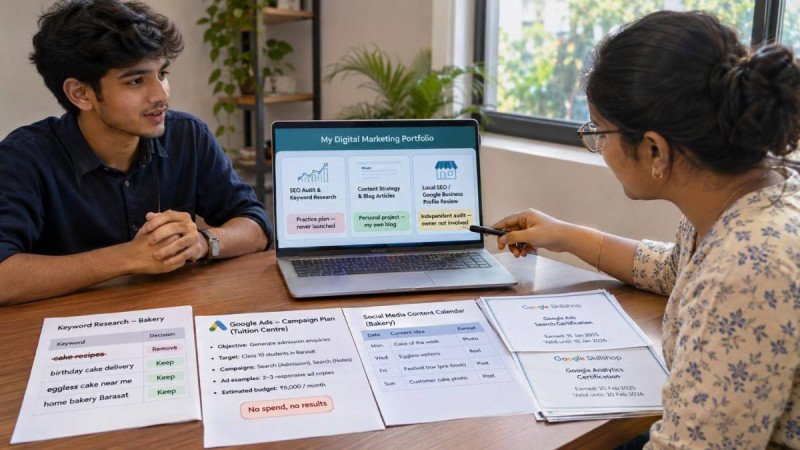
Many freshers reach their first interview with a folder like this: a keyword list from an assignment, screenshots from a Google Ads practice account, a social media calendar for a brand that does not exist, and a few certificates. All of it took effort. The trouble starts when the interviewer asks to see work you have done, and you are unsure what counts or how to describe it without making it sound like something it was not.
A digital marketing portfolio with no experience is possible. Practice work belongs in it if it is labelled accurately and explained properly, because a reviewer cannot tell from a screenshot what you did, what you assumed or what you were given. A portfolio will not guarantee a job, but it gives an interviewer something specific to ask about.
What counts as portfolio work, and how to label it
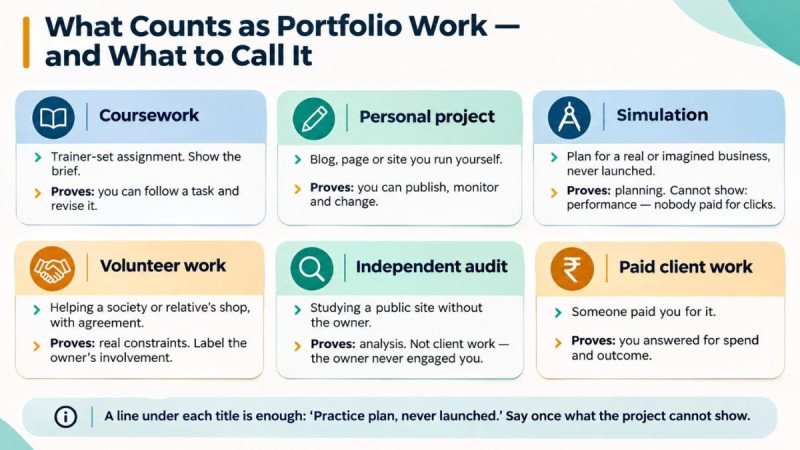
What you have depends partly on whether you learnt through a digital marketing course, internship or self-learning, but the labelling works the same way. Trainer-set assignments are coursework, shown with the brief stated. A blog, Instagram page or small website you run yourself is a personal project. It gives you the freedom to publish, monitor what happens and make changes without waiting for a client's approval. A campaign plan for a real or imaginary business that was never launched is a simulation. It shows planning, but nobody paid for clicks, so it says nothing about performance. Helping a college society or a relative’s shop, with their agreement, is volunteer work. Studying a public website without the owner’s involvement is an independent audit. It shows analysis, but the owner never engaged you, so it is not client work. Only work someone paid you for is paid client work.
A line under each title, such as “Practice plan, never launched”, is enough. Say once what the project cannot show, such as a live budget or a client changing the brief. Paid advertising is not needed for a beginner portfolio. A well-explained plan shows planning ability, though not results.
Turning an ordinary assignment into better work
Take a bakery keyword assignment. A beginner often chooses by search volume and ends up with “cake”, “birthday cake” and “cake recipes”. Recipe searches come from people baking at home, and “cake” alone is too broad for a bakery delivering within a few kilometres. A trainer asking who is searching, from where, and what they want next exposes this. The revised list might keep “eggless cake near me” and “birthday cake delivery”, drop the recipe terms, state the delivery area assumed and explain each decision. Showing both versions reveals more thinking than one flawless attempt.
Someone must read the first attempt critically. A trainer on a good digital marketing course can, and so can a senior or a working marketer. When comparing the best digital marketing courses in India, ask how much practical work is reviewed this way. Personal projects and audits have no brief, so you set the question and keep notes, which is much like handling a digital marketing project independently.
Digital marketing projects for beginners
SEO audit and keyword research
Choose a small site you have a legitimate reason to study: your own, or a clinic’s or shop’s with the owner’s agreement. Open the five or six pages meant to bring enquiries on a phone. Suppose a physiotherapy clinic’s home page is titled only “Home”, the phone number cannot be tapped, some images lack descriptions, and the knee-pain page seems absent from search. A manual search cannot establish that last point. The proper check is URL Inspection in Search Console, which needs the owner to give you access. Without it, record the page as unconfirmed. If Search Console confirms that the page is not indexed, check why and whether it should be indexed before deciding how urgently to address it. Record each finding with the URL, a dated screenshot, what you saw, why it matters and what you would change. For keywords, group them by what the searcher wants and give each group a page. Make no ranking claims unless you changed a site you control and tracked it.
Content strategy and sample content
For a Class 12 student in Barasat choosing between a BCA and a short computer course, real questions come from search suggestions, forum threads and a few conversations with students or parents. Keep what you found separate from what you assumed. A topic deserves priority when the question recurs, affects the decision and can be answered reliably. Fees and eligibility change, so a piece quoting them needs a dated official source. Show a short research note, the topic list with reasons, and two or three full articles published on your blog or LinkedIn with dates visible. A calendar of titles proves little, and none of this shows traffic.
Social media campaign and content calendar
A neighbourhood bakery mostly wants cake orders, so the calendar should help people order: finished cakes with a rough price, how far ahead to book, eggless options, and a festival box announced early. The plan matters more where messages are concerned. At nine in the evening, someone asks, “Do you have a 1 kg eggless chocolate cake for Saturday? Can you deliver to Barasat?” Saturday is full. The plan says who replies, how soon, and what is offered instead, such as Friday, a smaller cake or collection. Saved replies cover the price list and delivery charges. Call it a sample plan, and show insights only from pages you actually managed.
Google Ads campaign plan
Take an imaginary tuition centre. Someone searching “class 10 maths tuition admission fees” may be comparing centres, while “class 10 maths notes free pdf” wants material. One ad for both would spend money on people unlikely to enquire. So the plan gives them separate keyword groups, with “free” and “pdf” as negative keywords in the first. The ad text repeats what was searched, the landing page answers it with fees, timings and a way to enquire, and a conversion, such as a call or form submission, is defined along with how it would be tracked. To use Keyword Planner's basic keyword suggestion features, you need a Google Ads account with billing information and completed account setup. Its figures are estimates, not actual campaign results. A plan is not a campaign. State that there was no spend and no results.
GA4 or Search Console reporting
Google’s GA4 demo account contains data from the Google Merchandise Store and the Flood-It! app. Every user has the Viewer role. It is Google's demo data, not data from your own website or a client, so mention this clearly in the report. Start with one question, such as where shoppers leave the purchase journey, using a funnel exploration over a fixed date range. If fewer mobile users reach checkout than desktop users, that is an observation. Slow pages, delivery charges or casual browsing could each explain it, so note what you would check next, such as mobile speed or the checkout steps. Search Console needs a site you have verified. Average position is the topmost position your pages held, averaged across searches, so read it per query or page alongside clicks and impressions.
Local SEO or Google Business Profile review
Public information is enough for a local review. Compare the Maps listing with the business’s website: phone number, hours, category, photos, unanswered reviews. Record each inconsistency with a dated screenshot and write your recommendations as advice. Reviewing a profile does not give you permission to change it. The owner can add you through the profile’s access settings. Never ask for a password, claim a profile you do not represent, or write or buy reviews.
Presenting a project so an employer can assess it
Open each project with one sentence on its purpose and its label. Then say what you personally did, what information or tools you used, why you made particular decisions, what you produced and what evidence exists. End with what it cannot prove. These need not be identical headings in every project. A GA4 entry might read: “Practice exercise using Google’s GA4 demo property for the Google Merchandise Store. Not my website and not client data. Question: where do shoppers leave the purchase journey, and does it differ on mobile? Method: funnel exploration, one date range. Observation: [your own figures]. Limit: shows where people leave, not why.” If a project uses a real business’s information, get permission first, even by a saved WhatsApp message, and blur customer names, phone numbers and account details.
Choosing projects, format and number
Projects should follow the vacancy. For an SEO role, show the audit with its evidence, a published piece and a Search Console report. For a social media role, lead with the calendar and the enquiry-handling plan, and keep the audit short. Reading about what employers expect from freshers in a particular profile helps with the choice. There is no employer rule on numbers. Three to five projects is a reasonable start because it covers more than one skill without leaving you unable to explain any of them in detail.
A website, Notion page, PDF or shared folder all work. Presentation matters less than whether the reviewer can open it and follow it. Check it on a phone, open the link in a private window to confirm no login is needed, and click every link. Skillshop certifications are valid for one year from the date earned unless the certificate says otherwise, so show the date. If AI helped with research or drafts, using AI to complete a digital marketing project works only when you verify each fact and can explain every choice.
Explaining practice work in an interview
Describe practice work as practice. A fresher might say:
“This was a practice plan, so it never ran. I made it for an imaginary tuition centre in Barasat. I kept people searching for admission and fees separate from people searching for free notes, because I thought the second group wouldn’t enquire. I added ‘free’ and ‘pdf’ as negatives for the first group. I haven’t seen it with real money, so I can’t say it would work. What I learnt is that the ad and the landing page have to match the search. If it went live, I would check the search terms report after a week and see what was actually triggering the ads.”
If you are asked what you would do with a real budget, or how you would know enquiries came from the ads, say what you would check, and say plainly what you have not done.