How to Compare Digital Marketing Courses: Fees, Projects and Certificates
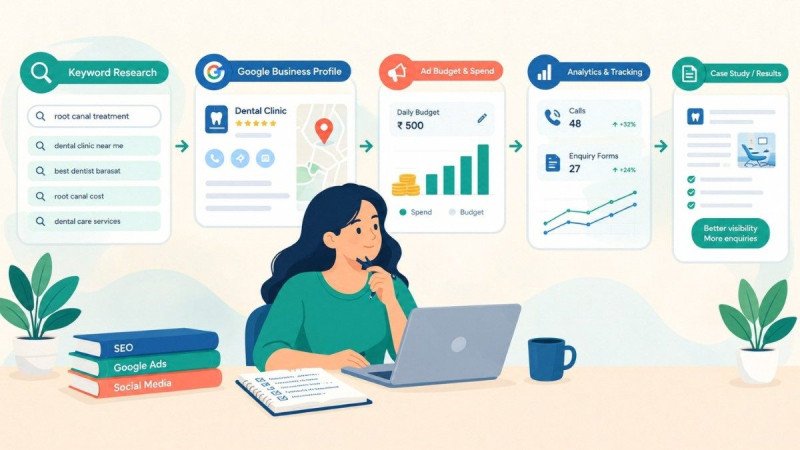
A syllabus can list keyword research, Google Ads and analytics and still miss the point. Imagine a dental clinic in Barasat that wants more enquiries for root canal treatment. Someone has to decide which search phrases deserve their own page, whether the Google Business Profile matches the website, how much to spend on ads, and how to tell afterwards whether anything improved. Plenty of courses teach these topics separately. The real test is whether learners get to apply them together and explain the decisions they make.
What to look for before comparing courses
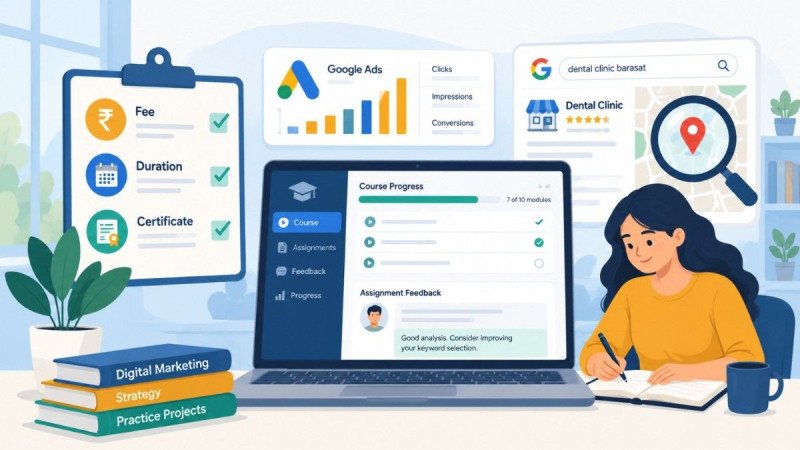
Look for a course where someone reads your assignments and tells you what to fix. If it ends in a multiple-choice test, it is checking what you remember rather than what you can do. That works for a first look at the subject, but less well if you hope to change careers.
Duration says little by itself. A three-hour certification and a six-month programme can both be worthwhile, but they do different jobs. Delivery, how often someone looks at your work, total cost and support after the course count for more.
Credentials are not interchangeable either. A completion certificate shows you finished a programme. A platform certification, such as Google’s, shows you passed that company’s assessment on its own tools. A degree is awarded by a recognised university, while other qualifications may be issued by awarding bodies, institutes or training providers. Their recognition and purpose depend on the qualification. None of them replaces work you can show.
Practical training varies too. Running a campaign with real money is different from working through a simulation, so find out which a course offers.
Your starting point matters as well. Someone considering a digital marketing course after Class 12 has no work context yet and needs structure and feedback. A working professional is limited by time and should look at the weekly commitment first.
Six learning routes compared
Most of these routes are online, so learners in Barasat and nearby areas can join whether or not the provider is local.
Mivja
Mivja runs a six-month digital marketing course in Barasat listed at ₹18,499. It covers SEO, Google Ads and PPC, social media marketing, content marketing with AI tools, and analytics and strategy, with flexible batch timings. The course page has the full syllabus.
The format is assignment-based: each module ends with an assignment so learners apply what they have covered before moving on. The course page also mentions live projects, but the Google Ads exercises use demo budgets and simulations rather than large live advertising campaigns.
As part of Local SEO, students learn how to set up and optimise Google Business Profiles. This includes completing business information, choosing relevant categories, adding services and photos, and reviewing how the profile appears in local search and on Maps. The aim is to understand the process. Ranking improvements depend on many factors and are not guaranteed.
Mivja prepares learners for Google’s free Ads certification through Skillshop. That certification is Google’s and is taken separately; Mivja’s own certificate only confirms completion of the course. Career guidance and placement assistance are offered as support, not as a job guarantee.
AIDM Academy
AIDM Academy teaches online and offers a 4.5-month advanced course followed by a two-month internship, giving an overall commitment of approximately 6.5 months. It also offers a three-month course with no internship and short tracks of 20 to 22 days in single skills such as Google Ads or WordPress. The advanced course covers SEO, Meta and Google Ads, WordPress and analytics, and AIDM issues its own certificate. Confirm the complete training and internship schedule with AIDM before enrolling.
The site advertises “100% placement support”, including mock interviews and resume help. That is its own description of the support offered, not a placement rate, and its homepage lists no placement figures or fees. Ask for both before enrolling.
Kraftshala
Kraftshala’s Marketing Launchpad is available in full-time and part-time formats. The full-time course is about 920 hours over six months, with classes from Monday to Saturday. The part-time version takes 11 months, with Sunday classes and additional weekday project sessions. It is open after Class 12, with no marketing experience needed. The fee is ₹1,64,000 plus 18% GST, or ₹1,93,520 in total.
The full-time curriculum includes SEO. The part-time programme excludes SEO to allow more revision time. Learners who need SEO training should compare the two curricula before enrolling. Both versions involve live Meta and Google Ads campaigns, and the credential is its own INDUSTRYCreds certification, not a degree.
Kraftshala reports a 94% placement rate over the last 14 months and more than 3,300 students placed since the programme began. These are provider-reported figures, so readers should consult its placement reports to see how they are calculated and what outcomes they cover. Completing the programme does not guarantee a job. Kraftshala refunds 60% of the fee if a learner has not secured a job paying at least ₹4.5 LPA within 15 months of finishing, under its terms. The refund does not apply to learners who join on a scholarship or leave the course midway, so read the current written terms before paying.
Internshala
Internshala sells two separate products. Digital Marketing with AI is an eight-week, self-paced online course for beginners, with recorded lessons, five assignments, a final project and preparation for Google’s Ads Search certification. It comes with certificates from Internshala and NSDC.
The placement-oriented option is a different product. Internshala currently offers a Digital Marketing Placement course with live sessions or weekly live classes, projects, resume tools and mock interviews. Some versions advertise a fee refund if the learner is not placed, subject to written conditions. Confirm the exact course name, duration, fee and refund terms on the current sales page before enrolling.
upGrad
upGrad offers the Advanced Certificate in AI-Powered Digital Marketing & Communication in collaboration with MICA. The core programme lasts four months at 8 to 10 hours a week, and each specialisation adds about six weeks, up to five, which is why durations run from 4 to 11.5 months. Fees start at ₹84,999 for the core programme and rise with each specialisation you add. The published eligibility criteria should be checked carefully before applying. upGrad specifies a bachelor’s degree from a recognised university, so this programme is not a direct route after Class 12. Applicants should confirm their eligibility with upGrad before enrolling.
Learners receive a certificate from MICA and upGrad, not a degree, along with one-to-one career coaching, and upGrad says there is no placement guarantee.
HubSpot
HubSpot Academy’s Digital Marketing Certification is free and self-paced: ten lessons, 30 videos and eight quizzes, covering digital marketing fundamentals, ethical strategy, content marketing and SEO, your website, email and the use of AI in digital marketing. The official estimated completion time is 3 hours 24 minutes. For someone still deciding whether the field suits them, or who only needs the vocabulary, it may be enough to start with. It is assessed by exam, not by trainer-reviewed projects, so it cannot give the same experience as supervised practice.
Matching a route to your situation
On a tight budget, a free certification is a low-risk first step. A working graduate may prefer upGrad’s specialisations to a general course. Kraftshala may suit learners who can commit substantial time to training and want a structured placement process. Check the part-time curriculum carefully if SEO is a priority, as that format excludes SEO. Mivja and AIDM suit learners who want structured assignments across the main channels at a moderate fee.
Showing practice work honestly
Employers and freelance clients need evidence of what you can do. When comparing options for SEO training in North 24 Parganas, ask what website problems learners will investigate and how their findings will be reviewed. A quiz can test your understanding of a canonical tag, but diagnosing why a service page is not appearing in search requires a different kind of work.
Take a coaching institute that gets few admission enquiries. A strong write-up states that problem, then what the audit found, perhaps that parents search for fees and batch timings and the site answers neither. It explains why those pages were fixed first, shows what was actually built or changed, and names the measures: calls and enquiry forms, and eventually admissions. A project on digital marketing for coaching institutes covers search, content and tracking in a single exercise. If the project was a simulation, label it clearly, describe the planned measures instead of results, and never present invented results or client work as genuine.
Freelancers and anyone aiming to join a digital marketing agency in Barasat are usually handed a business problem, not a tool to demonstrate. A project documented this way makes the step into a digital marketing career in Barasat, or into freelance work, easier to explain. It does not guarantee a job or a salary.
Questions beginners ask
Can I learn digital marketing without a technical background?
Yes, for most entry-level work. The tools are browser-based, such as analytics, ad platforms and WordPress, and a good course teaches them from scratch. You do not need to code, though technical SEO gets easier once you can read a page’s basic HTML.
Should I start with broad digital marketing or specialise in SEO?
Most beginners do better starting broad, because search, content, paid ads and analytics affect one another. Starting with SEO alone makes sense if a role already demands it or you work in content or web design.
Can a free certification complement a paid course?
Yes, if it covers different ground. Use it for vocabulary and fundamentals, but do not treat it as proof of skill. Put your paid-course time into assignments that leave you with finished work to show someone.
What to confirm before paying
Fees, formats and refund terms change, and several providers sell more than one version of a course. Before paying, confirm the exact course name, the total fee including tax, the weekly time required, what the certificate is and who issues it, and the full written conditions of any refund. Treat placement figures as the provider’s own claims unless an independent source supports them.