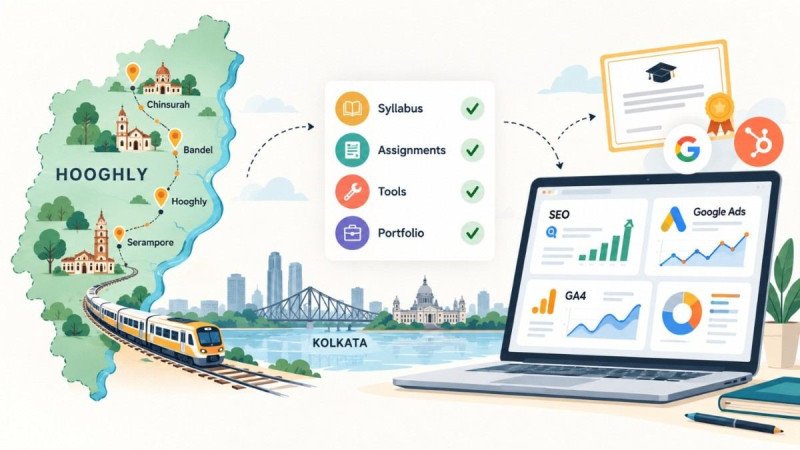

How to Start a Digital Marketing Career in Barasat
If you're in Barasat and considering digital marketing as a career, the practical questions come quickly: where can you work, what should you learn first, and do you need to commute to Kolkata? The harder question is which route fits where you're starting from: a local job, a Kolkata commute, remote employment, or freelancing.
The short answer is yes, you can start building a digital marketing career from Barasat without moving anywhere. For learners in Barasat and elsewhere in North 24 Parganas, the more useful question is what kind of career path makes sense after the initial learning stage. Structured learning and practice using local businesses as case studies are both entirely realistic from here. Freelancing is also geographically possible from Barasat, but it isn't automatic: getting paying clients depends on demonstrated ability and the ongoing work of finding those clients, not simply on where you live. What changes with location is the size of the opportunity. The local job market is more limited than the wider Kolkata market, and remote or freelance income takes real, demonstrable skill to unlock rather than location alone. The rest of this article works through what that actually looks like: what local employers are currently asking for, what to learn first, and how to build enough evidence of ability to move between local work, Kolkata, remote employment and freelancing as your skills develop.
Can You Start a Digital Marketing Career From Barasat?
A large share of digital marketing work is screen-based: writing content, running ad campaigns, checking analytics dashboards, managing social accounts. None of that strictly requires a fixed office in central Kolkata.
Local businesses give beginners something concrete to practise on. Coaching centres, clinics, salons, restaurants, property agents and small retail shops around Barasat can be studied through their public websites, Google Business Profiles and social accounts. Whatever state an individual business's online presence happens to be in, there's often a genuine gap you can learn from: an inappropriate Google Business Profile primary category, a slow-loading service page, or a WhatsApp enquiry number buried three clicks deep.
Competition still exists, and a certificate alone rarely gets anyone hired. What actually changes outcomes is being able to show, with evidence, that you can look at a real website or ad account and say something useful about it. A serious career in this field doesn't require living in central Kolkata from the outset, but it does require building that evidence deliberately rather than assuming a course completion certificate will do the job.
What Does the Digital Marketing Job Market Look Like Around Barasat?
Two current listings give a useful glimpse into the kinds of skills and working arrangements a beginner may encounter around Barasat.
An SEO Executive role at DS Creatives in Barasat is open to candidates with roughly six months to three years of experience, paying in the ₹10,000–15,000 a month range. It's an in-office role, not remote work, and it asks for keyword research and competitor analysis, on-page, off-page and technical SEO, familiarity with tools including Ahrefs, SEMrush, Moz and Screaming Frog, basic HTML and WordPress knowledge, and regular reporting through Google Analytics and Search Console. A title as simple as "SEO Executive" already assumes comfort with several adjacent tools and a habit of reporting results, not just the ability to research keywords in isolation.
The Orion Edutech Marketing Field Executive role in Barasat is explicitly office-based. One current listing for candidates with 0–3 years of experience shows in-hand pay of ₹12,000–15,000; a separate listing for candidates with 2–5 years of experience shows a higher range, roughly ₹17,500–20,000. These are two distinct postings, not a guaranteed progression from one figure to the other. The role combines online and offline promotion: managing social channels including Instagram, Facebook and YouTube, alongside customer engagement and branding activity, with basic familiarity with AI tools expected alongside standard marketing skills. Not every "marketing" role in Barasat is purely digital, and this one sits right at the boundary between fieldwork and online promotion.
These two listings aren't a statistical representation of the entire local job market, but they do support two practical conclusions. First, building breadth across two or three areas before specialising looks more useful early on than going deep on a single channel. Second, digital marketing work being deliverable online doesn't automatically mean local employers are offering to hire that way. The work itself can be location-flexible; the entry-level roles reviewed here are not.
Salary at this stage varies by employer, responsibilities and how much experience you're bringing in, so treat any single number above as an individual listing snapshot, not a fixed local average.
What Should You Learn First?
Understanding three or four areas properly, and being able to demonstrate that understanding, tends to make someone more employable than having skimmed ten without any real depth. A sensible order to build in:
- Marketing fundamentals. Who the audience is, what problem the business solves for them, and what action you actually want a visitor to take. Everything else sits on top of this.
- SEO and local SEO. Keyword research, search intent, and why a business shows up, or doesn't, when someone nearby searches for what it offers. For a closer look at the day-to-day work involved, see what an SEO professional actually does.
- Content and copywriting. Why a piece of content works for one audience and falls flat for another, what to post and when, and what a visitor needs to see before acting.
- Paid acquisition. Google Ads and Meta Ads at a beginner level: matching an ad to search intent, structuring a simple campaign, and reading whether it actually performed.
- Social media. Running accounts with a purpose beyond posting regularly, and understanding which platforms matter for which kind of local business.
- Analytics and measurement. Google Analytics and Search Console are the standard starting points. Pulling a report is straightforward. Working out whether a change in traffic reflects a genuine trend, a seasonal blip, or a technical problem takes longer to learn, and it's the skill that separates someone who reports numbers from someone who explains them.
- Websites and WordPress fundamentals. Understanding roughly how a WordPress site is structured, and what makes a page accessible to search engines, matters more than most beginners expect.
- AI-assisted workflows. AI can help with research, drafting, ideation and summarising data. It can't verify whether the output fits a specific business, catch a confidently stated factual error, or judge when a recommendation is wrong for the situation. The skill worth building is using AI while keeping full responsibility for the quality of the work yourself.
Nobody masters all eight at once, and no employer expects that from a beginner. Build a broad foundation across most of these first, then let real work, whether a job, a freelance project, or your own practice, tell you where to go deeper.
What Does Being Job-Ready Actually Mean?
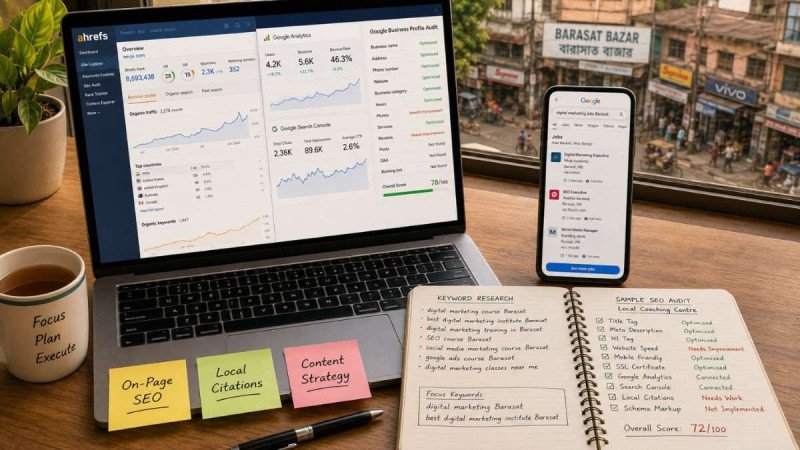
Being able to define a canonical tag, or explain what a Quality Score is, shows you've studied the material. Being job-ready sits at a different level entirely. Given an imperfect marketing problem, can you work out the actual objective, identify what information you need, investigate, form a reasonable recommendation, explain your reasoning, use the relevant tools, and check what happened after acting on it?
That sequence shows up in specific situations, not abstract ones. Noticing that a local business's Google Business Profile has an inappropriate primary category, and explaining why that may affect its relevance for local searches. Noticing that an ad campaign's keywords don't match what the ad copy promises, so clicks arrive but don't convert. Spotting that a traffic dip coincides with a site migration rather than a genuine drop in interest, and checking that before reporting it as bad news.
Knowing the vocabulary isn't the same as being able to make a decision on a real website under real constraints. That practical ability is what gives an employer something concrete to assess in an interview or a work sample, and it's also what a paying freelance client is actually judging, whether they use these words for it or not. A related piece on knowing whether you actually understand SEO works through this idea further, using examples from North 24 Parganas.
Do You Need to Move to Kolkata?
Four broad routes are open, and you're not expected to pick one permanently. Many people start with one or two of these and add the others later as their skills and circumstances change.
Local employment. Current listings include digital marketing and related marketing roles in Barasat and nearby areas, mainly with local businesses, smaller agencies and education-related companies. A shorter commute and early experience without relocating are the advantages. The local pool is more limited than the wider Kolkata market, and roles tend to have less room for early specialisation.
Kolkata employment. Kolkata offers a wider range of agency and in-house opportunities than Barasat, along with roles that can allow greater specialisation as experience develops. The trade-off is a daily commute and, for many roles, regular office attendance.
Remote employment. Digital marketing tasks can often be delivered without being physically present, so location matters less to the work itself. Genuine entry-level remote roles are less common than that fact might suggest, and the competition for them tends to be national rather than local.
Freelancing. Working independently removes the geographical constraint almost entirely, since a freelancer based in Barasat, or elsewhere in North 24 Parganas, can serve clients anywhere. It adds the ongoing work of finding clients in its place, and early income is typically inconsistent while that client base is being built.
Skill and track record tend to matter more than location once you have a year or two of work behind you. Someone who has shown reliable delivery without close oversight has a reasonable case for negotiating remote or hybrid arrangements later, even if their first role required office attendance.
Which Career Route Fits Your Starting Point?
No practical experience yet. Focus on learning, building sample projects, and getting feedback before applying widely. A local role, even a generalist one, can provide structure while a portfolio takes shape.
Some practical work already done. Apply more broadly, including Kolkata-based and remote roles, since a portfolio and a few completed projects carry more weight in wider applications than a certificate alone.
A demonstrable specialist skill. Freelancing becomes more realistic once there's enough evidence of ability that a prospective client can judge it without meeting you first.
Comfortable with a daily commute. Kolkata's wider employer pool becomes worth the trade-off, particularly for roles offering more specialisation than local generalist positions typically do.
These aren't fixed categories. Your route can change as your skills and experience develop.
How Can You Build a Portfolio Without Clients?
A portfolio should show how you think, not just what you produced. For every sample project, you should be able to explain what the problem was, what you observed, what you recommended, why, and how you'd measure the result. That's closer to what an employer or client can actually evaluate than a polished deliverable with no reasoning behind it.
Label all sample work clearly as practice, and never invent results: no fabricated rankings, leads, traffic increases or testimonials. A sceptical reader, or a sceptical hiring manager, can usually tell the difference between honest practice work and a dressed-up claim, and the honesty itself is part of what makes the work credible.
A practical Barasat portfolio exercise
Here's one way this actually plays out. Say you pick a hypothetical coaching centre in Barasat as your practice subject, one you're not working for and have no relationship with, purely to study.
You'd look at its website structure and loading speed, its service pages and whether they match what a parent searching "spoken English classes near Barasat" or "class 10 tuition Barasat" is actually looking for. You'd check its Google Business Profile: is the category right, are the hours current, are there recent reviews and photos. You'd glance at two or three competitors doing something similar nearby, and read through whatever reviews exist for tone and recurring complaints or praise.
From that, you could put together a small set of deliverables: a keyword map showing what people in the area are actually searching for around that subject, a short SEO audit listing three or four specific, evidence-backed issues, a sample rewritten service page, a simple local SEO improvement plan (profile fixes, review requests, a local landing page idea), and a short note on how you'd measure whether any of it worked, rankings, profile views, enquiry calls.
This is practice work, not client work, and it should say so clearly wherever you show it. But done properly, one exercise like this demonstrates far more than a general claim to have "learned SEO." It shows you can look at a real, messy local business and produce something specific and reasoned.
The same approach works for a content calendar, a keyword research exercise for a different business category, or a short analytics report explaining what a set of numbers shows.
Can You Freelance From Barasat?
Yes, though it helps to be precise about what that actually involves. Working from home is a location arrangement. Freelancing is a business model, and the two aren't the same thing. A freelancer based in Barasat still needs to choose a service, understand a client's objective, build a portfolio, find prospects, pitch, scope work, agree deadlines, deliver, report, handle revisions, invoice and maintain the relationship afterwards.
A remote client is assessing much the same things a local one would: whether you can do the work, communicate clearly and deliver reliably. Many beginners still find it easier to build that trust with local clients they can meet in person, before taking on remote clients they've never met.
A practical way to start looks something like this:
- Choose one service you understand well rather than offering everything.
- Build two or three sample projects, honestly labelled as practice work.
- Pick a local business category you understand, such as coaching centres, clinics, salons.
- Study a few examples' public information and identify a specific problem you can demonstrate with evidence.
- Prepare a short audit or recommendation based on that evidence.
- Approach the business with something specific. "I can audit your Google Business Profile and give you three concrete improvements" works better than "I can do your digital marketing."
- Start with a small, manageable project, a one-off audit or a two-week content plan, rather than asking for a long retainer straight away.
These steps don't guarantee clients, and income in the early months is genuinely unpredictable while a client base is being built. Freelancing doesn't remove the employability question either. Work that isn't good enough to convince an employer to hire you is unlikely to convince a client to pay for it.
Do You Need a Digital Marketing Course?
Structured training isn't mandatory, though it can help if chosen carefully.
When structured training tends to help: you need a learning sequence rather than a scattered list of topics, you benefit from deadlines to actually finish things, you want feedback on real work rather than guessing whether it's good, you're not sure which tools are worth learning first, or you want some access to people already doing the work.
When self-study can work just as well: you're disciplined enough to practise consistently rather than only consuming lessons, you can structure your own curriculum from reliable sources, and you can find or create opportunities for honest feedback on what you produce.
A certificate on its own shows you completed training; it can't demonstrate that you can analyse a problem, execute work or interpret results. What an employer or client can actually assess is a portfolio, practical work, your reasoning, your ability to use the relevant tools, and how clearly you communicate. Neither path guarantees employment on its own. The real question, whichever route you take, is whether you come out able to do the work and show it.
If you do look at a course, be cautious of "guaranteed placement" claims, and ask exactly what that support means in practice before enrolling anywhere. A comparison of digital marketing courses in and around Barasat covers how the local options differ, if that's the stage you're at. If you decide that structured training makes more sense for you, you can explore digital marketing courses in Barasat and compare the learning options before choosing a path.
A Practical First Month
Week 1. Choose one skill area, local SEO, content, or social media, and learn the fundamentals rather than skimming several topics at once.
Week 2. Pick two or three real local businesses and study their website, Google Business Profile, social accounts and reviews. Write down what they seem to be trying to achieve and where it clearly isn't working.
Week 3. Turn one of those observations into a sample project, an audit, a keyword list, a content plan, complete with your reasoning for each recommendation.
Week 4. Show that project to someone who actually works in the field and ask for direct feedback. Use what you learn to refine it, then either apply to suitable roles or approach a local business with a specific offer.
This is a starting structure, not a guarantee of readiness in four weeks. Repeat it with new projects as your understanding improves, and expect the second and third cycles to move noticeably faster than the first.
Frequently Asked Questions
Do I need a marketing degree to start?
No. Many entry-level roles place more emphasis on whether you can demonstrate the relevant skills than on having a specific academic background.
Can digital marketing realistically be learned from home in Barasat?
Yes. Structured online training is available locally, and self-study works too, provided you practise consistently and get feedback rather than only consuming lessons.
Does building a career here mean eventually moving to Kolkata?
Not necessarily. Barasat has some local roles, and freelancing or remote work can extend your reach without relocation, but Kolkata does offer a wider range of formal agency and in-house positions for those willing to commute.
Is freelancing from Barasat actually viable?
Yes, but it requires real skills, a portfolio, ongoing effort to find clients and the discipline to run a small business. Early income is typically inconsistent while that client base is being built.
How do I show ability if I've never had a paying client?
Through honestly labelled sample projects, a website audit, keyword research for a defined business category, or an analytics report, where you can explain the reasoning behind each recommendation.
Can I work with clients outside Barasat and West Bengal?
Yes. A remote client is assessing the same things a local one would: whether you can show past work and explain your thinking clearly.
Should I take a course, or can I self-teach?
Neither path guarantees employability on its own. A course offers structure and feedback that are harder to build alone; self-study works if you're disciplined about practice and seeking feedback.
What entry-level job titles should I look for?
Digital Marketing Executive, SEO Executive, Social Media Executive, Content Executive and Marketing Field Executive are among the job titles you may encounter in current listings. Several combine multiple channels rather than one narrow specialism.
How long does it usually take to become job-ready?
There's no fixed timeline. The sequence matters more than speed: learn the fundamentals, practise on real or realistic projects, build evidence of your work, then specialise once you have genuine experience behind you.
Job-market examples in this article were checked directly against publicly listed job postings for DS Creatives and Orion Edutech in Barasat. They're presented as individual snapshots of what specific employers were asking for at the time of checking, not as a complete survey of the local job market, and figures like salary should be read with that in mind.