

When Do You Actually Know SEO? A North 24 Parganas Perspective
Someone finishes an SEO course. They can define crawl budget, explain canonical tags, and walk you through the difference between relevance, distance and prominence in local search. Ask them a genuine question, though: say a client's most important service page gets almost no search visibility, what do you check first, and the confidence sometimes disappears. Not because they didn't learn anything. Because learning and doing turn out to be two different skills, and most training measures only the first one.
This gap isn't unique to SEO. But it's unusually easy to miss in SEO specifically, because the subject has so much vocabulary that fluency in the words can pass, for a while, as fluency in the work. Someone can talk convincingly about backlinks, technical audits and Search Console without ever having sat with an actual website and decided, under real constraints, what to fix first and why. The question worth asking isn't whether someone has learned SEO. It's whether they can make an SEO decision, and North 24 Parganas, a district whose own administration describes it as spanning genuinely different geographic and economic conditions within one boundary, is a useful place to watch that distinction show up.
Can Someone Know SEO Without Being Able to Diagnose a Website?
Take a scenario that can arise in practice, rather than as a hypothetical exercise. A local business hands over a website built up over a year or two, a few dozen pages in total. Some of it gets organic traffic. A handful of blog posts pull in a steady trickle of visitors every month. But the page that actually matters commercially, the main service page the business exists to sell, barely shows up in search results at all.
Someone who has only learned SEO in the abstract tends to reach for the nearest tactic on sight. Write more content. Build a few backlinks. Add the missing keyword to the heading. Someone who can actually do the work resists that pull and asks a narrower question first: what evidence would actually tell me what's wrong here, before anything gets touched.
The first thing worth checking isn't the page itself, it's what the page is currently being found for. Pulling the queries it already ranks for might show it's technically visible, just not for anything a buyer would type, showing up for a broad informational phrase instead of the commercial one the business actually needs. That's a mismatch between what the page targets and what the searcher wants, and no amount of new content fixes it if the underlying target is wrong to begin with.
Assuming the targeting looks reasonable, the next question is whether anything on the site actually points toward this page at all. It isn't unusual to find that every internal link from the blog content, the part of the site that is getting traffic, leads back to the homepage or to other blog posts, and never once to the page that needs the help. Internal linking can also help search engines understand the importance and relationship of pages. If the rest of the site rarely points to a page, that is worth investigating rather than assuming the page is well supported.
Then there's a possibility that looks, at first glance, like it has nothing to do with either of those checks: a second page on the same site, published months earlier by someone else on the team, describing a near-identical service under a slightly different title. Two pages competing for the same query on the same domain don't usually help each other. More often they split whatever relevance the site has between them, and a search engine ends up unsure which one to trust. That duplicate page could turn out to be the real explanation, or it could turn out to be a minor detail next to the missing internal links. The only way to know is to check whether it's actually ranking for anything, or just sitting there unindexed and irrelevant.
This is where prioritising matters as much as investigating. Fixing all three things at once means losing the ability to tell which one actually mattered. A practitioner might decide to leave the possible duplicate page alone for now, note it for later, and start with the internal links instead, precisely because that's the cheapest change to make and the easiest one to measure cleanly. Everything else waits, not because it's unimportant, but because testing one thing at a time is the only way the next round of decisions gets any smarter.
None of this is exotic. It's the ordinary discipline, observe what's actually happening, question the obvious assumption, investigate before recommending, decide what to test first, then measure honestly, that separates a diagnosis from a guess. What makes it hard to teach through lectures alone is that the right sequence depends entirely on what the specific website is actually doing, which is exactly the part a course syllabus can't hand someone in advance.
And the diagnosis doesn't end once a fix ships. Say the internal-linking gap gets addressed and the service page starts climbing for its intended query a few weeks later. That's encouraging, but it isn't proof of anything on its own. Did rankings move because of the linking change, or because a competitor's page dropped out for unrelated reasons in the same window, or because the query itself became slightly less competitive that month? Someone who's only learned the tactic stops at "it worked." Someone who can actually do the work keeps watching long enough to be reasonably confident about why it worked, because that reasoning is what gets reused on the next website. The specific fix rarely transfers, but the diagnostic habit does. That investigative habit is part of what SEO professionals actually spend their time on, far more than any single tactic.
How Can North 24 Parganas Reveal the Difference Between Knowing SEO and Applying It?
This is where geography earns its place in the argument, not as a set of location keywords but as evidence. North 24 Parganas is one district, but its business environment is far from uniform. The district administration's own description divides the territory into three broad geographic zones: an industrial and urbanised belt around Bidhannagar and Barrackpore, a largely cultivable plain covering Bangaon and the adjoining parts of Barrackpore and Barasat, and a riverine belt in the southern part of Basirhat subdivision that borders the Sundarbans and remains exposed to seasonal flooding and cyclones. Those aren't cosmetic differences. An urbanised industrial corridor, an agricultural plain and a flood-prone riverine belt can involve very different businesses, customers and commercial objectives.
That range matters for SEO judgement more than it matters for keyword targeting, because it forces a practitioner to actually ask what a business is trying to accomplish before touching anything on its website. A practitioner working on SEO for a coaching institute near Barasat may be dealing with a parent's decision that unfolds over weeks, involving comparison, trust-building and perhaps a demo class before anyone actually enquires. The same practitioner moving to a dental clinic somewhere in the district's urbanised belt is looking at something far more immediate, a searcher who wants to know who's open, how far away the clinic is, and whether the reviews look trustworthy, often within minutes of a toothache starting. An industrial supplier operating in the Barrackpore belt is chasing a different kind of searcher again: a procurement contact typing a precise product specification, who wants a spec sheet and a phone number, not a blog post. And the district's own registered artisan clusters make the same point from a different angle. The Ministry of MSME's industrial profile identifies bamboo craft, gauge and bandage, mat and bori among the major clusters in North 24 Parganas, while Basirhat is specifically associated with bamboo craft and gauge-and-bandage activity. These businesses involve different supply chains, different buyers and different commercial objectives, and almost nothing in common with a coaching institute's marketing problem or a dental clinic's.
None of these needs the same website structure, the same content plan, or the same definition of success. A practitioner who has only memorised "local SEO involves your Google Business Profile, reviews and citations" has a fact. A practitioner who understands why a bandage manufacturer's buyer journey has nothing in common with a coaching institute's has a working model of how business, customer, market and search intent connect, and that model is what actually gets applied to a website, not the fact on its own. The relationship runs in one direction: business shapes customer, customer shapes market behaviour, market behaviour shapes what gets searched, and only at that point does SEO technique become relevant at all. Skip the first three steps and the technique gets applied to the wrong problem.
It's worth being precise about what this argument is and isn't claiming. It isn't a case for building a separate website, or even a separate page, for every neighbourhood inside the district, that's the keyword-stuffing instinct the coaching, dental and industrial examples above are meant to guard against, and it produces thin pages that satisfy neither a searcher nor a search engine. The claim is narrower: a practitioner who has genuinely internalised how differently these business types operate will ask different diagnostic questions of each one before touching anything, rather than running through the same generic checklist because the district name happens to be the same. Two businesses sharing a postal address can need entirely different SEO strategies. Two businesses in different parts of the district can sometimes need nearly identical ones, if their customer and market situation genuinely lines up. The geography is a prompt to ask the right questions, not an answer in itself.
Why Isn't Knowing Individual SEO Techniques Enough?
SEO gets taught, understandably, as a list: keyword research, on-page optimisation, technical SEO, internal linking, backlinks, measurement. Learning the list is necessary. Mistaking the list for the skill is the trap.
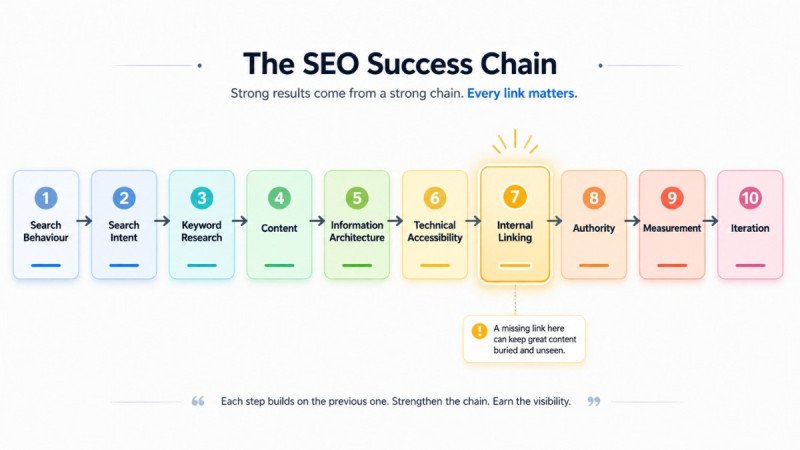
In practice, these pieces aren't separate boxes, they're a chain, and a weak link anywhere breaks the whole thing regardless of how strong the other links are. Search behaviour shapes search intent. Intent should shape which keywords a page is even trying to satisfy. Keyword decisions shape what the content needs to say. Content needs shape how pages should be organised against each other, which is information architecture. Architecture only works if the site is technically accessible enough for it to be crawled and understood. Internal linking is what actually connects that architecture together for both visitors and search engines. All of it, over time, builds toward authority on a topic. And none of it means anything without measurement feeding back into the next round of decisions.
A single example makes the chain concrete. A business publishes a genuinely well-written, well-optimised page targeting a high-value query. Nothing happens. The temptation is to blame the content. But if that page sits three clicks deep with no internal links pointing to it from anywhere else on the site, the content was never really the bottleneck, the architecture was. Someone who's only learned "content optimisation" as a standalone module will keep rewriting a page that was already fine. Someone who understands the chain checks the links first.
How Can You Tell Whether an SEO Learner Can Actually Solve a Problem?
This is really a set of questions a practitioner has to keep asking, not a skill that gets certified once. What should get investigated first, given limited time? What counts as enough evidence to act on, versus a hunch dressed up as a finding? Which of several plausible problems is actually the one worth fixing this month? Just as importantly, what shouldn't be touched, because it's already working and the real gap sits elsewhere?
Two habits tend to separate people who can genuinely do this from people who are still pattern-matching to what a course covered. The first is treating traffic as a proxy, not a goal. A page can gain traffic while losing relevance, which is a worse outcome than modest traffic aimed at the right searcher. A page that starts ranking for a broader, less specific version of its topic often looks like a win in a traffic report and is actually a warning sign that the page has drifted away from the exact audience it was built for. The second is distinguishing correlation from causation before declaring victory: rankings improved the same month three other things changed on the site, and it takes real discipline to admit that the specific cause isn't actually known yet, rather than attaching it to whichever change is most flattering to report.
There's a third habit worth naming, because it's the one most often missing from a beginner's instincts: knowing when not to act. A page that's ranking on the second page of results for a genuinely important query isn't automatically broken. Sometimes the most useful recommendation is patience, because the page is new, or the domain hasn't yet earned enough trust for that specific topic, and a premature rewrite would erase signals that were still accumulating. Restraint doesn't photograph well in a report the way a list of changes does, which is exactly why it's a harder skill to develop than the impulse to keep changing things.
What Becomes More Valuable When AI Can Handle More of the Routine Work?
Keyword lists, first-draft content, basic technical audits: a meaningful share of this is now genuinely faster to produce with AI assistance than it was even two years ago. That doesn't shrink the importance of SEO judgement. It concentrates it. When the mechanical part of the work gets cheaper to produce, the scarce skill shifts toward deciding what's actually worth producing, verifying that an AI-generated recommendation is even correct for this specific website, and knowing when to override a plausible-sounding suggestion that doesn't fit the business.
That shift shows up clearly in how differently AI-mediated search systems behave from each other and from traditional search. Research on why AI search engines disagree with each other found that Google Search, AI Overviews and Gemini pulled from substantially different sources for the same queries, which means there's no longer one stable "correct answer" a practitioner can memorise and reuse. Verification, interpretation and the judgement to say "this doesn't apply to my client's actual searcher" become the parts of the job that hold their value. A learner who can only follow an AI tool's suggestion is developing a skill that is increasingly easy to automate. A learner who can evaluate whether that suggestion is right is developing the part of the job that still needs a person.
What Should Someone Be Able to Show Before Calling Themselves Job-Ready?
A certificate can show that someone completed a course. It cannot, by itself, demonstrate that they can diagnose an unfamiliar website and produce a defensible next step. What does is closer to evidence than a credential: a real audit of a real page, with reasoning for why each recommendation was prioritised over the others that were considered and set aside. A keyword-to-content mapping exercise where the choices can actually be justified out loud. A before-and-after comparison on something genuinely changed, with an honest account of what moved and what the practitioner still isn't sure caused it.
This is a meaningfully lower bar than "prove professional mastery," and it should stay that way. A portfolio built from a handful of real exercises doesn't make someone a senior practitioner. It does something narrower and more useful: it shows whether the reasoning is there at all, which a certificate alone can't demonstrate.
What Should You Look for in SEO Training if Competence Is the Goal?
Given everything above, the honest question to ask about any SEO programme isn't which tools it covers or how many modules it includes. It's whether it puts a learner in front of a real, imperfect website and asks them to make a judgement call.
Terminology can be learned from documentation and video tutorials, largely for free, by anyone disciplined enough to work through it alone. What's much harder to build without structure is the habit of investigating before recommending, prioritising under real constraints, and being able to explain why one fix mattered more than the other five on the list. That's part of what Mivja's SEO course is built around: a full audit of a live website and portfolio-building projects rather than terminology alone. Self-directed learning works well for people who are comfortable testing ideas without guidance and correcting their own blind spots. Structured training tends to help more when someone specifically wants that practical grounding before they're the one making the call for a paying client.
What Is the Real Test of Knowing SEO?
A learner can know exactly what a canonical tag does and still not know whether this website needs one changed right now. A certificate can show a course was completed. Neither one tells you what happens when someone is handed a website with incomplete information, a stakeholder who's already convinced of the wrong cause, and more possible fixes than time to test them.
That's the actual test, and it doesn't look like a quiz. It looks like a coaching institute near Barasat, an industrial supplier in the Barrackpore belt, and an artisan cluster in Basirhat all needing visibility for reasons that have almost nothing in common, and someone being able to tell, for each one, what to investigate, what to leave alone, and how they'll know afterwards whether the decision actually worked. Everything else is preparation for that moment. The moment itself is where the knowing actually happens.
Sources
- North 24 Parganas District Administration, "DM Desk" (geographic division of the district into three zones, and the district's five subdivisions), https://north24parganas.gov.in/dmdesk/
- Ministry of MSME, Government of India, "Brief Industrial Profile of North 24-Parganas District, West Bengal" (major identified clusters including bamboo craft and gauge-and-bandage activity in Basirhat), https://dcmsme.gov.in/old/dips/NORTH%2024-PARGANAS.pdf
- Grossman, R., Liu, S., Chen, M. K., Smith, M., Borcea, C. and Chen, Y., "How Generative AI Disrupts Search: An Empirical Study of Google Search, Gemini, and AI Overviews," accepted to ACM SIGIR 2026, https://arxiv.org/abs/2604.27790