Digital Marketing for Coaching and Training Institutes: A Student-Acquisition Guide
A coaching institute in Kolkata teaching CBSE Class 10 mathematics is not competing for the same attention, the same keywords, or the same parent as a NEET coaching chain in Kota, or a digital marketing training institute trying to reach a working professional in their late twenties. Yet most advice on "digital marketing for coaching institutes" treats all three the same way — run some ads, post on Instagram, do local SEO, repeat.
That approach doesn't fail because the tactics are wrong. It fails because it skips the actual decision a family or a student is making and jumps straight to channels. Before anyone opens Google Ads or Instagram, it helps to understand what a parent researching "CBSE class 10 maths tuition near me" is actually trying to resolve, versus a 23-year-old searching "best digital marketing course with placement." Those are different problems, at different stages of trust, decided by different people.
The Indian coaching sector is large enough that getting this wrong is expensive. IMARC Group, a market-research firm, estimates the Indian coaching institutes market — spanning school-level tutoring, board-exam preparation, entrance-exam coaching, and professional skill development — at roughly USD 7.2 billion in 2025, with a projected compound annual growth rate of just over 10% through 2034. That's an IMARC market-research estimate rather than a government statistic, and different research firms scope "coaching" differently — some fold in private one-to-one tutoring, some don't — so it's worth treating as an industry-scale indicator rather than a precise figure. Whatever the exact number, the direction is consistent: demand is growing, competition for that demand is growing at least as fast, and institutes that convert digital attention into admissions systematically will keep pulling ahead of ones that treat marketing as an occasional campaign.
This guide works backwards from the decision itself. It builds a practical model of how students and parents move from not knowing an institute exists to sitting in its classroom, and shows where digital marketing genuinely changes that movement — and where it doesn't. The underlying decision looks much the same for institutes across India, whether they're based in Kolkata, Kota, or a smaller town, even though the specific channels and competition shift from place to place.
How Do Students and Parents Actually Choose an Institute?
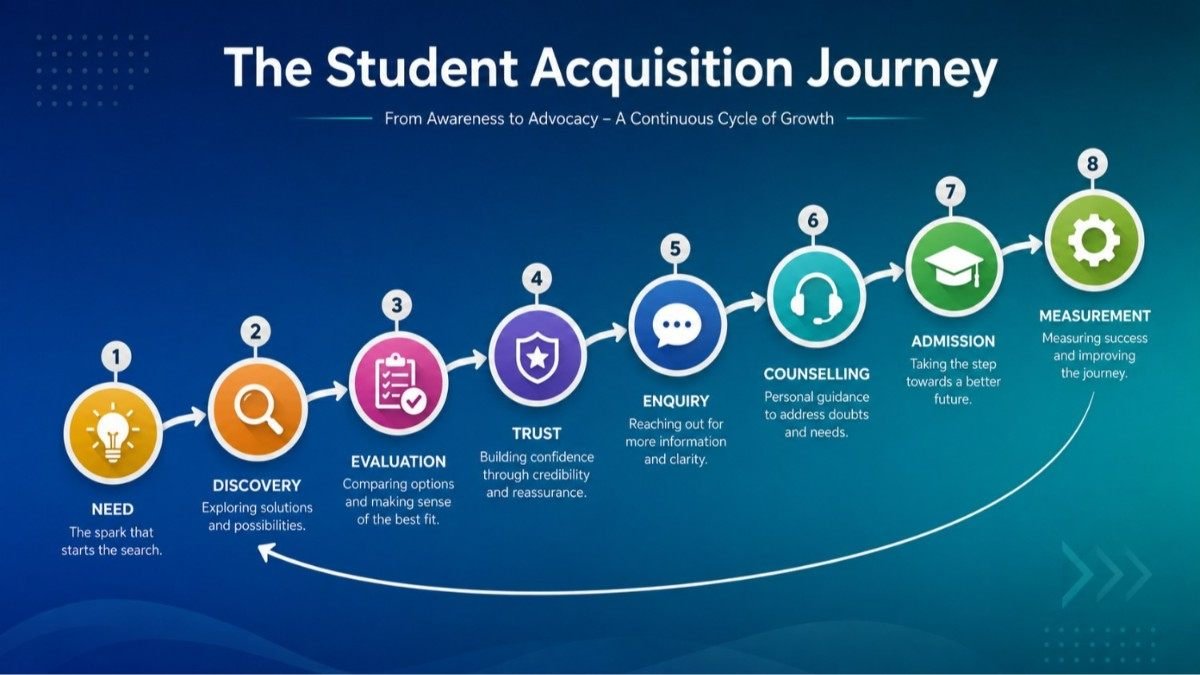
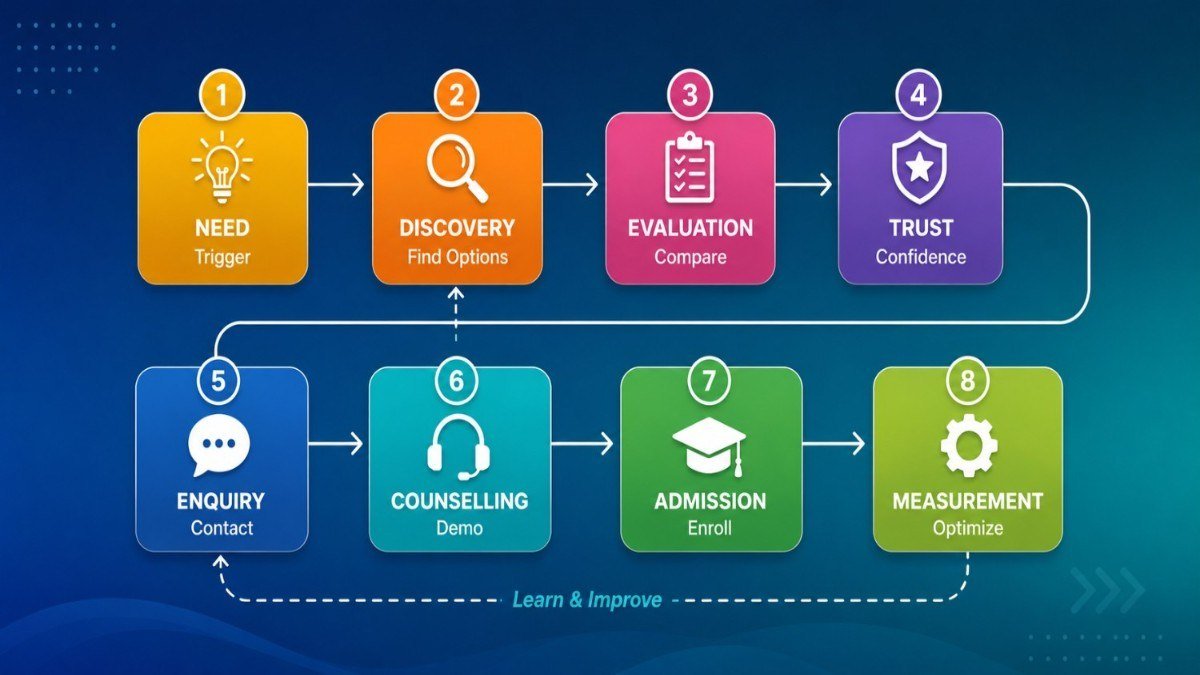
Strip away the marketing language and the process looks similar whether it's a Class 9 student's mother searching for ICSE science tuition or a 24-year-old evaluating training institutes for a career switch. It runs, loosely, through eight moments: a need surfaces, the person discovers some options, they evaluate those options against each other, they decide whether to trust one enough to commit, they make contact, they go through some form of counselling or a demo, they admit (or don't), and — for the institute — the results of that cycle should feed back into how the next one is run.
This is not a funnel in the neat, textbook sense where people fall through ordered stages. Real families loop back. A parent might discover three institutes on Google Maps, evaluate them by checking reviews and websites, drop two from consideration, enquire with one, sit through a counselling call, then go back and check that institute's Instagram page before finally deciding. Digital marketing touches nearly every one of these loops, but it plays a different role at each point, and that distinction is where most generic advice falls short.
The initial need
Something triggers the search — an exam result, a batch starting soon, a friend's recommendation, a career decision, an entrance-exam date getting closer. Digital marketing rarely creates this need for academic coaching; a Class 10 student needs board-exam preparation regardless of anyone's ad spend. For skill and professional training, though, awareness content can plausibly surface a need someone hadn't consciously articulated — "I didn't know digital marketing was a career option."
Discovery
This is the moment the need becomes a search, a scroll, or a question to someone else. Search visibility, a well-kept Google Business Profile, YouTube, and a consistent social presence do their work here — not by persuading anyone yet, but simply by being findable at the right moment.
Evaluation
The family or student now has two to six options in front of them and is comparing. Website quality, reviews, faculty credibility, and results data matter more here than search ranking position on its own.
Trust
Trust is a distinct stage from evaluation. "This institute looks fine" is not the same as "I am willing to pay this institute and commit months of my child's time to it." Trust tends to be built through specifics — named faculty, verifiable results, transparent fees, real student outcomes — rather than generic claims.
Enquiry
The point of actual contact: a form, a call, a WhatsApp message, a walk-in. This is where marketing hands off to the institute's own team, and, as covered later, it's also where many institutes lose leads they already paid to generate.
Counselling or a demo
For coaching institutes, this often means a demo class or a diagnostic test. For training institutes, it's usually a counselling call about career outcomes and course fit. This step frequently decides whether an enquiry becomes an admission more than any single ad does.
Admission
The event that actually matters financially.
Measurement and the next cycle
What separates institutes that improve every admission season from those that repeat the same mistakes is whether they close this loop — whether what they learn about which content answered real questions, which channels produced students who stayed, and where follow-up lost people actually reshapes the next cycle's discovery and content work, rather than starting over from a blank page each season.
A large share of digital marketing mistakes in this sector happen because someone optimised one stage — usually discovery, because it's the most visible — while ignoring what happens after. Getting more people to discover an institute does little if its enquiry-to-admission process leaks most of the leads it produces. Keep this sequence in mind; it's the spine of everything that follows.
What Are Students and Parents Actually Searching For?
Before discussing tactics, it's worth being precise about what people are actually searching for, because most content in this space conflates several distinct intents into one keyword list.
Consider these searches side by side:
- "CBSE class 10 maths coaching in [city]"
- "ICSE vs CBSE which is better for science"
- "JEE coaching in Kolkata"
- "NEET coaching near me"
- "best digital marketing course with placement"
- "spoken English classes in Pune"
- "data analytics course in Bangalore"
- "[Institute name] reviews"
- "how to prepare for CLAT"
These represent at least five distinct intents. Discovery intent ("I need coaching for X") means the searcher has decided they need help and wants to find providers. Learning intent ("how to prepare for NEET biology," "difference between JEE Main and Advanced") means the searcher wants information, not necessarily an institute yet — this is where genuinely useful content builds long-term trust and search visibility. Comparison intent ("ICSE vs CBSE," "online vs offline coaching for NEET") means the searcher already knows their options and is narrowing down. Location intent ("coaching near me") matters more for school-level tuition, where daily commute is a real constraint, and less for high-stakes exam coaching, where families are often willing to travel further for a stronger brand. Decision intent ("[institute] fees," "[institute] admission process") is late-stage, high-value, often branded traffic — and frequently under-optimised, because institutes assume people already know enough.
Each intent deserves a different kind of page. Conflating them is exactly how institutes end up with either one generic "coaching in [city]" page trying to rank for everything, or hundreds of near-duplicate location or keyword pages built by swapping a city name into a template.
That second pattern is worth naming precisely, because it isn't just a stylistic preference — it maps directly to something Google's own documentation addresses. Google's Search Central spam policies describe "scaled content abuse" as generating many pages primarily to manipulate search rankings rather than to help users, and separately describe certain "doorway" pages as ones where multiple pages are targeted at specific regions or cities to funnel users toward one destination, or where a site creates many substantially similar pages instead of a clearly defined, browsable structure. A city-name-swapped template farm is a fairly direct match for that description. This doesn't mean every location page is a problem — a genuine branch with its own address, faculty, and batch information is legitimate content. The distinction Google draws is whether each page adds real, distinct value or exists mainly to occupy more search real estate.
Why board, class, subject, course, and location interact
A useful exercise: multiply these variables out for a mid-sized institute offering CBSE, ICSE, and West Bengal state board coaching from Class 8 through Class 12, plus JEE and NEET batches, across two locations. The combinations run into the hundreds. No institute should build a separate page for every mathematical combination — but collapsing everything into three generic pages ("CBSE coaching," "ICSE coaching," "competitive exam coaching") is equally wasteful, because a Class 10 ICSE science parent and a Class 12 ICSE commerce parent have almost nothing in common except the board name.
The practical middle ground is to build pages around genuine differences in what the searcher needs, not around every keyword variation. A West Bengal Higher Secondary (WBCHSE) student has a different syllabus and exam pattern than a CBSE student in the same city — that's a real distinction worth its own page. Two branches five kilometres apart teaching the identical CBSE Class 10 syllabus with the same faculty do not need two separate "near me" pages differentiated only by neighbourhood name.
A reasonable structure looks less like a keyword spreadsheet and more like a curriculum map: organise by board and level where the syllabus genuinely diverges, by exam where preparation genuinely diverges (JEE and NEET, despite both being "competitive exams," need separate pages because the subjects, exam pattern, and audience differ substantially), and by location only where a distinct physical branch exists with its own faculty, batch timings, and address worth showing on its own local listing.
Audience, intent, and channel at a glance
| Audience | Typical search intent | Where they actually look | Content that satisfies it | Likely first conversion |
|---|---|---|---|---|
| CBSE parent (school-level) | Discovery + location | Google Search, Google Maps, parent groups | A CBSE-specific class/subject page with faculty, timing, fees | Phone call or WhatsApp enquiry |
| ICSE/ISC parent | Discovery + comparison | Google Search, referrals | Board-specific page distinguishing syllabus and marking pattern | Enquiry form or call |
| JEE aspirant (student-led) | Learning + comparison | YouTube, Google Search, peers | Faculty-led explainer content linking to the programme page | Demo class booking |
| NEET aspirant (student-led) | Learning + decision | YouTube, Instagram, Google Search | Results-specific content, faculty credentials, diagnostic offer | Diagnostic test or counselling call |
| Professional training prospect | Comparison + decision | Google Search, LinkedIn, Instagram, alumni | Placement data, curriculum detail, alumni stories | Counselling call or preview signup |
This table is a starting framework, not a fixed rule. The right channel mix for any specific institute depends on its exact location, courses, and competitive set, and should be checked against its own traffic and enquiry data over time.
How Do Students and Parents Discover Coaching and Training Institutes?
Search is the anchor, but rarely the whole story, and the channel mix genuinely differs by segment based on how each audience tends to research a decision like this.
For school-level coaching, Google Maps and Google Search tend to dominate discovery, since it's usually a local, recurring, parent-led decision — someone typing "class 9 tuition near me" or opening Maps to see what's nearby. Community and parent-network word of mouth also carries real weight, particularly in smaller cities, though this is a practical observation about how the category tends to work rather than a formally measured statistic.
For competitive-exam coaching, YouTube plays a larger visible role. Students often watch faculty explain problems and form opinions about teaching style before any enquiry happens, and the student is generally a more active, visible participant in the decision than at the school-tuition level.
For skill and professional training institutes, the mix shifts toward Instagram and YouTube for awareness, Google Search for late-stage comparison queries, and LinkedIn or alumni networks for career-outcome credibility. The prospective student is usually both researcher and payer, evaluating this closer to a career decision than an academic one — which changes what "trust" needs to look like, with placement data and alumni outcomes often mattering as much as faculty credentials.
The underlying principle: match discovery channels to how a specific audience segment actually behaves, rather than assuming every segment behaves the way a general local business audience would.
Why Does SEO Matter for Coaching and Training Institutes?
Search engine optimisation for a coaching institute isn't really about "ranking for keywords." It's about making sure that when someone searches with a specific, real need, the institute's page is the one that actually and completely answers it — well enough that Google's systems recognise it as genuinely useful, and well enough that the person reading it decides to enquire.
Google's guidance on creating helpful, reliable, people-first content has been consistent for several years. It asks creators to consider whether content demonstrates real first-hand expertise, provides a substantial and complete treatment of the topic, and leaves a reader feeling they've learned enough to achieve their goal — as opposed to content made primarily to attract search traffic. The same documentation flags content that is mass-produced by a large number of creators, or produced through extensive automation, as a warning sign that works against ranking well, not for it. For a coaching institute, the practical translation is direct: a course page for "JEE coaching" that names actual faculty and their qualifications, states real batch structure and timings, shows genuine past results with appropriate context (results vary by student effort, prior preparation, and batch), and answers the real questions a JEE aspirant has, is doing exactly what that guidance describes as helpful content — independent of any SEO technique. Institutes building this kind of page-by-page authority over time are, in effect, building topical authority around their subject rather than chasing individual rankings.
Course and programme pages, not one generic services page. A frequent structural mistake is treating "our services" as a single page instead of building a proper page for each genuinely distinct offering — CBSE Class 10 Science, the JEE Main-plus-Advanced two-year programme, spoken English for working professionals — each answering that programme's version of: what's taught, who teaches it, how long it takes, what it costs, what outcomes a prospective student can reasonably expect, and how to start.
Internal linking that mirrors the decision path, not just SEO convention. A blog post answering "JEE Main vs JEE Advanced: what's the difference" should link naturally to the JEE programme page, which should link to faculty profiles, results, and the enquiry form — mirroring the actual research-to-enquiry sequence a student follows.
Technical health remains a prerequisite, not a differentiator. Mobile page speed, a working sitemap, correct structured data where genuinely applicable, and a site that renders reliably on the mid-range Android phones many Indian students and parents use won't win rankings on their own, but weak technical SEO quietly caps everything else built on top of it.
Search Console as an honest feedback loop. Rather than chasing vanity keyword-rank positions, a more useful habit is watching which queries actually bring impressions and clicks to which pages, and whether those queries match genuine student or parent intent. If a "NEET Biology coaching" page gets impressions for "NEET biology syllabus" but very few clicks, that's a signal the page isn't answering that specific informational need well enough — a fixable gap, not a failure. Understanding how to find and prioritise the right keywords in the first place makes this loop far more useful.
When Does Local SEO Matter Most for an Institute?
Most local-SEO advice is written for restaurants and dentists, where immediate proximity dominates the decision almost entirely. Coaching institutes sit in a more interesting middle ground: proximity matters a great deal for school-level tuition, where a parent generally prefers a manageable daily commute, but matters far less for a strong JEE/NEET brand or a well-regarded professional training institute, where families and students are often willing to travel, relocate, or choose a distant but trusted institute's online batch over a closer but weaker one — a pattern that holds whether the institute is in Kolkata, Pune, or a smaller Indian city.
Google's own Business Profile documentation states that local results are based mainly on relevance, distance, and prominence (sometimes called "popularity" elsewhere, including in older Google material and much third-party writing — the underlying concept is the same). The documentation is explicit on one point worth stating plainly: there is no way to request or pay for a better local ranking on Google, and Google keeps the exact algorithm details confidential specifically to keep the system fair.
Relevance means a Business Profile's categories, listed services, and description should reflect exactly what the institute teaches, not a generic "education" or "tutoring service" label — Google ties relevance directly to how complete and detailed the business information is. Distance is essentially fixed once a branch's address is set, since Google determines it from how far the business is from the searcher or from the location implied in their search; this interacts with site structure, since an institute with genuinely separate branches benefits from separate, accurate listings for each one rather than one shared listing covering multiple locations. Prominence is where sustained effort compounds — Google points to two concrete levers here: reviews (more reviews and positive ratings can help local ranking) and how well-known the business is across the web, including how many sites link to it.
For a coaching institute, the practical implication is a genuine, ongoing habit of asking satisfied parents and students to leave honest, specific reviews after meaningful moments — a strong result, a completed batch, a successful admission — rather than a single push before enrolment closes. Google doesn't publish an exact review count or scoring formula, so specific numeric claims about "how many reviews you need" should be treated as informed estimation from practitioners, not confirmed policy. This is also why near-me searches carry particular weight for a category like coaching, and why a profile that's actively optimised rather than left on autopilot tends to keep pulling ahead of one that isn't.
For institutes with multiple branches, each genuinely distinct branch benefits from its own verified listing, its own accurate hours and batch information, and its own local landing page with genuinely distinct content — not a shared "locations" page listing several addresses under identical copy. The same logic extends to Google Maps visibility specifically, which functions as its own discovery surface distinct from organic search results.
When Should an Institute Use Google Ads?
Paid search tends to earn its cost at moments organic SEO can't yet cover: a new batch launching with limited seats and limited time to fill it, an admission season with a hard deadline, or a highly competitive keyword where ranking organically would take longer than the institute has.
Google's own documentation on conversion measurement and automated bidding is worth taking seriously here, because it clarifies something institutes often get backwards. Automated bidding strategies rely on an account's conversion tracking data to optimise, and Google states plainly that misconfiguring which conversion action is treated as primary (used for bidding) versus secondary (observation only) can prevent these systems from optimising effectively, since the algorithm depends on those signals. Google's guidance on Display and Search bidding adds that when there's an issue with conversion tracking, the system will adjust and react to that inaccurate data, which can itself cause volume, cost, or return-on-spend fluctuations. In plainer terms: an institute running search ads toward a form that isn't properly tracked as a conversion, or that treats every form fill — including obviously irrelevant ones — as equally valuable, is giving the bidding system an inaccurate optimisation signal, which can lead to poorer campaign decisions than the institute realises it's making. This does not mean every form submission is bad data; it means bidding systems work from whatever conversion signals are configured in the account, so inaccurate, incomplete, or poorly prioritised signals can lead to poorer optimisation than the institute would otherwise get.
A few distinctions worth making explicit, because "just run Google Ads" isn't a strategy on its own.
Brand and non-brand campaigns serve different purposes. Bidding on an institute's own name protects against competitors bidding on it and captures late-stage, high-intent searchers who already know the institute. Non-brand campaigns — "JEE coaching in [city]," "spoken English classes near me" — capture new demand but usually cost more per click and convert at a lower rate, since the searcher hasn't decided on the institute yet.
Landing pages, not the homepage. Sending ad traffic to a general homepage instead of a page specific to the exact course and intent named in the ad forces a paid visitor to do navigation work the ad should already have done for them — a common and avoidable source of wasted spend.
Cost per lead is not the number that matters most; cost per admission is. An institute can have an impressively low cost per lead and still lose money if those leads convert to admissions at a fraction of the rate of a more expensive, better-targeted campaign. This requires connecting ad spend to actual admissions data, not just to form submissions — a step many institutes never set up.
Seasonality is real and worth planning around. Enquiry volume for school-year coaching tends to spike around results announcements and academic-year transitions; competitive-exam coaching enquiry follows the exam calendar; professional training enquiry is often steadier year-round with spikes around graduation seasons. Budgets that don't flex with this pattern either overspend in slow periods or underspend exactly when demand peaks.
None of these — brand versus non-brand, cost per lead versus cost per admission, or seasonal flexing — should be treated as a universal law that applies identically to every institute; they're patterns worth testing against an institute's own data. Paid search does not, on its own, produce admissions. It produces qualified traffic and enquiries, and what happens after the click — the landing page, the form, and critically, the institute's own follow-up — determines whether that spend was worthwhile.
What Role Should Facebook and Instagram Ads Play?
Google Search captures existing intent; Meta (Facebook and Instagram) is generally better suited to creating awareness and staying present with people who haven't started actively searching yet, or reminding people who visited a site but didn't enquire.
This matters for coaching institutes because a meaningful share of the audience — particularly parents of younger students and prospective career-training students early in their decision — aren't yet typing search queries. They're scrolling, and a well-targeted ad about an upcoming batch, a faculty introduction, or a genuine student result can plant a seed that later becomes a branded Google search.
Meta's own advertiser documentation is directly relevant here. It positions lead ads with instant, in-app forms as reducing friction versus sending traffic to a website form, since the form can autofill using information already on the person's profile. Meta reports — worth flagging clearly as the platform's own data rather than independent research — that instant-form lead campaigns tend to generate more submissions at a lower cost per lead than sending the same traffic to a website form. That's a real trade-off worth planning for rather than a fixed law: a lower-friction form generally brings in more submissions at a lower cost per submission, but it doesn't automatically follow that every one of those leads is as serious as one from someone who searched Google and filled out a website form. The honest answer is that lead quality from any given form varies by audience and creative, and it's a downstream question — measured by qualification rate and eventual admission rate — rather than something to assume from the ad format alone.
This is exactly why lead qualification matters more for Meta leads than for Google Search leads. Someone who filled a Google Ads form after actively searching "NEET coaching near me" has already self-selected for intent; someone who tapped a Meta lead ad while scrolling has not necessarily done the same, and treating both lead sources identically in follow-up wastes counsellor time on the wrong calls first.
Creative approach also tends to differ by audience, as a practical pattern rather than a documented rule. Parent-facing creative for school coaching often performs better when it's specific and calm — a named faculty member explaining an approach, a genuine result, clear batch details — while student-facing creative for competitive-exam or skill-training audiences tends to tolerate, and sometimes benefits from, more direct and energetic creative, since the student is usually the one scrolling and deciding whether to tap.
How Can Video Build Trust Before an Enquiry?
Video does something neither search nor static ads can: it lets a prospective student or parent evaluate teaching quality before paying for it. A faculty member explaining a genuinely difficult concept — a tricky organic chemistry mechanism, a commonly misunderstood grammar rule, a real digital marketing campaign breakdown — can build more trust with a competitive-exam or skill-training audience than a written page, because it lets the viewer judge competence directly.
This works best when it stays close to genuine teaching rather than drifting into pure marketing. Content that tends to perform well includes short explainers on commonly confused topics, faculty answering the specific questions students actually search for, sample lesson excerpts, and honest student-experience content that goes beyond "this institute is great" into what actually changed for that student.
For school-level coaching, video plays a smaller but still real role — mostly around demonstrating faculty quality and answering parent questions about exam-pattern changes or board-specific preparation, rather than driving discovery on its own.
What Should an Institute Website Do Before Someone Enquires?
Traffic is not enquiries, and enquiries are not admissions. An institute can generate thousands of monthly website visitors and still lose money on marketing if the site doesn't convert visits into genuine enquiries, and if the team doesn't convert enquiries into admissions.
A website that functions as part of the admissions process — rather than as a digital brochure — tends to share a few characteristics. It states fees clearly, or at minimum states the process for getting fee information, rather than hiding behind "contact us for pricing," which reads as evasive to most parents comparing several institutes side by side. It shows faculty as real, named, credentialed people rather than generic "expert faculty" language. It shows results with enough specificity to be credible — which students, which year, what outcome — rather than unverifiable blanket claims. It explains the admission process itself, since uncertainty about "what happens next" is itself a drop-off point. And it makes contact frictionless across channels people actually use: a phone number that's answered, WhatsApp as a genuine option, and a form that asks only what's needed to start a conversation.
Demo classes and diagnostic tests deserve particular attention because, for many coaching formats, they function as the real conversion event — more decisive than any ad or web page. An institute that makes it easy to book a demo, and runs it well, will generally out-convert a competitor with better ads but a clunkier demo-booking process.
How Should Institutes Build Content Around Real Questions?
The most durable content an institute can build isn't organised around keywords at all — it's organised around the actual questions students and parents ask at each stage of their decision.
Before discovery, questions are exploratory: "is CBSE or ICSE better for science," "what's the difference between JEE Main and Advanced," "is it too late to start NEET preparation in Class 12." Before comparison, they sharpen: "online vs offline coaching for NEET," "how to choose a good coaching institute." Before enquiry, they get practical: "[institute] fees," "[institute] batch timings," "does [institute] offer a free demo." After enquiry but before admission, they get specific to the individual: "what if I miss classes," "how are doubts cleared," "what study material is provided."
Content built to genuinely answer these does two things at once: it aligns with the kind of people-first content Google's guidance describes, well enough to earn organic visibility over time, and it does real persuasive work with the person reading it, because it demonstrates the institute actually understands the decision being made. The relationship is straightforward, even if it's rarely followed in practice — a real question becomes a genuinely useful piece of content, which links naturally to the relevant programme page, which is where the enquiry actually happens. Building this habit is, in practice, a specific and learnable skill rather than something that happens automatically once someone is assigned to "do the blog."
This is also where generic, templated content does real damage rather than just wasting effort. Content that could describe any coaching institute in any city, published purely to hit a publishing schedule, doesn't just fail to rank — the same Google guidance names content produced through extensive automation, and content that mainly summarises what others have already said without adding real value, as explicit warning signs of search-engine-first rather than people-first content. The institutes that keep compounding their content and domain authority year over year tend to be the ones treating each piece as a genuine answer to a genuine question, not a slot to fill.
Why Does Lead Follow-Up Matter as Much as Lead Generation?
This is the part most digital marketing content skips, and it's arguably the highest-leverage one, because no amount of ad spend or SEO effort survives a broken follow-up process.
The most-cited research here is worth getting precisely right, because the widely repeated version of it — "contact a lead within five minutes and you're up to 100 times more likely to qualify it" — is usually attributed to the wrong study. That specific multiplier traces to a 2007 industry study conducted in partnership with a lead-management technology vendor, not to the study it's typically pinned on. The actual study usually cited alongside it — "The Short Life of Online Sales Leads" by James Oldroyd, Kristina McElheran, and David Elkington, published in Harvard Business Review in March 2011 — audited response behaviour at 2,241 US companies using real test leads. Its findings: 37% of companies responded within one hour, the average response time among companies that responded at all was 42 hours, and 23% of leads received no response whatsoever. A related dataset examined in the same article, covering 1.25 million sales leads at other companies, found that firms making contact within an hour were roughly seven times more likely to qualify the lead than firms that waited even an hour longer, and more than sixty times more likely to qualify it than firms that waited 24 hours or more.
Two things are worth being honest about here. First, this research is now well over a decade old, comes from a general commercial-lead context rather than coaching or education specifically, and involved companies that opted into being studied, which may not represent every industry evenly. Second, even with those caveats, the direction of the finding — that response speed has an outsized effect on whether a lead converts, and that most businesses respond far slower than they assume — is broadly consistent across the available research and matches ordinary experience: a parent comparing two or three institutes on the same afternoon is likely to favour whichever one calls back first and explains things clearly.
For a coaching institute, this has direct operational implications, offered here as a recommendation rather than a guaranteed multiplier. Route enquiries for an immediate callback rather than batching them for end-of-day follow-up. Qualify before pitching — a short conversation to understand the student's board, class, subject needs, or career goal before launching into a pitch, since generic pitches tend to read as impersonal. Treat WhatsApp as a legitimate primary channel, since it is, in practical observation, often the channel Indian parents and students prefer for ongoing communication, rather than an afterthought to a web form. Track leads through to admission, even in a simple spreadsheet, so the institute knows which channel and which counsellor actually produce admissions rather than just enquiries. And remarket to people who enquired but didn't convert, since a student who didn't join this batch may join the next one if the institute stays visible without being pushy.
None of this is glamorous, and it's not "digital marketing" in the narrow sense — but it's the stage that determines whether everything upstream was worth doing.
What Should an Institute Actually Measure?
Vanity metrics — followers, impressions, likes — are easy to report and largely disconnected from whether an institute is filling seats. A useful, institute-specific measurement model tracks the journey described earlier end to end.
Search visibility and impressions show whether the institute is being found for the right queries at all. Qualified traffic shows whether discovery is actually working, not just whether any traffic is arriving. Leads and enquiries, broken down by source, show which channels produce contact rather than just clicks. Cost per lead by channel shows efficiency, but only means something alongside the next metric. Counselling or demo bookings show how many leads progress past first contact — a mid-funnel number most institutes never track. Admission conversion rate reveals whether the counselling and follow-up process works, independent of marketing quality. And cost per admission, not cost per lead, should be the number that actually drives budget decisions, since a channel with a higher cost per lead but a much better admission conversion rate is often the better investment.
The discipline that separates institutes that improve steadily from those that don't isn't sophisticated analytics — it's simply connecting these numbers to each other consistently, cycle after cycle, rather than looking at each one in isolation.
How Should Marketing Change for Different Types of Institutes?
School-board coaching (CBSE, ICSE/ISC, state boards such as WBCHSE and WBBSE) tends to be highly local and recurring — many families return year after year for successive classes — relatively price-sensitive compared with competitive-exam coaching, and influenced by community reputation alongside digital discovery. Seasonality follows the academic calendar and results announcements closely.
JEE, NEET, and other competitive-exam coaching typically involves a longer, higher-stakes decision cycle, often beginning a year or more before the exam, with students playing a more visible role in the choice than at the school-tuition level. Trust requirements tend to be higher given the financial and time commitment involved, and faculty reputation, results transparency, and YouTube presence carry disproportionate weight. Competition is often regional or national, since strong brands attract students willing to relocate or join an online batch.
Skill-development and professional-training institutes (digital marketing, coding, data analytics, spoken English, and similar) usually involve the individual student as both decision-maker and payer, a shorter but career-outcome-driven decision cycle, and a purchase process that resembles a professional-service decision more than an academic one — placement data, alumni outcomes, curriculum currency, and instructor credibility often carry as much weight as traditional exam-style results. Seasonality tends to be flatter across the year but often spikes around graduation periods and career-transition moments.
Treating all three with an identical marketing playbook — same channels, same content style, same measurement approach — is a common and avoidable mistake, because their audiences make decisions differently even when the underlying tools (SEO, Google Ads, Meta Ads) are the same. This three-way distinction holds across India, whether the institute is based in a metro like Kolkata or Bangalore or in a smaller town, even as the specific boards, exams, and competitive set shift from region to region.
What Digital Marketing Mistakes Should Institutes Avoid?
A few patterns show up repeatedly across institutes that spend on digital marketing without proportional results.
Mechanically stuffing board and location names into content — "Best CBSE ICSE WB Board Coaching Institute in [city] [locality] [pincode]" — reads as low-effort to both readers and Google's ranking systems, and rarely converts anyone, because it doesn't answer a real question. Generating hundreds of near-identical location or keyword pages by templating city or locality names into otherwise identical content matches the pattern Google's spam policies specifically describe under doorway and scaled-content abuse, and it also does little for a genuine reader, since two thin pages differentiated only by a place name serve no one better than one honest page.
Running ads without proper conversion tracking means the automated bidding systems powering modern search campaigns are optimising against incomplete or inaccurate signals — which, per Google's own guidance, can directly cause the volume, cost, or return fluctuations institutes then blame on the platform. Measuring clicks or impressions as if they were success metrics disconnects marketing activity from the outcome — admissions — it's meant to serve, and focusing on follower counts over actual enquiry and admission numbers optimises for a metric that doesn't fill batches.
Ignoring a Business Profile because it feels like "just a listing" overlooks that, for local coaching searches, it's often the first thing a parent sees before deciding whether to click through to a website at all. Weak, generic course pages that don't specify faculty, results, batch structure, or fees give a genuinely interested visitor a reason to leave and check a competitor instead. And slow lead follow-up, as covered above, quietly erases the value of everything spent to generate the lead in the first place.
Copying a competitor's website or ad copy produces content that satisfies neither Google's expectations around original, first-hand content nor a reader's need for a genuine reason to choose one institute over the one being copied — and publishing generic, templated content with no institute-specific detail fails the same test, since content produced through heavy automation with little differentiation is a warning sign, not a growth tactic. Finally, treating every lead as equally valuable — giving identical counsellor time and urgency to a casual Instagram tap and a high-intent Google Search enquiry — misallocates the scarcest resource in the system, which is usually counsellor time, not marketing budget.
Each of these failures shares a root cause: optimising for a visible, easy-to-report proxy — traffic, followers, clicks, page count — instead of the actual outcome, because the proxy is easier to point to in a report.
How Does the Student Acquisition Journey Fit Together?
Put the whole system together, and the path from search demand to a seat in the classroom runs through the same eight moments described earlier, now with the specific tools attached to each one.
Search demand and a real need come first — nothing downstream matters if this isn't genuine. That need turns into discovery through Google Search, Google Maps, YouTube, Instagram, Facebook, community recommendation, and directories, depending on the audience segment. Discovery leads to evaluation, where a website, a Business Profile, reviews, and social presence get compared against two to five alternatives. Evaluation, if it goes well, builds trust — through named faculty, verifiable results, transparent fees, and genuine student outcomes, held consistently rather than claimed once. Trust produces an enquiry: a form, a call, a WhatsApp message, a walk-in. The enquiry moves into counselling, a demo class, or a diagnostic test, which is where many institutes either earn or lose the admission regardless of how strong the marketing was. If that goes well, admission follows. And admission should feed measurement and optimisation — cost per admission, conversion rates by source, and feedback into content, targeting, and the follow-up process for the next cycle.
The reason to think of this as a loop rather than a straight line ending at "admission" is that what an institute learns from its measurement stage — which content answered real questions, which channels produced students who stayed and succeeded, where the follow-up process lost people — should directly reshape the discovery and content work in the next cycle. Institutes that treat this as a one-time setup rather than a system they keep tuning are the ones that plateau after an initial burst of results.
What Should an Institute Fix First?
Reading all of the above raises an obvious practical question: where does an institute actually start?
There's no universal answer — an institute with no tracking in place and one already handling two hundred enquiries a month with a broken follow-up process need different starting points — but a reasonable general order looks like this.
Measurement and conversion tracking come first, even before anything else changes, because without it there's no way to know whether any later change actually helped. An institute that can't yet say which channel produced which admission is flying without instruments, regardless of how much it spends on ads or content.
The website and programme pages come next. Sending more traffic — paid or organic — to pages that don't state fees, name faculty, or explain the admission process wastes whatever attention is already being earned. This is usually cheaper to fix than it looks, and it improves the return on every channel built afterwards.
Local visibility follows for institutes where proximity matters, particularly school-board coaching. An accurate, complete, actively-maintained Business Profile is often the single highest-leverage fix available to a local institute, because it affects both discoverability and the first impression a parent forms before ever reaching the website.
Organic search and genuinely useful content compound from there. This is the slowest lever to show results, which is exactly why it should start early rather than being left until an institute suddenly needs organic traffic in six weeks.
Paid acquisition fills the gaps — the batch that needs seats now, the keyword that will take too long to rank for organically, the seasonal spike that content and SEO alone won't cover in time.
Lead follow-up and counselling sit last in this list only because they're listed last, not because they matter least. In practice, an institute already generating enquiries it isn't converting well should treat this as urgent regardless of where it falls in a general sequence — fixing follow-up on existing leads is usually faster and cheaper than generating new ones.
This is a general prioritisation framework, not a universal law: an institute already doing several of these well should simply start wherever its own data shows the biggest gap, rather than restarting the sequence from the top.
How Can an Institute Evaluate Its Digital Marketing System?
Everything described above can, in principle, be built by an institute's own team — none of it requires proprietary tools or secret techniques. What it requires is consistent effort across search, local presence, content, paid channels, the website, and — most commonly neglected — the follow-up process, sustained over admission cycles rather than a single campaign.
Where institutes most often need outside help isn't any single tactic in isolation; it's connecting the pieces so that SEO, local visibility, paid campaigns, the website, and lead handling function as one system rather than several disconnected efforts run by different vendors with different, or no, shared measurement. This is the kind of connected setup Mivja works on with coaching and training institutes — from search and local-listing work through to conversion tracking and lead-management process, alongside the SEO and digital marketing services it offers more broadly — because the framework above only produces results when every stage of it is actually built, not just the visible parts like ads and social posts.
Whether that's the right fit for a given institute depends on team size, existing digital maturity, budget, and how much of this is already being done in-house — worth an honest internal assessment before bringing in outside help for any part of it. The framework itself holds for coaching and training institutes across India, from Kolkata to any other city; what will always vary locally is the exact mix of channels, content, and strategy, shaped by the institute's city, courses, and audience.
Frequently Asked Questions
How much should a coaching institute spend on digital marketing?
There's no fixed percentage that applies universally — it depends on admission-cycle length, average revenue per student, competition in your specific board, exam, or course and location, and how much of the funnel is already built versus needing to be created from scratch. A more useful starting question than "how much" is "what's an acceptable cost per admission," worked backwards from your fees and margins, then tested against actual channel performance.
Is SEO or Google Ads better for a coaching institute?
They serve different timeframes. SEO builds compounding, lower-cost visibility over months but takes time to establish, especially for a newer website. Google Ads produces visibility immediately but stops the moment spend stops. Most institutes with any real runway benefit from both — ads to fill immediate seats and cover keywords where organic ranking will take too long, SEO to reduce dependence on paid spend over successive admission cycles.
Do I need a website if I already have a strong Business Profile and Instagram presence?
In almost every case, yes. A profile and Instagram are effective for discovery and initial impression, but they can't hold the depth of information — detailed programme pages, faculty credentials, transparent results, a real enquiry process — that builds trust and supports SEO growth over time. Relying solely on platforms an institute doesn't own also leaves it exposed to changes in those platforms' algorithms or policies.
How important are Google reviews, really?
Meaningful, for two separate reasons. Google's own documentation names review count and rating as factors that can help local ranking, so reviews affect discoverability. Separately, reviews are often the single most-read piece of content by a parent or student during evaluation, functioning as informal proof of whatever trust signals the institute's marketing claims. Google doesn't publish an exact scoring formula, so treat any specific "you need X reviews" number from third parties as an estimate, not confirmed policy.
Should every branch have its own website page?
If it's a genuinely distinct branch — its own address, its own faculty, its own batch timings — yes, with its own listing and genuinely distinct content. If it's the same programme delivered from a different building with no real operational difference, a shared page with clear location and contact information usually serves visitors better than a duplicated page that adds little beyond an address.
How fast should we actually respond to enquiries?
As fast as practically possible, ideally within minutes rather than hours. The research most often cited here — a 2011 Harvard Business Review study of 2,241 companies — found that firms responding within an hour were roughly seven times more likely to qualify a lead than slower responders, and more than sixty times more likely than firms waiting a day or more; the same study found the average company took 42 hours to respond, and nearly a quarter never responded at all. The much-repeated "100x more likely within five minutes" figure is often attributed to this study but actually comes from a separate, earlier industry study — worth treating with appropriate caution rather than as a settled scientific finding. The reliable takeaway either way: most institutes respond far slower than they assume, and speed matters more than most marketing spend.
Is Instagram worth the effort for a school-level coaching institute?
It tends to be more useful for reinforcing trust with parents already considering an institute than for cold discovery at the school-tuition level, where Google Search, Maps, and word of mouth typically do more of the initial discovery work. It becomes more central for competitive-exam and skill-training audiences, where the student is a more independent decision-maker.
What's a realistic timeline to see results from SEO?
Meaningful organic movement typically takes several months at minimum, and often longer for competitive keywords in dense markets, depending on content depth, technical health, and how established the domain already is. Institutes expecting SEO to fill a batch starting in six weeks are usually better served leaning on Google Ads or Meta for that specific, time-bound need while SEO compounds in the background.
Do I need separate marketing for CBSE, ICSE, and state board students?
Where the syllabus, exam pattern, and audience genuinely differ, yes — at minimum separate pages and messaging, since a WBCHSE parent and a CBSE parent are evaluating different things even if the subject name is identical. Whether it needs entirely separate ad campaigns depends on an institute's scale and whether it's actively targeting each board's audience with distinct offers.
What should I look for when evaluating a digital marketing agency for my institute?
Ask specifically how they connect marketing activity to admissions, not just leads or traffic — an agency that can't explain how it will track cost per admission, not just cost per lead, is measuring the wrong thing. Ask how they handle conversion tracking setup, since it directly affects whether paid campaigns can be optimised properly at all. And ask whether they understand the differences between school-board, competitive-exam, and skill-training segments, rather than offering one generic playbook for "education marketing."