
Where Should You Begin Your Digital Marketing Career: Agency, In-House or Startup?
Two people can have the same job title, Digital Marketing Executive, and come out of their first year with almost nothing in common. One spends her days running SEO audits, pulling campaign numbers, building landing pages, and joining client calls. The other spends most of his day scheduling Instagram posts and waiting to be told what to post next.
The gap between them usually isn't talent. It's what their manager let them touch.
People ask this question as if agency, in-house and startup are three fixed experiences with predictable outcomes. Agency for breadth, in-house for depth, startup for ownership. It's a tidy answer, and it's not entirely wrong, but it tells you almost nothing about the job you're actually being offered. The label on the offer letter doesn't run your first year. Your manager does.
What actually decides whether a first job is good: whether the work is real, whether someone senior looks at it, and whether you're trusted with a little more each month than you were the month before.
Why the First Job Shapes More Than It Should
Nobody warns freshers about this, but your first year quietly decides what you think digital marketing is. Spend twelve months doing scattered, low-context tasks, and you'll walk away with a slightly wrong picture of the whole field. Spend that same year close to strategy and real numbers, and you build instincts that stick.
Habits form early too: how you read a dashboard. How you defend a budget in a meeting. How you explain a campaign that flopped without either panicking or making excuses. Nobody teaches this in a course. You pick it up from whoever happens to be sitting next to you in your first job, if anyone is.
Agencies: A Lot of Work, Fast, Across Accounts You Don't Own
Agencies run on client accounts, and client accounts run on deadlines. As a fresher, you'll probably be staffed on more than one account at once. Monday you're on an ecommerce brand's Meta Ads calendar. Wednesday you're pulling together a LinkedIn plan for a B2B client who wants everything by Friday.
The pace is real. Clients may review agency work frequently, sometimes weekly, and that pressure trickles straight down to whoever is executing the account. In return, you get through a lot of tools quickly. Google Ads, Meta Ads Manager, an SEO platform, a reporting dashboard, all inside a few months, because someone has to run them and it's often you.
What you usually don't get as a fresher is a say in strategy. You execute someone else's plan. You might execute it well, and eventually you might get pulled into the planning conversation, but that depends on the agency's size, which account you land on, and whether your manager trusts you in front of a client yet. There's a specific kind of gap that shows up here: you might run a Google Ads account for six months and never find out what happened after the campaign ended, because by then you've already moved to the next brief.
In-House: One Brand, Longer Memory
In-house usually means working with one brand or business for a longer stretch of time, which gives you a chance to actually understand its history, its customers, and what's already been tried before you got there. You're not proving your worth to a new client every thirty days. You're watching something you built mature, or fail, or scale, over a much longer window.
This is usually where depth comes from. Say the company cares about organic growth. A year in, you might know that domain's technical SEO issues, its content gaps, its search performance history, in a way that no agency junior gets time to learn about any single client. Being inside the company can also put you closer to numbers like revenue or retention, though that's not automatic. A junior marketer might still only see a dashboard someone else built, while a senior in-house marketer sits in the meetings where those numbers actually get discussed.
The catch is that you're not seeing much else. Two years buried in one brand's SEO builds real expertise there and almost nothing in paid media, email, or content. And the pace isn't automatically slower just because it's one brand. A fast-growing D2C company can move as hard as any agency. The only difference is there's no account manager standing between you and the founder's message at 11 p.m.
Startups: Fewer People, More Hats, Less Structure
Startups sit somewhere between agency and in-house, then throw in a fair amount of chaos. Many early-stage startups don't have separate SEO, paid media, and content teams, so whoever's doing marketing ends up covering several of those areas at once. Sometimes that's just you.
"Wearing many hats" sounds like a line from a job posting until you're actually living it. Same week, you're writing ad copy, setting up a campaign, checking analytics, and helping draft a landing page, because there isn't another person handling each of those tasks. That can teach you a lot, fast, across functions most freshers never touch in year one. It can also mean you're spread so thin you never get properly good at any one thing. You're always putting out the next fire.
There's a question worth sitting with here: is the responsibility you've been handed real, or is it just that nobody else was around? Both look identical from the outside. A fresher usually can't tell the difference for the first few months. One decent signal is whether someone senior is still checking your work and asking why you made the calls you made. If nobody ever looks at what you produce, that's not trust. It's just nobody having the time.
A Rough Comparison
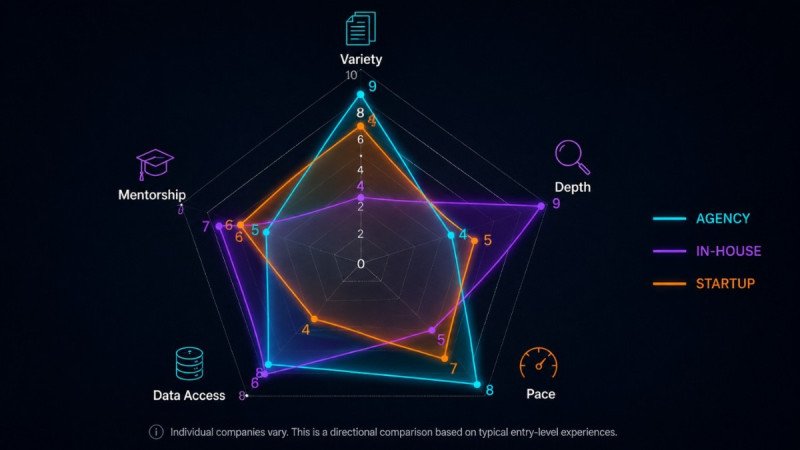
Individual companies vary a lot, so treat this as a general pattern rather than a guarantee. The team you land on matters more than the row it sits in.
| Factor | Agency | In-house | Startup |
|---|---|---|---|
| Variety | High, when working across multiple accounts | Lower, focused on one business | High, often across functions |
| Depth | Can be limited early on | Can build over time | Depends on the role and team |
| Pace | Often deadline-driven | Depends on the business | Often fast, but highly variable |
| Data access | Depends on client and account setup | Often closer to first-party data | Depends on tools, team, and stage |
| Mentorship | Depends on the account and team structure | Depends on team maturity | Highly variable, especially in smaller teams |
| Fits well if | You're still exploring | You already have a direction | You're comfortable with ambiguity |
The Manager Usually Matters More Than the Category
A well-run agency where a manager actually reviews your campaigns will teach you more in a year than a poorly managed startup that leaves you to figure everything out alone. The same thing happens in-house. A strong team with real data access can outteach an agency where juniors sit doing repetitive execution and never see how their work landed.
So before accepting anything, look past the category. Who's the manager? What will you actually do day to day? Will you see live data or just a summary of it? Will your responsibility grow at all over the first year, or will month six look exactly like month one?
Telling Real Work From Busywork
There's a difference between doing something and learning something. Working on a live campaign, watching how it performs, making a change based on what you see, and getting feedback on whether that change worked- that's the version where you learn. Formatting the same report every week without ever being asked what it means is the other version.
Some repetitive work is normal everywhere. Most beginners will handle some routine work, scheduling a few posts, running basic checks, early on. The problem shows up when a role never moves past that. If your day in month four looks identical to your day in month one, say something to your manager before it becomes the whole job.
What You Should Have to Show After a Year
A decent first year leaves you with something you can actually point to. An SEO project you worked on. A campaign you contributed to and can talk an interviewer through. A landing page you helped test and rebuild. A report you built yourself, not one someone else handed you a template for. How much of this you'll have driven yourself versus contributed to as part of a team depends a lot on the employer, and that's fine. What matters is having a real answer either way.
You don't need to share confidential numbers to make this useful in an interview. What you need is the ability to explain what the problem was, what you tried, why you tried it, what you were watching to know if it worked, and what happened. That's a much better answer than "I worked in digital marketing for a year." It gives an interviewer something concrete to actually ask about.
Someone building toward that first interview sometimes benefits from getting the basics out of the way beforehand, so the job itself is where you're building judgment instead of vocabulary. Structured training with live campaign can help with that groundwork.
Generalist for Now, or Specialise Already?
Agencies can give you breadth quickly, particularly when you're working across several accounts and industries. Useful if you're still not sure whether SEO, paid media, or content is your thing. Startups give you a different kind of breadth, across functions instead of clients. In-house work usually narrows your focus, and that narrowing is more useful once you already have a rough idea of where you're headed.
Nobody needs to lock in a specialisation at the start of their career. A year or two spent exploring different areas before choosing one to go deep in is a perfectly reasonable path, not a red flag on your resume.
Feedback Changes What Any Job Is Worth
None of this- the agency's variety, the in-house depth, the startup's ownership- means much without someone checking your work. A senior person catching a bad targeting call or a misread number early can stop a small mistake from becoming a bad habit. Being around people who've already made the mistakes you're about to make is one of the most underrated things a first job can offer, and it rarely shows up in the job posting.
Being left alone gets mistaken for being trusted more often than it should. Sometimes it really is trust. Usually it just means nobody had the bandwidth to check in. If you're not getting feedback, notice that early and ask about it directly, rather than three months in when you're wondering why nobody's looked at your work.
What the Salary Numbers Actually Say
There's no single reliable salary figure for digital marketing freshers in India, and knowing whether a company is an agency or a startup tells you very little about what you'll actually be paid. City, industry, and the specific company move the number far more than the category does.
A July 2025 snapshot from AmbitionBox's Digital Marketing Executive salary data, drawn from roughly 36,700 self-reported salaries, showed fresher pay reported somewhere between about ₹1.1 lakh and ₹4.7 lakh a year, with the reported range reaching about ₹1.8 lakh to ₹6 lakh for employees with two to three years of experience. This is reported data from that specific period, not a guarantee of what any individual fresher will earn, and it varies a fair bit by city, company, and industry.
Foundit's July 2026 hiring tracker adds a useful data point. Marketing and Communications was the fastest-growing function it measured that month, up 22% year on year, even while overall white-collar hiring in India fell 12% over the same period. The tracker linked the growth to budgets moving from brand-led spend towards measurable acquisition, including performance marketing, analytics, and content operations.
The same tracker also showed a shift in where freshers were being hired. Startups' share fell from 18% to 16%, while global capability centres increased from 8% to 11%, the fastest growth among employer types. Indian corporates remained the largest employer category at 34%. The same data found that 65% of fresher roles offered below ₹5 lakh a year, with the ₹8 lakh-plus roles concentrated in AI, data science, cybersecurity, semiconductor and product-engineering work. These figures are useful context, but they don't mean one employer type is automatically a better starting point than another.
A higher number on the offer letter doesn't automatically mean a better year. A slightly bigger salary attached to repetitive, low-context work is often a worse deal than a smaller one that comes with a manager who actually teaches you something.
SEO or Performance Marketing: Does It Change the Answer?
For SEO specifically, an agency role can let you see technical audits, content strategy, and link building across a lot of websites fairly quickly. Good for pattern recognition. An in-house role can let you stay with one domain long enough to actually watch rankings move and traffic compound over a year or two, something agencies rarely let you see through to the end.
For a beginner, an agency role can have an advantage in performance marketing for a similar reason. Skill there comes from volume, testing across accounts, audiences, and budgets faster than one brand's spend would ever let you. A performance-heavy startup can offer something close to that, though the size of the budgets and what's actually riding on a mistake varies wildly from one startup to the next. Lower stakes can mean less pressure. It can also mean thinner data to actually learn from.
If You're Thinking About Freelancing Eventually
Someone who's spent a couple of years at an agency already knows what it feels like when three clients all want something by 4 p.m. the same day. That skill, staying calm and organised when everything's due at once, transfers almost directly to freelancing. Someone coming from an in-house role might know one industry inside out but have had very little practice explaining a bad month's performance to someone who isn't already invested in the brand the way a colleague would be.
Neither background automatically prepares you to freelance. Freelancing needs technical skill plus something else: the ability to manage a client's expectations, report results in a way a non-marketer understands, and stay steady when a campaign underperforms and the client wants to know why on a call in twenty minutes.
What to Ask Before You Accept an Offer
A fresher usually can't tell what a job is actually like from the title or the job description. A handful of specific questions during the interview can tell you far more than either of those will.
- What will I actually work on during the first three months?
- Will I touch live campaigns, or mostly internal decks and documents?
- Will I see analytics directly, or will someone summarise the results for me?
- Who reviews my work, and how often?
- Will I get exposure to SEO, paid media, and content, or just one narrow task like social posting?
- Am I measured by what I produce or by what it actually achieves?
- Is there someone whose job includes mentoring me, or am I expected to work it out on my own?
- What would I likely be trusted with after six months?
- Can you tell me about a project a junior on this team worked on recently?
Don't expect a perfectly mapped six-month plan in response, especially from a smaller company. Most won't have one. What you're really listening for is whether the person hiring you can describe, with some detail, what you'll be doing and who's going to help you get better at it. Vague answers usually mean the role is vague too.
So, Which One Should You Pick?
An agency may suit you if you're still exploring which channel you'd rather specialise in. In-house may suit you if you already have a direction and want the time to go deep. A startup may suit you if you're comfortable with ambiguity and don't mind picking up whatever needs doing.
None of that matters much if nobody's paying attention to your work. A startup with a founder who reviews your campaigns weekly can beat an agency where you're one of fifteen juniors nobody has time for. Ask about mentorship wherever you're looking, not just at the companies that feel less structured.
The First Job Doesn't Need to Be Perfect
It needs to give you real work, and someone who actually looks at it.
Before you accept anything, find out what you'll actually be doing, who reviews it, what data you'll get to see, and what you might reasonably be trusted with a year from now. That question tells you more about a job than any label ever will, agency, in-house, or startup.