
Digital Marketing Course vs Internship vs Self-Learning: Which Builds Job-Ready Skills?
A shop owner tells you his ads are getting clicks, but nobody is calling, and asks what to change. Someone who has completed a course, spent months interning or watched hundreds of tutorials may still struggle to answer that question. Being job-ready largely means being able to answer that kind of question. A course, an internship and self-study all move you towards it, in different ways and with different gaps.
What a NEET coaching campaign looks like after launch
Suppose a coaching institute wants more NEET admissions and gives a beginner a small monthly budget. Setting up the campaign is the easy part. The real work starts after a week or two of data.
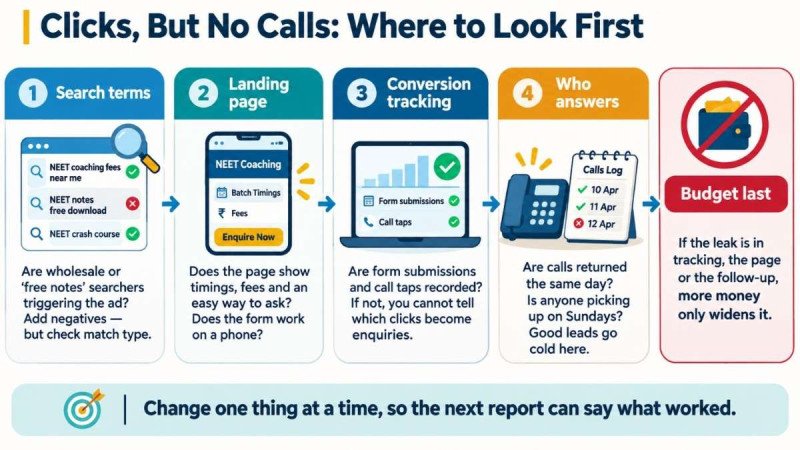
Open the search terms report, and you may find that “NEET coaching fees near me” and “NEET notes free download” both triggered the ad. The first person is probably comparing institutes. The second wants study material and is unlikely to join. Negative keywords can filter out the second kind, but match type decides how much they block. A broad match negative blocks searches containing all of its words in any order, phrase match needs them in sequence, and exact match blocks only that precise search. Adding “free” as a phrase negative would also block searches such as “free demo class NEET”, which the institute would want. A more specific negative such as “notes free download” may avoid excluding those useful searches.
If clicks look healthy but enquiries are few, the landing page is the next suspect. Batch details, timings and a way to ask about fees should be visible, and the form should work properly on a phone. Conversion tracking is another thing to check. Without tracking form submissions and call clicks as conversions, you cannot easily tell which clicks are bringing enquiries.
Sometimes the cause sits outside the ad account. If calls are returned two days later, or nobody picks up on Sundays, good leads go cold, and the campaign gets blamed.
What a course can and cannot give you
Most digital marketing courses cover familiar subjects: SEO, Google Ads, social media and analytics. Where they differ is in what happens to your work after you submit it. A worksheet that comes back with a mark tells you very little. You do not learn whether your keyword list was sensible or only passed. A course in which you build a campaign for a specific business, and a trainer tells you that half your keywords are terms no customer would type, gives you something to fix and a reason why.
A trainer who has managed real campaigns can explain decisions that a slide cannot, such as why a small budget may work better with a narrower keyword set in one city. When you compare courses, ask to see a sample assignment with the comments students received. The checklist on what to check before choosing a digital marketing course has more questions worth asking.
For someone starting from nothing, a structured digital marketing course with practical assignments settles what to study first and gives a place where a wrong setting costs nobody anything. Some courses do include proper assessments, so a certificate does not always mean attendance alone. Even so, finishing a course does not prove you can handle a live account.
What an internship teaches depends on the work
In an agency, much of an intern’s week is small, concrete jobs: pulling keyword ideas into a sheet, drafting meta descriptions, scheduling the month’s posts, checking whether a client’s ads are still within budget, compiling Friday’s report. You work to real deadlines, and someone responsible for the client account may review what you produce. That is hard to recreate at home.
Whether any of it turns into understanding is a separate matter. Scheduling approved posts all quarter teaches a tool. Writing the first draft of an ad and seeing a senior cut half of it teaches judgment, but only if the senior has a minute to say why. Many agency teams are stretched, and reasons that seem obvious to them rarely get spoken aloud. Asking a short question, such as why a campaign targets one city and not the nearby ones, often gets a useful answer, and it helps to write the answers down.
Before accepting an offer, ask which tasks would be yours and who would look at them. Also be honest about your level. An internship assumes you can follow what is happening, and a complete beginner may spend the first weeks lost.
Learning on your own
Google Skillshop has learning paths for Google Ads and Analytics, Meta Blueprint covers Meta’s advertising tools, and the Search Console and GA4 documentation explain how the reports work. Finding learning material is rarely the difficult part. Knowing what to study next, and whether you can apply it correctly, is harder.
Without anyone to set an order, it is hard to know what to practice. You might spend a week on keyword research, then jump to reels because a video recommended it, and later realise you have never run anything to the end. Tutorials add to the confusion because many were recorded on older versions of a platform, and the screen in the video no longer matches yours. Check the date and compare with the official documentation.
The harder part is finding out whether your work is any good. A tool will accept a badly planned campaign without complaint. Deciding the business, city, budget and goal before you begin gives you something to judge the result against, even if nobody else does. GA4 shows the same problem. Finding the acquisition report is easy. Understanding which sources bring engaged visitors takes more work. Engagement rate, average engagement time and key events can help you see what visitors do after arriving.
Self-taught marketers can and do get hired, though no route guarantees it. Those who manage it tend to follow one syllabus, finish their projects and find someone experienced to look at the work now and then.
Reviewing a local business website
Choose a local clinic, tuition centre or shop and tell the owner what you are doing. Do not log in to anything or change anything without their permission.
Search for its services as a customer would, see which pages appear, and check whether the titles and snippets say what is offered and where. Open the main pages on a phone and see whether timings, address and contact details are easy to find, and whether any page cannot be reached from the menu.
If the owner gives you Search Console access, the performance report shows which queries bring impressions and clicks, and the page indexing report lists pages Google has not indexed, with reasons.
Some sites will have problems, such as service pages buried in the menu or two pages competing for the same query. Others are in good shape, and recognising that is part of the skill. Write your observations for the owner in plain language. Suggestions remain suggestions unless the owner agrees and makes the change.
Describing your projects honestly
Most freshers have no client work to show, and a portfolio does not need any. It needs honest labels. A campaign structure you planned for an imagined institute is a simulated project, and it shows how you think even though nothing was run. A blog or page of your own, where you actually published and tracked results, is a personal project. Work done for a real business with someone reviewing it counts as supervised client work. Paid campaign experience belongs only to people who managed actual ad spend and answered for the outcome.
Mixing these up tends to show quickly. A single question about the budget, or what you changed after week two, separates someone who ran something from someone who designed it. A modest project that you can defend is worth more than an impressive one you cannot. Handling a digital marketing project alone means choosing where to begin, checking that tracking works and explaining numbers to someone who is not a marketer, so even a small project gives you something real to discuss.
Talking about your work in an interview
Hiring processes differ. Some companies set a short task; others talk through work you have already done. A fresher has little work history, so a conversation about one project often shows how you think, and many of the things employers look for in a fresher digital marketing executive come out that way.
Interviewers usually want a story in order: what you were trying to achieve, what you decided and why, what you did yourself, what happened, and what you could not measure. Saying what you would change next time shows you can see the weaknesses in your own work, which is more convincing than claiming there were none.
Knowing it and doing it
Anyone can learn what a negative keyword is in an afternoon. Knowing when to add one, and which match type to use, and noticing a month later that it blocked a good lead, takes a few mistakes made on something real and someone to point them out. A course, an internship and self-study each supply some of that. Whichever you choose, the useful question to ask of it is how often it will put you in front of a problem like the shop owner’s and make you work out an answer.