You Have Learned SEO, Google Ads and Social Media. But Can You Handle a Marketing Project Alone?
Most beginners finish a course able to build a keyword list, set up a search campaign and schedule a month of posts. The first real project shows a different gap. Nobody tells you which skill to use first, what to leave alone, or what to say to the owner when enquiries have not grown.
This article follows one project from the first conversation to the first monthly report. The coaching institute in it is hypothetical. It is not a Mivja client, and none of the numbers or outcomes are real results.
“We need more students” is not a brief
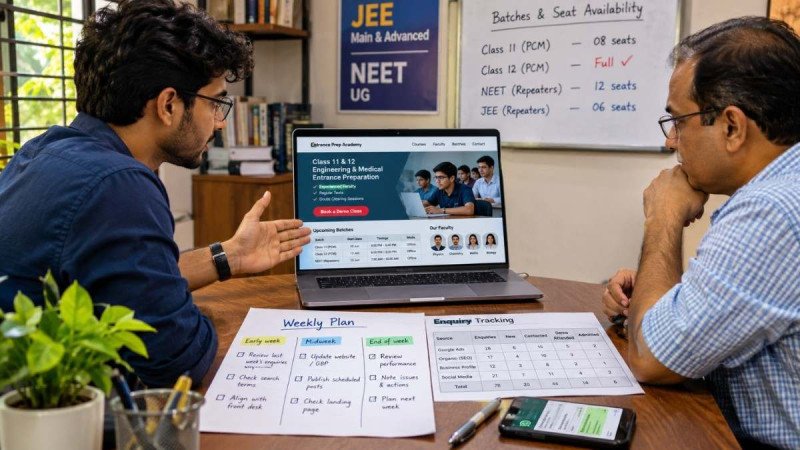
Imagine an institute in a mid-sized Indian city that prepares Class 11 and 12 students for engineering and medical entrance exams. It has a website, a Google Business Profile and active Facebook and Instagram pages. The owner says, “We need more students this year.”
That is a wish, not a brief. A brief names the batch, the buyer, the area and the budget. So before you open any tool, ask:
- Which batches have empty seats, and which are already full?
- Who decides, the student, the parent or both?
- How many enquiries come in each month, how many attend a demo class, and how many join?
- What can be spent monthly, and who answers calls and WhatsApp messages?
People tend to skip the last question. If nobody replies to an enquiry for a day, no campaign can repair that. The admission team’s response time is part of the marketing problem.
Research the market, then audit the institute
Search for the institute’s courses the way a parent would. Note who shows up in map results, ads and regular listings, then open their websites on your phone and compare batch details, faculty information and demo class offers. Results change with location, device and personalisation, so a handful of searches gives you a useful snapshot of the local market, not the whole picture. Repeating them from another area or another phone helps. You are looking for what parents cannot easily find today, not for pages to copy.
Then audit the institute’s own presence. Typical findings are course pages that describe the institute but not the courses, outdated timings on the Business Profile, and a contact form that nobody has tested.
Be clear about where each number comes from. Search Console shows the queries that actually produced impressions and clicks. Keyword tools only estimate demand, which is fine for direction. Neither will tell you what the front desk already knows, for example, that parents of Class 11 students worry about faculty changes midyear.
AI can speed up the reading, such as summarising competitor pages or grouping search terms. It can also misread a page and state the error with full confidence. That is why AI skills for digital marketers mostly come down to checking its output against the source and deciding what the findings mean.
Choose channels by problem and budget
Spreading a small budget over every channel teaches you very little. Rank the problems by how directly they stop an enquiry, then match channels to them.
| Channel | Fits when | Hold back when |
|---|---|---|
| SEO and Business Profile | People already search for these courses, and the pages are weak | Admissions are needed within weeks |
| Google Ads (search) | Searches show clear intent, and the landing page is ready | Tracking is missing, or the budget is too small to gather useful data |
| Social media | Parents need reassurance about faculty and teaching style | Nobody can post consistently or answer messages |
| Content | Common questions about batches or syllabus go unanswered | Core course pages still need fixing |
An established website may already bring enquiries through organic search, and better pages can add to that. What nobody can promise is quick admissions, so SEO alone is a weak plan when a batch must fill within weeks.
Say the weakest batch starts in two months and the Business Profile already generates calls. Repairing the profile and running a small search campaign for that batch comes first. Faculty posts can follow, and articles can wait. An institute with full batches and strong word of mouth might skip ads entirely. What matters is that you can explain the choice.
Coaching has its own pressures. Admissions bunch around exam cycles, searches are mostly local, and parents want proof before they trust a name. These are the reasons digital marketing for coaching and training institutes needs a different approach from selling a product online.
Fix the landing page before paying for clicks
Someone searching for entrance exam batch timings wants timings, not the institute’s history. When a landing page does not match what visitors are looking for, some may leave without making an enquiry. Increasing the ad budget will not solve that problem.
For this batch, the page should show the batch name, timings, mode, faculty and how to book a demo class. Show fees, or explain how to get them. Keep the form short, make the call and WhatsApp buttons easy to find, and open the page on a phone to see how it loads.
Test tracking before you judge any result. Submit the form yourself, tap the call button, and confirm that each action appears in GA4 and that the owner actually receives the enquiry. Broken tracking is worse than none, because the numbers look like evidence.
Keep the work moving with a weekly routine
- Early week: go through last week’s enquiries with the front desk and check which search terms triggered the ads.
- Midweek: make one improvement to the website or Business Profile and publish scheduled posts.
- End of week: record the key numbers and pick next week’s main task.
Keep a log of changes, dates and approvals, and change one thing at a time where you can. Otherwise, you will not know what moved the results.
Designers, developers and writers may handle parts of the work. Your job is to brief each of them clearly and keep them coordinated. Many working professionals already own one piece, like posting or reporting. The step up is owning the plan around it, and that is what taking on broader digital marketing responsibilities really involves.
When clicks arrive but enquiries do not
Two weeks in, the ads are bringing visitors, but enquiries have not moved. The beginner’s reflex is to raise the budget. If the leak is in tracking, the page or the follow-up, more money only widens it. Check in this order:
- Tracking: Is the form submission being recorded? Are calls happening that no tool sees?
- Audience: Do the search terms show people looking for free notes, another city or a different exam?
- Page: Does it answer a parent’s questions and make contact easy?
- Follow-up: Are enquiries answered quickly, by someone who can explain the batch?
Only then change things: add negative keywords, rewrite the page, fix the reply process. Budget comes last. Organic traffic without enquiries often means the content attracts the wrong readers. Social posts with engagement but no site visits may be doing an awareness job, which is fine, but likes are not admissions.
Traffic, enquiries, qualified leads and admissions
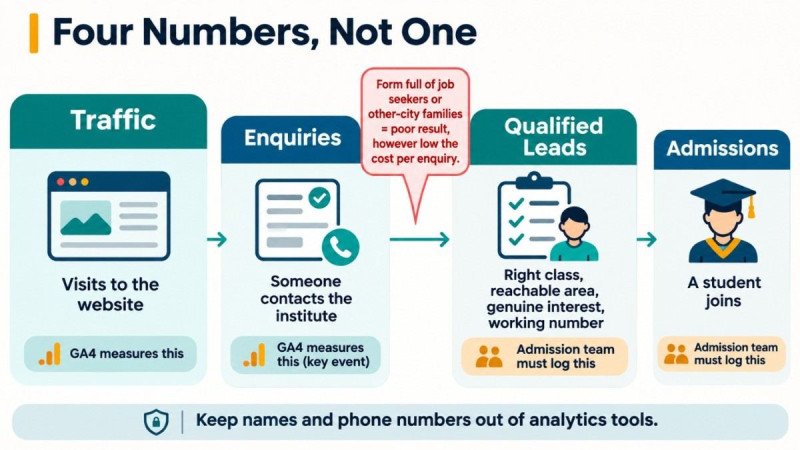
These are four different numbers. Traffic is visits to the website. An enquiry is someone contacting the institute. A qualified lead is an enquiry that fits: the right class, a reachable location, genuine interest and a working phone number. An admission is a student who joins.
A campaign can look healthy on the first two and fail on the last two. A form full of submissions from job seekers or families in another city is a poor result, however low the cost per enquiry looks.
GA4 helps with the first two. You can mark a form submission as a key event and, once GA4 and Google Ads are linked, import it into Google Ads as a conversion. Set the event to fire only after the website confirms that the form has been successfully accepted. A button click alone does not confirm that an enquiry was received. It is worth practising tracking website leads with GA4 and Google Tag Manager on a test form before you touch a client’s site.
GA4 cannot see a call made from a number on a printed flyer, a walk-in, or anything that happens after the enquiry, and it cannot tell you whether an enquiry was a good one. Keep names and phone numbers out of analytics tools.
The rest depends on the admissions team. Ask them to log every enquiry in a shared sheet with its source and a status such as new, contacted, demo attended, admitted or not suitable. Agree on what counts as qualified before the campaign starts. Without that record, you cannot connect marketing to admissions, and when the owner asks why leads did not become students, you will both be looking at the same data.
What the first monthly report should say
After a month, the owner does not need a tour of dashboards. The owner needs help deciding what to do next. Cover what you found and changed, the key numbers with a sentence each on what they mean, enquiry quality from the admissions team’s sheet, and what did not work and why you suspect it.
End with the decisions you need: keep funding ads, pause a channel, promote another batch, or change how enquiries are handled. If traffic rose and enquiries did not, say so and explain what you checked. Hiding weak results costs you trust faster than the weak results do.
Could you run this project?
- I can turn a vague request into specific business questions.
- I can learn from competitors without copying them.
- I can explain why I would skip a channel for a particular business.
- I can judge whether a landing page is ready for traffic.
- I can test that tracking works before trusting any numbers.
- I can separate traffic, enquiries, qualified leads and admissions.
- I can investigate a weak result in a sensible order before changing the budget.
- I can tell a non-technical owner what happened and what to decide.
Feeling unsure about several of these at the start is normal.
Practice on small projects first
Pick a local business with its permission, or invent one, and produce the audit, the channel decision, a weekly plan and a sample report. That portfolio lets you begin starting a digital marketing career with evidence of how you think, not just a list of tools.
Students who have just finished school can apply the same test when comparing digital marketing courses after Class 12. Ask whether a course teaches you to run projects or only to operate tools. The practical training in our digital marketing course follows that planning, execution, troubleshooting and measurement loop, although no course can replace the experience of handling a live business.
Tools can be learned in weeks. The harder skill is looking at a weak month and finding the real cause. When an owner says “We need more students,” the question is not whether you know Google Ads. It is whether the right families are reaching the front desk and joining, and whether you can show how you know.