
What Employers Expect from a Fresher Digital Marketing Executive in India
Say a manager hands a fresher last month’s Google Ads report for a coaching institute and asks, “Anything odd here?” One candidate says the click-through rate looks healthy. Another notices that much of the spend went on searches like “free online course”, and asks what each enquiry actually cost. The second has understood the campaign well enough to question the quality of the traffic and whether the reported enquiries are reliable.
That is roughly what a small task in a fresher interview is testing. This article looks at what employers watch for in the response, and how to prepare without any job history. Companies differ, so treat it as common expectations, not a fixed standard.
What a fresher is realistically asked to do
The first months usually go on defined tasks under supervision: pulling keyword data, checking titles and headings, drafting ad variations, scheduling posts, updating a weekly report. Nobody expects a fresher to run a campaign alone.
Doing the task is only half of it. If you are asked to update the weekly report, you should know what the figures represent, which dates they cover and who reads the report, and ask when any of that is unclear.
Job titles can also mislead. A “Digital Marketing Executive” listing may be written for someone with a year or two of experience, so check the eligibility line before applying.
What each channel looks like in actual work
In SEO, the starting point is search intent. Someone searching “dentist near me” is often looking for a nearby clinic, while someone searching “causes of wisdom tooth pain” is more likely seeking information and may never book. A fresher should be able to say which of the two a page serves. Search Console helps here, because its performance report shows which queries led to your pages appearing in Google results and how many of those turned into clicks. Our piece on what SEO work looks like across a normal week covers this further.
In Google Ads, the keywords you bid on are not the same as the search terms people actually typed, and the search terms report shows the difference. If an interior design campaign is attracting searches for free design software, you can add negative keywords, though these have their own match settings and do not automatically cover variations. Check what you have really blocked, and recheck the search terms report after changes to see whether irrelevant searches continue.
Traffic needs the same scrutiny. A coaching institute’s visits may double after publishing a blog on free study notes, yet admissions may remain unchanged because many visitors are looking for free resources rather than a paid course. Before suggesting any change, a fresher needs to know who the business wants to reach and what a good result looks like.
Social media is judged against what the post was meant to do. A reel with thousands of views may have real awareness value even if it brings no enquiries. A plain post about opening hours that brings genuine enquiries may be more useful when enquiries are the objective. Not every post needs to generate leads, but each should have a purpose.
Content work is mostly checking facts, writing for the reader and not the keyword, and cutting what says nothing.
GA4 automatically collects some events, while Enhanced Measurement can track additional interactions when enabled. Other actions, such as phone-number clicks or custom form interactions, may need separate configuration. A fresher should check whether the relevant event is being recorded and whether it represents a genuine enquiry. After all, more recorded activity does not necessarily mean better business performance.
Opened a tool versus used it
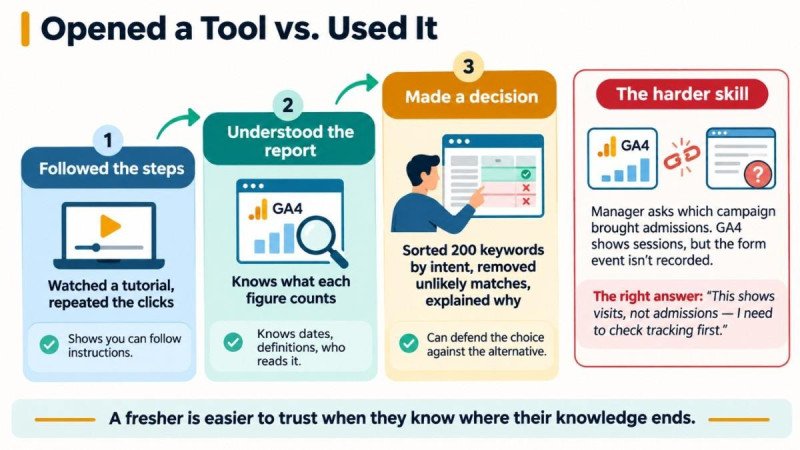
Watching a tutorial shows you can follow steps. Understanding a report means knowing what each figure counts. Using it well means making a sensible decision from it, such as sorting 200 keywords by intent in Google Sheets, identifying the keywords that are unlikely to match the business's target audience, removing them from the shortlist and explaining why.
The harder skill is noticing when a report cannot answer the question. Suppose a manager asks which campaign brought admissions, and GA4 shows sessions, but the relevant form submission event is not being recorded. The sensible reply is, “This shows visits but not admissions, so I need to check the tracking first.”
A small portfolio, honestly labelled
Not every employer asks for a portfolio, and you do not need client work to show how you think. Two or three well-explained pieces can be a useful starting point. A keyword sheet could list the terms you selected, the ones you rejected, and why. A sample Google Ads structure for an imaginary local business could state your assumed budget, location and keyword groups. A one-month social calendar could be built around a named audience and purpose. For reporting practice, Google’s public GA4 demo account holds real e-commerce data from the Google Merchandise Store.
Interviewers tend to ask how a project was done because it quickly shows whether you did the work and understood it: what you assumed and what you could not verify. A walk-through of handling a small project from brief to report shows how many such decisions there are.
Be clear about what each piece is. A project you started yourself, a course assignment, an internship task and paid client work are different kinds of evidence. Never invent results or present practice work as client work.
The ordinary habits employers notice
A manager says, “Improve our campaign.” A dependable fresher asks what improved means: more enquiries, a lower cost per enquiry, better quality leads, or something else. They do not need to know the strategy already. They need to know what they are aiming at.
The same person tells the manager on Tuesday that a report will be a day late, instead of going quiet. They revise an ad draft after feedback without a debate. If they used the wrong date range, they say so and correct it before anyone else finds it. And when they do not know something, they say they will find out.
Agency, brand team or startup
Responsibilities and supervision depend more on the actual team and manager than on the company type. One agency may put a fresher across several client accounts, while another keeps juniors on one account under a senior. A brand team may go deep into one business or stretch one person across many channels. Ask who will review your work and how often. We have compared agency, in-house and startup first jobs in more detail.
Using AI without trusting it blindly
Say you ask a tool to group 300 search terms for a signage business by intent. It saves an hour, but you spot-check thirty rows and find “free logo maker” filed under people ready to buy a signboard, and “shop name board price” marked as informational. You regroup them, note what went wrong and tell your manager the first pass was not reliable.
Follow whichever tools your employer has approved and its data-handling rules. Do not enter customer names, phone numbers or other client information into a public AI tool without proper authorisation. There is more on how AI is changing the skills digital marketers need.
What an interview assignment might involve
Some companies only talk, others set a short task, and there is no standard process. A task might involve listing on-page problems on a given page in ten minutes, suggesting keywords for a local dental clinic and explaining what each searcher wants. You might see three ads with clicks and enquiries and be asked which to pause.
Interviewers in these situations tend to watch a few things: how you start, whether you ask for missing information such as the goal or the date range, how you prioritise when everything looks wrong, whether you explain your reasoning, and whether you admit what the data cannot establish. A question about why traffic rose but enquiries did not suits this well, because there is no single right answer, only a sensible order of checks.
Before you apply
Take one project and explain it aloud, in five minutes, to someone outside marketing. Say what the problem was, justify one decision against the alternative you rejected, name one thing you could not verify, and say what you would look into next. If you can explain it clearly and answer those four questions honestly, it is ready to be included in your portfolio.
A fresher is easier to trust when they know where their knowledge ends and are willing to say so. That honesty also makes them easier to train.
If you would prefer guided practice while developing these skills, you can explore our digital marketing course.