
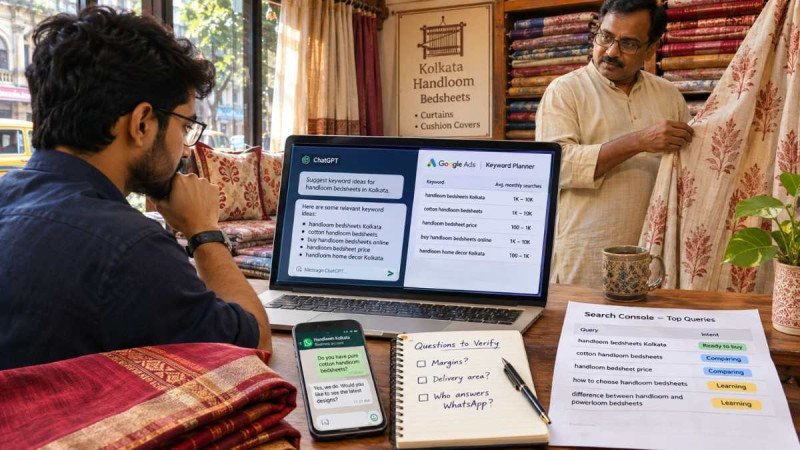
How to Use AI to Complete a Digital Marketing Project: A Practical Workflow
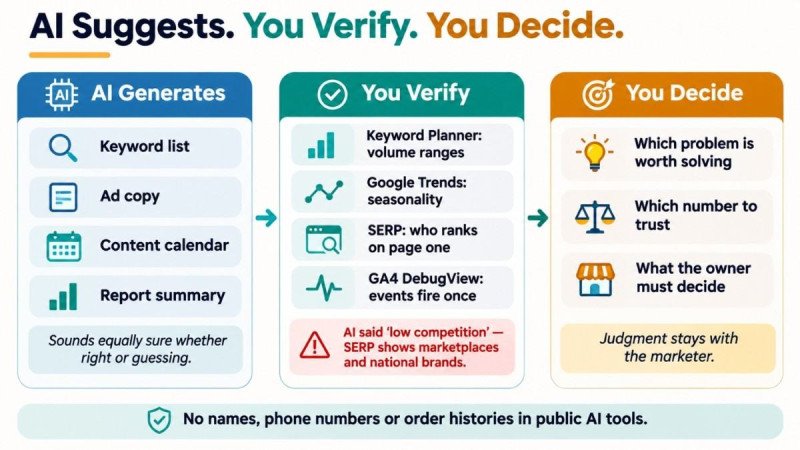
AI will hand you keywords, ad copy, a content calendar and a report summary in minutes, and all of it reads as if it were right. The tool sounds equally sure whether it is right or guessing, so quality depends on how you brief it, what data you give it and what you check before anything reaches a budget or a customer.
This workflow follows one project from first message to monthly report. The business, Rang Ghar, is a fictional Kolkata shop selling handloom bedsheets, curtains and cushion covers; its numbers and decisions are illustrative, not real results.
Ask AI what the brief is missing
The owner writes, “We want more online orders before the wedding season.” Paste that into a chatbot, and you get a tidy plan, because the model has quietly assumed a budget, a delivery area and someone answering WhatsApp.
A better first task is to make it hunt for gaps.
Below are the owner’s message, my call notes and the product list. List the missing facts that would change the plan: margins, delivery area, budget, stock, target customers, existing sales channels, repeat purchases, and capacity to handle extra orders. Assume nothing. Group the questions by who can answer them.
Take those questions to the owner, not back to the model. Suppose curtains carry the best margin, delivery covers Kolkata and nearby districts only, and WhatsApp messages sometimes wait a day. Bedsheets are what people search for; curtains are what pays. Bedsheets may bring customers in, and curtains could then be cross-sold, if real buying behaviour supports it. That tension is a strategy decision, so the objective should reflect it: more qualified enquiries for bedsheet sets from deliverable areas, with confirmed orders counted separately. The same questions open this look at how to handle a marketing project alone.
Research with AI, then measure with real tools
Give AI material, not just a topic: Search Console queries, three competitor product pages, and customer questions from WhatsApp. Remove names, phone numbers, addresses and order IDs; removing names alone does not anonymise anyone.
Here are 120 Search Console queries, three competitor pages and 15 customer questions. Group the queries by intent: learning, comparing, ready to buy. List the customer questions that no competitor page answers. Label each finding as found in the material, a reasonable inference, or needing verification. Do not invent search volume, keyword difficulty, ranking positions or competitor traffic. Identify which findings require validation through external tools.
Now a realistic failure. Say the model recommends “cotton bedsheets online India” as high volume and low competition. Without live search data, that is a likely-sounding sentence, not a finding. Keyword Planner shows volume, often as ranges. Google Trends shows whether demand swings with wedding season. The results page shows who you are up against: If page one is dominated by marketplaces and national brands, a small shop may find it difficult to compete for that query. “Handloom bedsheets Kolkata” may carry stronger local buying intent, but its demand and competition still need checking, and Search Console shows whether the site already earns impressions. No single source settles it, as this comparison of keyword research tools shows; such checking is a large part of what an SEO professional actually does.
Let AI argue the strategy, then decide yourself
Strategy is where a model is least reliable, because the answer depends on facts it lacks. Use it as a sparring partner: give it the verified brief, budget range and research summary, and ask for the best case for two channel mixes and what would make each fail. For Rang Ghar: Google Business Profile with local content, against a small Google Ads test plus festival posts on Instagram.
The choice turns on what only the marketer can judge: how soon orders are needed, whether anyone can post weekly, whether bedsheet margins survive paid clicks. Record the decision and why.
Build content, ads and posts from facts you supply
SEO content. Ask for an outline, and the questions buyers still have after a competitor’s page. The substance must come from the shop: the weave, behaviour in Kolkata humidity, washing care. Google’s guidance says generative AI can help with research and structure, while its spam policy targets many pages made mainly to manipulate rankings, regardless of how they are produced. Usefulness matters, not the tool. It also says models predict likely wording rather than retrieve facts, so AI-generated content, including titles and alt text, should be checked manually before publishing.
Search ads.
Write six Google Search headlines for handloom bedsheets, with the character count beside each, and flag any over 30. Use only these facts: cotton handloom, queen and king sizes, delivery in Kolkata, order on WhatsApp. Make sure every claim matches the landing page. Do not add discounts, certifications, reviews or any unverified benefit.
Without that last line, models add “certified”. Count characters yourself; models miscount. Google's generative asset feature in Performance Max has its own eligibility requirements. The language used in the Google Ads interface and the landing page both matter. Check Google's current requirements before assuming the feature can generate assets for a Bengali landing page. Review generated assets before publishing.
Social media. AI can draft a festival calendar and captions; a person checks dates, Bengali or Hindi phrasing, prices, photographs and tone.
Test tracking before spending a rupee
Ask AI for a launch checklist and a UTM naming convention, then test both. Submit the form, tap the WhatsApp and call buttons on a phone, and confirm each action appears once in GA4. DebugView shows events as they arrive. For a closer look at how this works, check out our explanation of tracking website leads with GA4 and Google Tag Manager. An event that fires on a button click instead of a completed submission will flatter every report that follows.
Read the numbers without mixing them up
Traffic, clicks, enquiries, qualified leads and confirmed sales are five different things. For Rang Ghar, a qualified lead is someone in a deliverable area asking about a stocked product, and a sale exists only when the order is confirmed. GA4 will not automatically know that an enquiry became a confirmed order in the shop’s register. That information needs to be recorded separately or connected through an appropriate measurement setup.
Each week, export the latest two weeks from GA4, Search Console, Google Ads and Instagram Insights, remove personal details, and ask:
First check whether the date ranges and metrics are comparable, whether any data is missing, and whether tracking looks inconsistent. Then compare the two weeks, showing absolute figures beside percentage changes, and note where small starting numbers make percentages misleading. Flag unusual movements and list questions to investigate. Do not explain causes.
Without pasted data, a chatbot’s “analysis” is invention. Verify every figure in the platform.
When clicks arrive but enquiries do not
Two weeks in, ads earn clicks but few enquiries. Paste the exports and ask for explanations ranked by cost to test. Candidates: an untracked WhatsApp button, search terms drawing wholesale buyers, an ad promising what the page does not show, no prices, slow replies.
Treat that list as hypotheses. Tap every contact route, read the search terms report, open the page on a phone, check reply times. That is the order used when diagnosing a site that gets traffic but no enquiries. Change one thing at a time, so the next report can say what worked.
What stays with the marketer
Customer data. Names, phone numbers and order histories do not belong in public AI tools without authorisation and safeguards. India’s Digital Personal Data Protection Act, 2023 covers digital personal data. Its 2025 Rules take effect in phases: PIB describes an 18-month compliance timeline, with different provisions starting on different dates. Which obligations apply to a given business, and when, is a question for a qualified adviser.
Judgement. Originality and brand reputation need a person’s check.
Report, decide and keep a log
A monthly report says what was done, what the verified numbers show, what is still a guess, and what the owner must decide. AI can draft it from verified figures and help plan next month:
Based on the verified campaign data, recommend three actions for the next month. For each, give the supporting evidence, expected business benefit, potential risk and what to check before implementing. Separate recommendations from confirmed findings.
The recommendation is still yours. If traffic rose and confirmed orders did not, say so plainly.
Keep a short log of what AI suggested, what you checked and what you decided. Over time it shows where the tool misleads you. That is how judgement gets built, and employers increasingly look for it, as how AI is changing the skills digital marketers need explains.
Execution is getting cheaper. Knowing which problem is worth solving and which number to trust is not. Learners who want to practice this loop on live projects can look at our digital marketing course.