The AI-Era Digital Marketing Stack: A 5-Layer Framework for Indian Businesses — And What Students Should Learn to Build It
What Is an AI-Era Digital Marketing Stack?
A digital marketing stack is not a shopping list of software. It is the set of connected capabilities a business needs to find the right customers, reach them, understand what worked, and keep improving — with generative AI and AI-mediated search now woven through most of that process rather than sitting to one side of it.
That distinction matters more in India this year than it did two years ago. India crossed 958 million active internet users in 2025, an 8% year-on-year rise, and 44% of them have used AI-enabled features such as voice search, image search, and chatbots, according to the IAMAI–Kantar Internet in India Report 2025. Rural India, which now accounts for roughly 57% of the country's active internet users (about 548 million), is growing nearly four times faster than urban India — a finding about overall internet-user growth, not specifically about AI-feature adoption, though it points in a similar direction. A business's marketing stack now has to work across a market that is simultaneously larger, more AI-literate, and more fragmented across languages and geographies than it was even a year ago.
Why Do Indian Businesses Need a Connected Digital Marketing Stack?
The pieces of digital marketing — search visibility, paid acquisition, content, analytics, AI tools — are usually sold and taught separately. In practice, they only work as a system. A business that runs Google Ads without conversion tracking cannot tell whether the spend is working. Skipping foundational work can undermine otherwise well-executed campaigns: a well-run ad aimed at the wrong audience, or a page that answers the wrong search intent, can still perform poorly.
Google and the India SME Forum's 2026 report, The Google Dividend: Measuring Digital Commerce's Contribution to India's Economic Future, based on a primary survey of 3,249 Indian MSMEs, found that 66% of surveyed enterprises reported expanded market access after adopting digital tools, 58% reported improved customer acquisition, and nearly 60% reported double-digit revenue growth. Separately, Vi Business's 2026 MSME Growth Insights Study — drawn from its ReadyForNext advisory platform, which has engaged with more than 2.5 lakh MSMEs — found that 57% of surveyed enterprises view AI as a core driver of business growth, though only 25% have actually integrated AI into their workflows so far; its Digital Maturity Index rose from 58.0 in 2025 to 60.8 in 2026. Both studies are self-reported and largely correlational rather than controlled comparisons, but taken together they point to reported gains in market access, customer acquisition, and digital maturity among the businesses they covered.
What Are the Five Layers of the AI-Era Digital Marketing Stack?
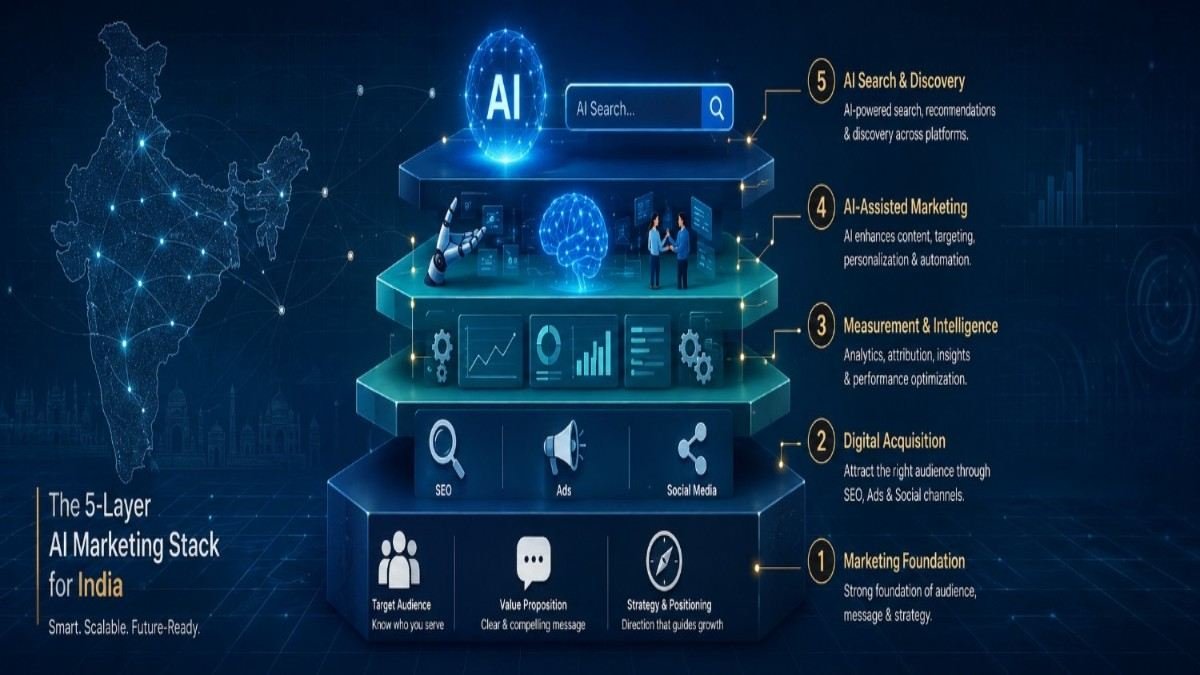
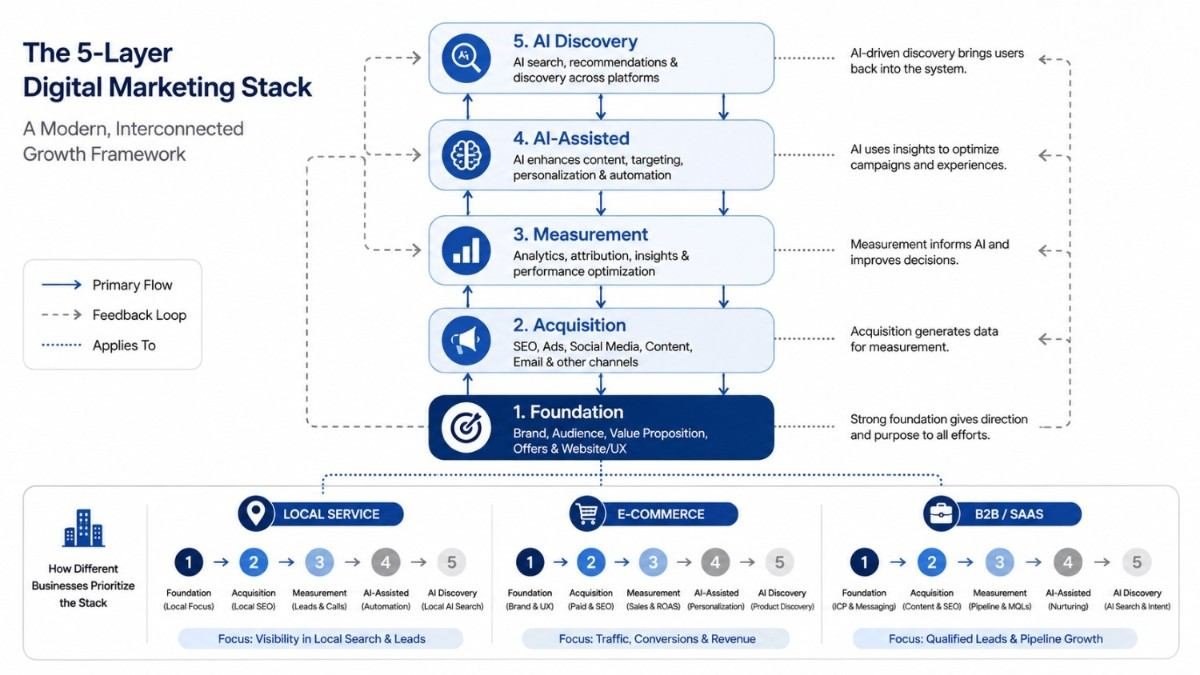
Five layers hold up well as a way to organise the stack, provided they are treated as interdependent rather than sequential. Measurement does not sit neatly inside one layer; it runs through all of them. AI is similarly both a distinct discovery layer and a horizontal capability touching every other layer. The five layers are an organising framework, not five isolated departments. The value of the framework is in showing the dependencies between capabilities, not in prescribing a fixed technology stack.
Layer 1: Marketing Foundation
Before any channel or tool, a business needs clarity on who it is trying to reach, what those customers need, why they should choose this business, and what a successful conversion looks like. This layer covers audience definition, positioning, search intent, messaging, and the offer itself.
Layer 2: Digital Acquisition
This is where a business reaches people: SEO (including technical and local SEO), paid search and social advertising, organic social media, content marketing, and email. Acquisition channels differ enormously by business type — a local clinic depends on Google Business Profile and local search, while a B2B software company depends more on content and lead generation — which is why acquisition strategy has to follow from Layer 1, not precede it.
Layer 3: Measurement and Marketing Intelligence
Measurement is not installing GA4 and calling it done. It is the discipline of knowing what is working, what is not, and what to change, through conversion tracking, attribution, dashboards, and genuine interpretation of the numbers. A business can have flawless acquisition and still lose money if nobody is reading the data correctly.
Layer 4: AI-Assisted Marketing
Generative AI now assists research, first drafts, data exploration, ideation, and repetitive workflow tasks across every other layer. It does not replace the judgement that decides what to do with that assistance. The AMA's 2026 State of Marketing Careers Report, which surveyed 1,412 US marketing practitioners and scored 35 marketing skills on Stanford's Human Agency Scale, found that execution-heavy skills — SEO, paid media, performance analytics, email marketing, copywriting — sit in the most automatable tier, while marketing strategy, brand management, and critical thinking sit in the least automatable, human-led tier. This is primarily US-weighted research, so it should be treated as international context rather than Indian labour-market evidence. The report also identifies discernment and quality control among the capabilities marketers should strengthen as AI takes on more execution-heavy work.
Layer 5: AI Search and Discovery
As AI-generated answers become part of more search and conversational experiences, businesses increasingly need to consider how they remain discoverable beyond the traditional ranked-results page. Terms like AEO (answer engine optimisation) and GEO (generative engine optimisation) are used inconsistently across the industry and are not yet standardised disciplines with agreed methods. What the evidence does show clearly is that different AI search systems frequently draw on different sources for identical queries. A 2026 study accepted at the ACM SIGIR conference — Grossman et al., "How Generative AI Disrupts Search" — compared the sources retrieved by Google Search, AI Overviews, and Gemini Flash 2.5 for the same 11,500 queries and found an average source overlap of less than 0.2 on a standard similarity measure. In that study's representative real-user query set, AI Overviews were generated for 51.5% of queries. That has a direct practical implication: optimising for one AI system's citation behaviour does not guarantee visibility in another.
For businesses, the practical response is not to optimise for a single AI platform. It is to make the business itself easy to understand: clearly state what it does, who it serves and where it operates; keep important information consistent across its website and business profiles; and publish useful, well-structured answers to the questions customers actually ask.
How Do the Five Layers Work Together?
None of the five layers functions in isolation. Foundation shapes what acquisition channels are worth pursuing. Acquisition generates the data that measurement interprets. Measurement tells a business where AI-assisted workflows would help most, and where they would not. AI-search visibility can benefit from many of the same foundations that support strong traditional search visibility — useful content, topical coverage, clear information, and trustworthy sources — though AI systems do not necessarily use the same ranking mechanisms as traditional search. Mastering Topical Authority for SEO Success makes the point that comprehensive, trustworthy coverage of a subject is now something both search engines and AI systems draw on, which is one reason Layers 2 and 5 increasingly reinforce rather than compete with each other.
When Should a Business Invest in Each Layer?
Not every layer needs equal depth at every stage. A useful discipline is to build capability in the order a business can actually use it.
A local service business — a clinic, tutor, salon, or retailer — often gets the most value from Foundation, local-first Acquisition (Google Business Profile, reviews, local SEO), and basic Measurement, before investing meaningfully in advanced AI-search monitoring.
An e-commerce business typically needs product-level SEO, paid acquisition, and conversion-focused Measurement earlier, with AI-assisted content and retention workflows layered in as volume grows.
A B2B or SaaS business tends to need Foundation and content-led Acquisition first, since B2B buying cycles often reward search intent and topical depth, with AI-search visibility becoming more relevant as competitors adopt it.
An education or training business may benefit from local search, content, and reviews early, since decision-making in this category leans heavily on trust signals.
These are illustrative patterns, not universal rules — the underlying point is that capability should be built before complexity is added. A small business does not need a marketing automation platform, multi-channel attribution, and an AI-visibility monitoring tool before its Google Business Profile is complete and its analytics are actually being read.
What Type of Search Queries Matter in AI-Driven Discovery?
Different search intents likely behave differently across traditional and AI-mediated search, and a stack has to account for that variation rather than treat "search" as one channel. As a practical matter — not a precisely measured one — informational queries ("what is technical SEO") are widely observed to be the queries most often answered directly inside an AI Overview without a click. Comparative queries ("SEO vs paid advertising for a small business") and commercial-investigation queries ("best digital marketing agency in Kolkata") tend to still draw users toward multiple sources before a decision. Transactional queries ("buy SEO software") and local queries ("digital marketing institute near me") tend to remain more click-driven, because the user needs to complete an action a summary cannot finish for them. This is a practical framework practitioners use to prioritise content, not a set of measured India-specific statistics.
What is measured, and worth treating as a real signal: SparkToro's June 2026 analysis of Similarweb clickstream data found that 68.01% of US Google searches ended without a click in the first four months of 2026, up from 60.45% in 2024. This is US-specific data and should be read as a directional signal for India rather than a precise Indian number, since comparable India-specific zero-click data remains limited. Complex conversational queries — the kind increasingly typed into ChatGPT or Google's AI Mode — reward content that answers a genuine question thoroughly, not content built primarily to rank for a keyword.
How Is AI Changing SEO and Digital Marketing Without Replacing the Fundamentals?
AI is not replacing SEO, content writing, or analysis — it is changing which parts of those disciplines are worth a person's time. Keyword lists, first-draft copy, and basic reporting are increasingly automatable. Judging which keywords actually match real customer intent, verifying whether a draft is accurate and useful, and deciding what a report implies for the next campaign are not. A global job-postings analysis cited in the AMA's 2026 report found that content marketer postings fell 11% and SEO specialist postings fell 15% between 2024 and 2025, even as senior strategic and analytical roles held steady — global data, not an India-specific labour-market finding. The implication is that execution alone is becoming less differentiated, while the ability to direct, evaluate, and improve that execution becomes more valuable — a distinction that matters as much for a solo Indian small-business owner running their own AI tools as it does for a large in-house marketing team.
What Should Students Learn to Build the Stack?
Mapped to the five layers, a student building real capability needs: from Foundation, an understanding of audience, intent, and conversion, not just definitions of these terms; from Acquisition, working knowledge of SEO, local SEO, paid media, and content, ideally demonstrated through a real project rather than a certificate alone; from Measurement, the ability to read GA4 and Search Console data and explain what it means; from AI-Assisted Marketing, practice in verifying AI output rather than only generating it; and from AI Search and Discovery, a working sense of how AEO and GEO concepts relate to established SEO principles like topical authority and structured content.
India's talent-market data supports learning the logic over the tools. The India Skills Report 2026, released by ETS in collaboration with CII, AICTE, AIU, and Taggd, draws on insights from more than 100,000 candidates through the Global Employability Test alongside industry responses, and found national employability rose to 56.35%, with more than 90% of employees already using generative AI tools at work — meaning tool access is no longer the differentiator it once was. What separates candidates now is whether they can explain the decisions behind a real project. Anyone comparing structured options can start with best digital marketing course in Kolkata, which sets out what different programmes actually cover.
What Should Businesses Look for When Hiring Digital Marketers?
A CV listing fifteen tools is not automatically stronger than a candidate who can walk through one real campaign and explain why they made the decisions they made. For hiring managers, a more useful test can be whether a candidate can explain the reasoning behind a real project — an SEO audit, a small ad campaign with results, a piece of content built around genuine search intent — rather than a list of software names. The skills that hold up under AI adoption, based on research into how AI is reshaping marketing roles, include marketing fundamentals, data interpretation, the ability to verify AI-generated output before it reaches a customer, and communication grounded in business outcomes rather than vanity metrics.
Where Is the Digital Marketing Stack Heading?
The five layers will not stay static, and the specific tools inside each one will keep changing faster than any course or article can track. What is more durable is the relationship between them: Foundation gives Acquisition a target, Acquisition generates the data Measurement depends on, Measurement tells a business where AI-Assisted Marketing actually saves time versus where it just produces faster mistakes, and AI Search and Discovery increasingly rewards much of the same information quality that good SEO has always required — just distributed across more systems that do not always agree with each other. A business, student, or marketer who understands that chain of dependency will still be able to reason about the stack years from now, long after today's specific AI tools and search features have been replaced by the next ones.
Sources and Further Reading
- IAMAI & Kantar, Internet in India Report 2025
- Google and India SME Forum, The Google Dividend
- Vi Business, MSME Growth Insights Study 2026
- American Marketing Association, 2026 State of Marketing Careers Report
- India Skills Report 2026
- How Generative AI Disrupts Search
- SparkToro, 2026 Google Zero-Click Research