Best Digital Marketing Courses in India
Open ten different digital marketing course pages, and you will notice they all say roughly the same three things: practical training, expert mentors, strong placement support. None of that helps you choose, because the actual programmes behind those sentences can be almost nothing alike. A three-month weekend batch and an eleven-month postgraduate diploma will both describe themselves that way.
What follows is a look at fifteen programmes currently running in India, put together from each institute's own published course information rather than from other comparison articles. They are presented in no particular order and are not ranked against each other, since a college student with a spare year and a working professional with two free evenings a week are not really shopping for the same thing, even when they type the same search query.
How to Choose a Digital Marketing Course in India
Most of what separates a course you will be glad you took from one you will regret is not visible on the landing page. It shows up a few weeks in, once the novelty wears off.
Digital marketing is several adjacent skills stitched together: SEO, paid ads, social media, content, analytics, and increasingly AI-assisted work across all of it. A syllabus that lists forty topics but gives each an hour teaches less than one that covers fifteen properly, so the gap between courses usually comes down to how much time is spent on each area rather than how many are listed.
Hands-on work separates programmes more than curriculum breadth does. There is a real difference between watching someone else set up a Google Ads campaign in a recorded video and running one yourself, picking a budget, writing the copy, watching how it performs over the following days. Written exercises and quizzes do not close that gap; live or semi-live campaigns on real accounts do.
Institutes are also staffed differently. Some run on full-time trainers, some are the training wing of a working marketing agency, and several blend recorded lectures from senior people with live sessions run by junior facilitators. None of these setups is inherently better, but each shapes how current and specific the guidance turns out to be, along with how much direct access you get to a mentor versus a pre-recorded video.
Format matters more than people expect going in. A rigid in-person weekday schedule is hard to sustain alongside a full-time job, and a fully self-paced course can be harder to stick with than expected for someone who needs the structure of physically showing up somewhere.
A certificate issued by the institute itself mainly confirms that someone finished the course. One tied to a university, a business school, or a platform like Google or Meta carries somewhat more independent weight, since the curriculum has usually been reviewed or co-built with that partner. What "placement assistance" actually covers also varies a great deal: resume help and mock interviews are a different offer from direct hiring connections or an internship placed inside a working agency. Running through a short set of checks before choosing a digital marketing course before enrolling tends to surface most of these gaps before you have paid anything.
15 Digital Marketing Courses Worth Considering in India
The programmes below range from a few weeks to almost a year in length, and from a nominal registration charge to several lakhs in cost. They appear here in no particular order, and their position in the list does not reflect how good any of them are. Fees are given as they appear on each institute's own official page, where that could be confirmed. Where a fee could not be confirmed on the institute's own current enrolment page, this is stated plainly rather than using a figure sourced from a third-party listing.
Mivja
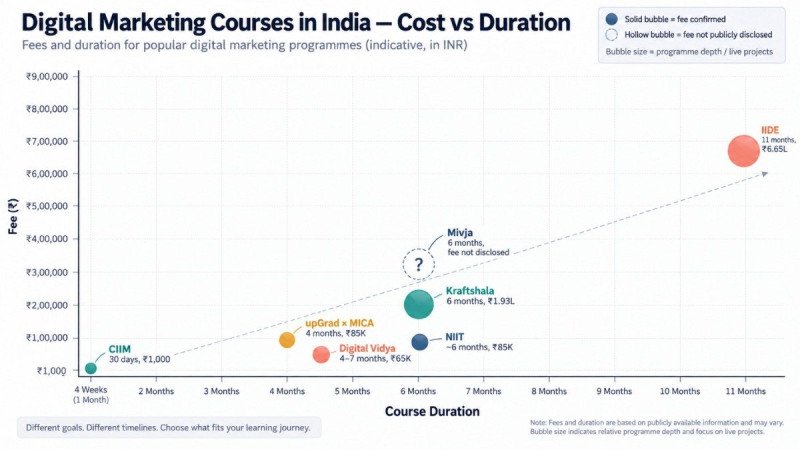
Mivja runs a six-month digital marketing course out of Kolkata, structured around five broad areas: SEO, Google Ads and PPC marketing, social media marketing, content marketing, and analytics and strategy. Online learning is the main format, though classroom and in-person sessions are also available around Kolkata. On the SEO side, the course covers on-page, off-page, technical and local SEO, including Google Business Profile optimisation, and works with Google Search Console, WordPress-based SEO tools, SEMrush and Google Analytics 4. The paid media component uses Google Ads and Keyword Planner, and the social media portion works through Meta Business Suite. Rather than teaching AI as a separate unit, the course folds it into tasks students are already doing, such as keyword and search intent research, content outlines, and testing ad copy variations. Assignments include SEO audits and campaign exercises, alongside mentorship and portfolio guidance. Fee not publicly disclosed.
Digital Vidya
Digital Vidya has run its Certified Digital Marketing Master programme since 2009, and its current AI-integrated version, marketed as the Certified AI Digital Marketing Master (CADMM), spans four to seven months, mixing self-paced material with live virtual sessions across more than forty modules covering SEO, SEM, social media, content and analytics. Digital Vidya's own site currently lists the programme fee at ₹65,000, with EMI options available. Digital Vidya reports placement support backed by several hundred hiring partners and a long history of corporate training work alongside its individual courses.
IIDE
IIDE describes itself as a digital business school, and its main product bears that out: an eleven-month Post Graduate Programme in Digital Marketing, with an optional Business Strategy specialisation for candidates who already have some work experience. It runs out of Mumbai, with a further campus in Delhi, and teaching follows what IIDE calls a "Learn, Apply, Evaluate" method built around live brand campaign work rather than classroom theory alone. IIDE's own current fees page lists the base eleven-month programme at ₹6,65,000, with the Digital Marketing and Business Strategy specialisation at ₹8,85,000. The same page also lists shorter options: an Advanced Certification in Digital Marketing at ₹1,25,000 and a Professional Certification in Digital Marketing and Strategy at ₹1,80,000, alongside scholarships of up to 25 to 35% of the programme fee depending on academic and financial criteria. IIDE holds recognition from NSDC, MESC and NASSCOM, and reports a placement rate in the low nineties percentage range with several hundred hiring partners, a figure that comes from IIDE's own materials rather than independent verification.
Kraftshala
Kraftshala's Marketing Launchpad runs on live campaign work rather than lectures, with a project bolted on: performance marketing, SEO, content, social media, e-commerce and programmatic advertising, using real ad budgets across more than 920 hours and nine or more completed projects, over six months full time or around eleven months part time. Kraftshala's own site currently lists the fee at ₹1,64,000 plus 18% GST, coming to about ₹1,93,520 in total, with EMI options starting around ₹7,200 a month. The programme also carries a fee refund condition: if a graduate is not placed in a marketing role paying at least ₹4.5 lakh a year within fifteen months of finishing, Kraftshala refunds 60% of the fee. That is not a job guarantee; Kraftshala reports a 94% placement rate, so a meaningful minority of students do not clear the threshold within the window. Mentors come from professionals who have worked at companies including Unilever, Nykaa and Zomato, and a separate merit and need-based access track exists for students who cannot cover the fee upfront.
upGrad + MICA
MICA, an institute for communications and marketing education, designs the curriculum and supplies faculty here, while upGrad handles online delivery. The core programme, currently marketed as the Advanced Certificate in AI-Powered Digital Marketing and Communication, runs for four months as a base track and extends by roughly six weeks for each additional specialisation a student adds, up to five. upGrad's own current pricing page lists the core programme fee at ₹84,999, payable through a no-cost EMI option starting around ₹2,708 a month, rising to about ₹1,85,000 if all five specialisations are added. Teaching mixes recorded MICA faculty lectures, live sessions with industry mentors, case studies and live projects funded on Meta and Google. Graduates receive MICA Executive Alumni status alongside the certificate itself, a different credential from what a standalone institute certificate offers.
NIIT
NIIT's digital marketing programme has been reworked since its earlier "Digital Marketing with Generative AI Edge" branding. It now runs as the AI Digital Marketing Professional Program on NIIT's platform, a 300-hour, AI-first curriculum covering SEO, GEO and AEO, paid search, social and Meta ads, CRM, and analytics, delivered over roughly 25 weeks online. NIIT's own current course page lists the fee at ₹85,000 plus 18% GST, with a concession bringing the upfront payment to ₹80,750 plus GST, and a refundable ₹1,500 token booking fee to secure a seat. The syllabus is built to prepare students for Google Skillshop certifications and the Meta Certified Digital Marketing Associate exam. Placement support exists for eligible learners, with attendance, score and age conditions attached, so it is not automatically available to every enrolled student.
Digital Scholar
Digital Scholar's four-month course, available live online or through classroom batches in Chennai, organises students into small teams that work more like a working marketing agency than a lecture class, with assignments built around live ad budgets rather than simulations. The syllabus covers website basics, social media management, paid search and display advertising, copywriting and email automation. Its AI component moves as a structured progression: prompt engineering, then a set of generative AI tools, then workflow automation, rather than sitting as a single bolt-on module. A separate, longer postgraduate programme is also offered, priced substantially higher than the four-month course. Fee not publicly confirmed on the current official enrolment page.
DigiPerform
DigiPerform, headquartered in Noida with classroom centres across a large number of Indian cities alongside its online offering, runs a ladder rather than a single flagship course: a shorter Digital Marketing Specialist course as an entry point, a longer Master Programme spanning around twenty-five specialisation areas, and a top tier, sometimes marketed as a "mini MBA in AI digital marketing", that adds a mandatory internship and extra modules on D2C marketing and YouTube monetisation. Fee not publicly disclosed: DigiPerform's centres price courses differently by city and format, and no single current figure could be confirmed for the exact tier described here. DigiPerform states it has trained more than 75,000 individuals and runs a five-step placement process including resume preparation and mock interviews.
DSIM
DSIM, the Delhi School of Internet Marketing, spreads its curriculum across somewhere between thirty-six and forty modules, delivered through a blend of classroom and online sessions. Students build and manage their own website or blog across the duration of the course, so the SEO, content and analytics lessons apply to something the student actually owns rather than a hypothetical case handed out as homework. The course also walks students through Google certification exams alongside HubSpot certifications, and includes a section specifically on affiliate marketing and monetisation. Fee not publicly disclosed: published listings vary by DSIM branch and were not confirmed on the institute's own site. DSIM operates primarily out of Delhi NCR, with an expanding footprint in other cities.
Brandveda
Brandveda, based in Ahmedabad with training also available in a few other Gujarat cities, runs a roughly three-and-a-half-month course covering website analytics, content marketing, SEO, paid advertising across Google and social platforms, email marketing and mobile marketing. Learners get an assigned mentor for one-to-one guidance alongside the regular batch sessions. Both online and classroom formats are available, and the institute reports having trained tens of thousands of students over more than a decade. Fee not publicly disclosed.
Aviv Digital
Aviv Digital is the training arm of Acodez, a web and digital agency based in Kochi with offices in a few other Indian cities, and that connection shapes how the course runs: students get access to live projects inside a working agency rather than only simulated case studies. The core programme is a diploma running roughly five to six months, with an advanced diploma extending further, available offline through the Kochi and Calicut campuses or online elsewhere. The syllabus covers SEO, SEM, social media marketing, and email and inbound marketing, and the institute holds Google Partner status alongside a government-recognised certificate. Fee not publicly disclosed.
Web Marketing Academy
Web Marketing Academy's Modern Digital Marketing Certificate Course is classroom-based out of Bengaluru's Indiranagar, running for around four months and including over two hundred hours of instructor-led time, with a live project attached to each module. The institute has run since 2002, which predates most others on this list by close to a decade, and it has been associated with organisations including Christ University and an IIM Bangalore digital marketing workshop on specific occasions. It describes a "lifetime mentorship" approach, where former students can return for guidance after finishing, and its placement assistance is described as continuing until a student secures a role rather than being capped at a fixed period. Fee not publicly disclosed.
Seven Boats Academy
Seven Boats Academy, based in Kolkata, functions as the training side of a working digital marketing agency, so students doing internships here work inside an actual agency setting rather than a simulated one. It offers a genuinely tiered range within one institute: a compact short certification, a three-and-a-half- to four-month specialisation course with an attached internship, a six-and-a-half- to seven-month diploma, and an advanced diploma stretching past a year. Classes run in English, Hindi and Bengali, and the internship component is paid rather than unpaid. The curriculum covers SEO, social media marketing, Google Ads, analytics, marketing automation, and some grounding in WordPress and cPanel. Fee not publicly disclosed.
CIIM
CIIM, the Chandigarh Institute of Internet Marketing, holds Google Partner status and ISO 9001 certification, and runs its own ladder: a thirty-day introductory certification carrying a nominal ₹1,000 registration fee with a seven-day refund policy, a longer Advanced Digital Marketing and AI Certification course that includes an internship, and a Professional Diploma running around seven months for the fullest version. Fees for the two longer tiers are not publicly disclosed on the institute's site, which asks prospective students to contact it directly. The introductory tier gives prospective students a way to explore the subject before committing to a longer programme. CIIM reports having trained well over 100,000 students since 2010, with a curriculum spanning SEO, PPC, social media, content and web analytics, and AI tools built into the more advanced tiers.
Which Digital Marketing Course Fits Your Goal?
The fifteen programmes above sort more usefully by what they demand of you than by any single quality ranking.
If you are starting from zero, the practical question is whether a syllabus explicitly builds from fundamentals or assumes you already know what a keyword or a conversion rate is. Mivja's six-month course starts with a broader digital marketing curriculum, while CIIM also offers an introductory tier before its longer programmes. The two take different approaches to someone who is new to the subject.
College students with a flexible schedule tend to get more out of the longer, project-heavy end of this list, such as IIDE's eleven-month postgraduate track, Kraftshala's live campaign model, or Digital Scholar's agency-style teams, since there is time to absorb material at that pace and something concrete to show an employer before finishing a degree.
Working professionals are usually better served by format than by syllabus depth. The upGrad + MICA programme is built around recorded faculty content plus live sessions, which makes it easier to manage alongside a full-time job than an institute running purely on real-time instruction.
Anyone planning to freelance should look specifically at what a course does with client-facing skills. DSIM has students build and run their own website throughout, and Seven Boats' internships are paid, but neither published syllabus explicitly covers finding or pricing client work, so it is worth confirming this directly rather than assuming it is included.
Business owners learning for their own company may prioritise direct application over the depth of a postgraduate-style programme. A shorter course covering areas such as local SEO, social media and paid advertising may be sufficient when the objective is to manage marketing internally rather than prepare for a specialist marketing role. If this describes your situation, it is worth reading a more focused breakdown of what a digital marketing course for small business owners should actually cover.
What a Digital Marketing Course Should Actually Teach
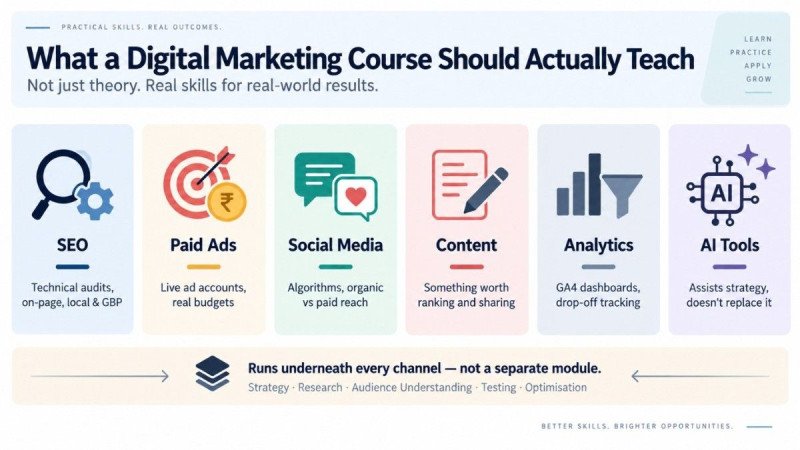
A meaningful SEO module goes beyond keyword lists and covers technical site health, on-page structure, and local optimisation such as Google Business Profile, areas where ranking factors shift often enough that a one-week overview leaves real gaps. It should also look close to what an SEO professional actually does day to day: running audits, fixing technical issues, and tracking how changes affect rankings over weeks rather than hours.
A paid advertising module should put students inside an actual ad account, since budgeting and conversion tracking matter as much as writing the ad copy itself, and mistakes on a live account cost money immediately in a way a simulation does not.
A social media component worth the name covers how each platform's algorithm surfaces content and how paid boosting interacts with organic reach, rather than only a posting calendar.
Content marketing and analytics tend to run underneath both of those. Content gives search and social something worth ranking or sharing, and analytics, particularly reading a GA4 dashboard and tracing where visitors drop off, is the skill that applies regardless of which channel a student ends up specialising in.
AI now shows up across most of these areas rather than as its own topic: speeding up keyword research, drafting a first pass at ad copy or a content outline, and making sense of analytics data faster than doing it by hand. The skills employers expect from digital marketers now assume some comfort with these tools, but they are most useful to someone who already understands the underlying strategy well enough to judge whether what the tool produced is actually any good. Used as a substitute for that understanding, AI tends to produce generic output that a client or employer notices quickly.
How Much Does a Digital Marketing Course Cost in India?
Fees among the programmes above run from a nominal registration charge for a short introductory course to several lakhs for a postgraduate-style programme, and the range tracks a handful of factors rather than being arbitrary. Duration is the most obvious one: an eleven-month programme costs more to run than a four-month one. Live teaching and mentoring intensity matters too, since one-to-one or small group guidance is inherently more expensive to deliver than a recorded course watched by thousands of students. Built-in internships and real budget live projects add further cost, and so does university or institutional affiliation, since a certificate co-branded with MICA or a partner university typically costs more than a standalone one, reflecting the partner's name as much as anything added to the teaching itself. None of this makes the most expensive course automatically the best, or a lower-priced one automatically weaker. It is worth being clear on which of these factors you are actually paying for before comparing prices across institutes, and confirming the current figure directly with the institute, since course fees, and sometimes even which university a programme partners with, change more often than course comparison pages are updated.
Is a Digital Marketing Course Worth It?
A certificate on its own does not carry much weight with employers or clients, who increasingly want to see actual work: a campaign that ran, a website that was optimised, content that measurably performed. Structured learning helps here mainly by giving a beginner a curriculum, feedback, access to real tools, and a mentor to check work against, rather than leaving them to work it all out alone. What it cannot do is remove the need to practise independently once the course ends. Digital marketing is a genuinely growing field, but no course can promise a specific salary or a guaranteed job, and any claim that sounds too certain is worth some scepticism.
Online vs Offline Digital Marketing Courses
Online training removes the location constraint and adds flexibility around timing, which matters for anyone working full-time, and recorded sessions allow revisiting material a physical classroom does not offer. The trade-off is that it demands more self-discipline, since there is no physical presence pushing attendance. Classroom training gives a fixed schedule, in-person access to a trainer for immediate doubt clearing, and classmates to compare notes with, useful for learners who need that structure to stay consistently engaged, at the cost of being tied to a specific city. Hybrid formats, which several of the institutes above now offer for the same syllabus, combine elements of both and let the choice come down to how you actually work rather than which format an institute happens to specialise in. The choice between an online vs offline digital marketing course usually comes down less to which format is objectively better and more to how consistently you can show up to each.
FAQs
Which digital marketing course is best for beginners?
There is no single best option, but a beginner should look for a programme that explicitly builds from fundamentals rather than one that assumes prior knowledge, along with enough live or semi-live practical work to build a small portfolio by the end.
How much does a digital marketing course cost in India?
Anywhere from a few thousand rupees for a short introductory certificate to several lakhs for a postgraduate-style programme, depending on duration, mentoring intensity, and whether a university or platform partner is attached.
How long does it take to learn digital marketing?
Many comprehensive, job-oriented courses run for three to eight months. Shorter certificates exist for specific skills, while postgraduate-style programmes can run close to a year.
Is online digital marketing training effective?
It can be, particularly when it combines live sessions with recorded material and includes real campaign work rather than only video lectures. Several of the longer-running institutes above deliver their entire programme this way.
Do digital marketing courses include practical projects?
Most of the programmes covered here do, though the depth varies considerably: some involve live ad budgets and real client work, while others rely more on written exercises and simulated case studies.
Is certification necessary for a digital marketing career?
Not strictly. A certificate from a university or recognised platform can provide additional external validation, but employers and clients may still place greater emphasis on practical work and demonstrated skills.
Can I learn digital marketing while working full time?
Yes, though the format matters more than the syllabus here. Programmes built around a mix of recorded content and live sessions tend to tolerate a missed class better than ones that run purely on real-time, in-person instruction.