Why a Trustworthy Online Presence Matters for Doctors in India
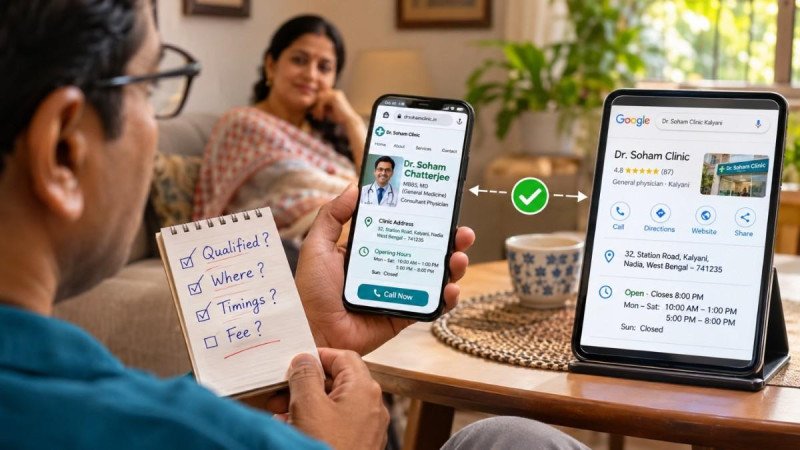
Before booking an appointment, most people want a few plain answers. Is the doctor qualified in the right speciality? Where is the clinic, and when is it open? What does a consultation cost?
Usually they start with Google. A patient finds the doctor’s name, opens the clinic website and notices, or doesn’t, whether the information matches. Those first few minutes shape what they think of the clinic before anyone has picked up the phone.
Where the details usually go wrong
If the Google listing says the clinic opens at 10 and the website says 11, the patient has to guess which one is right. The same happens when one page lists a qualification that another leaves out. A patient who travels to an old address, or rings a number that now belongs to someone else, blames the clinic, not the listing.
Your registration number needs the same care. Keep it accurate and identical on the website, the Google listing, directory pages and social profiles.
What the NMC’s guidelines mean in practice
Doctors in India also work within the NMC’s professional guidance on what they can say publicly. The most recent piece is the Guidelines on Ethical Advertising and Public Communication, issued on 6 October 2026, which sit alongside the NMC’s existing conduct regulations.
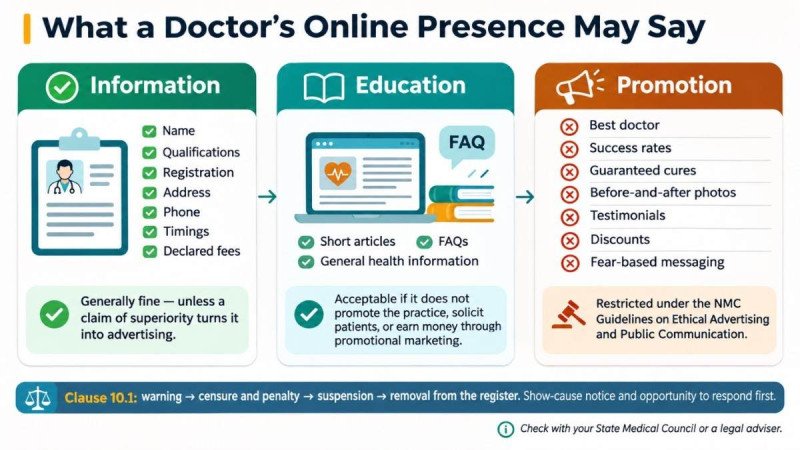
The useful question is whether a piece of content tells patients something they need to know or tries to persuade them to choose you. Basic details such as your name, qualifications, registration number, clinic address, contact information and consultation timings help patients understand your practice. The important thing is to present them accurately, without turning factual information into claims of superiority or guaranteed results. Health education is welcome too, as long as it is not a disguised pitch for your clinic.
Promotion is where the restrictions start. Claims of being the best, guaranteed cures, success rates, patient testimonials, before-and-after photographs, discount offers and fear-based messaging are all areas the guidelines restrict, though not in identical ways. Some are ruled out for promotion altogether. Others, such as case photographs or fee announcements, depend on the purpose and how they are presented. If you are unsure where a particular post falls, check the guidelines or ask your State Medical Council.
Why ordinary local SEO advice does not always fit a doctor
Most guides to optimising a Google Business Profile or ranking in local searches are written with shops, salons and restaurants in mind, and a medical practice cannot copy that checklist as it stands. Some businesses actively encourage customers to leave reviews or add descriptive keywords to their profile names. Doctors need to approach these practices differently because professional rules also apply to how they present themselves online. A doctor needs more care with both, and a name like “Best Cardiologist” is a claim of superiority, not a name.
What works is plain accuracy: the doctor’s name as it appears on the signboard, the correct address, consultation hours, fees if you publish them, the right category and genuine photographs of the clinic. Google expects the profile name to match the real-world name on signage and stationery, so a name stuffed with keywords risks suspension anyway.
Nobody can guarantee a position in local search results, and the NMC guidelines specifically rule out manipulating reviews or search rankings to create a misleading impression of a doctor’s standing.
What patients should find without hunting
Someone who opens your website should not have to click through four pages to learn whether you see patients on Saturdays. The basics belong on the first screen, or one click away: your name and qualifications, registration number, clinic address with a map link, phone number, consultation days and timings, and a plain description of what you treat.
Appointment forms work best when they are short. A name, phone number and preferred time are enough for a first request. Leave out the medical history. Collecting symptoms or reports through a general web form without a clear need creates a privacy risk, and the doctor will ask in the consultation anyway.
Educational content and using AI carefully
A short FAQ on when a child’s fever needs attention, or an explainer on what to expect before a scan, helps patients arrive better informed. These pieces work best when the doctor has read every line, the language is plain, and sources are named where they exist. A line saying that general information is no substitute for an examination is worth adding.
AI tools can speed up drafting, but they can also get medical details wrong. Anything AI-assisted needs the doctor’s careful review and fact-check, and patient information should never be pasted into general-purpose tools. The NMC also places restrictions on AI-generated promotional campaigns and synthetic endorsements. Whatever the tool, the doctor should review the content before it is published.
Reviews, testimonials and replies
Fake and paid reviews are clearly out. The guidelines also say a doctor should not request or share patient testimonials or reviews for promotion on social media. Nothing spells out how that applies to Google reviews, so it is sensible to avoid pressuring patients or offering anything in return. A patient’s consent does not, by itself, make a prohibited testimonial acceptable.
Negative reviews are harder to deal with. Reply briefly and politely, and never confirm that the reviewer was your patient or mention anything clinical, even to correct something untrue. “Thank you for the feedback, please contact the clinic so we can look into it” is enough.
Social media
Doctors’ posts should show their name, qualifications, registration status and registration number. A doctor’s name, photograph, voice or professional status should not be used to endorse a medicine, device or any other health or commercial product, paid or unpaid. Clinical cases should only be shared for scientific or educational purposes, with appropriate patient consent and identifying details removed. A patient's face, name or other identifying information should never appear in a casual promotional post.
Visits are not appointments
A website can get plenty of visitors and still produce no appointment enquiries. Plenty of visitors but few enquiries usually points to missing information or a confusing form, not a shortage of traffic.
To see where the gap is, look at a few places. Google Search Console shows how people reach the site, and the Business Profile shows calls and direction requests. GA4 can record form submissions and call taps as key events once you track leads with GA4 and Google Tag Manager. Confirmed appointments are best noted at the front desk, since online tools cannot see them.
Hiring an agency is not a simple decision for an individual doctor
It is natural to think of handing all this to an agency. For an individual registered medical practitioner, it is not that simple. NMC professional guidance places restrictions on registered medical practitioners engaging third parties to market their medical services, and publishing through an agency or influencer does not remove the doctor’s responsibility for content they authorised or knowingly allowed. An individual doctor should not assume that hiring a digital marketing agency to promote their medical services is permitted. If an arrangement is unclear, ask your State Medical Council or a qualified legal adviser.
A good deal of the useful work involves no promotion at all, and a doctor can do it personally. That means matching the name, qualifications, registration number, address, hours and phone number across every profile, correcting outdated directory entries, and knowing who owns the website domain and the Google accounts and who approves anything published in your name.
Hospitals and medical institutions are in a different position, with separate provisions of their own.
Where outside digital support fits for hospitals and healthcare organisations
For hospitals and medical institutions, our digital marketing services focus on accurate information across locations, local SEO, Google Business Profile management and relevant healthcare content, subject to applicable rules. Social media and paid promotional campaigns need separate assessment under the NMC rules on promotion. The work is focused on helping healthcare organisations keep their public information accurate and accessible.
Start with the basics
A clinic does not need to publish something every day. A sensible starting point is checking that the phone number, address, timings and website information are current, and checking again whenever any of them change. Nobody remembers that a clinic skipped a post last week. They remember the number that did not connect when they called.