
Choosing a Training Institute? What Should You Check Before You Enrol?
Most training providers describe themselves in nearly identical terms. Experienced faculty, hands-on learning, live projects, placement support. Those phrases may all describe legitimate parts of a course, but they have been used so often that the words alone no longer tell you much. The useful question isn't which pitch sounds more convincing. It's what you can actually check before you pay.
What Are You Actually Solving For?
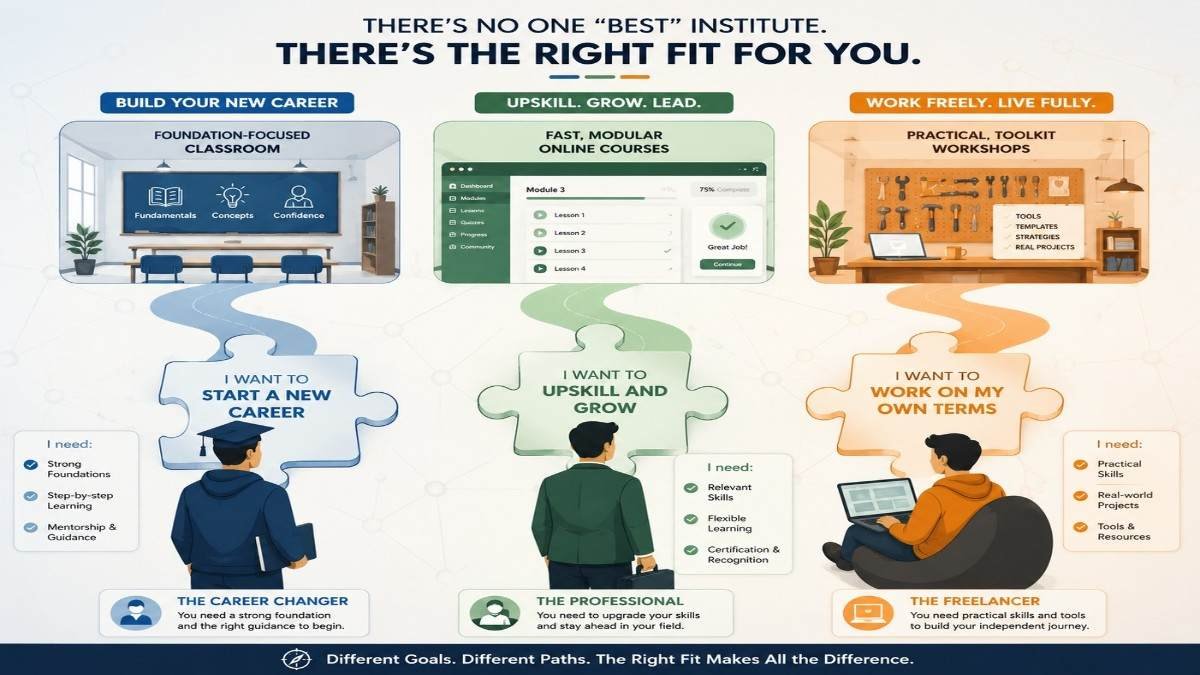
A course that suits one person can be wasted on another, and this has little to do with how good the institute is. Someone changing fields entirely usually needs the reasoning behind a discipline, because sooner or later they'll meet a situation the syllabus never covered. Someone upskilling inside a job they already hold often wants something narrower: two or three specific capabilities, taught quickly, without much surrounding theory. A freelancer serving small local clients tends to need a working toolkit more than an academic grounding.
Skip this step, and you'll end up comparing a slow, thorough programme against a fast, tool-heavy one as though they're competing for the same seat. Write down, in one sentence, what you actually need. Everything else gets measured against that.
Does a Longer Syllabus Mean a Better Course?
A syllabus lists topics. A curriculum decides what a learner needs to know first, how much time each idea deserves, and where practice and feedback actually happen inside the schedule. A long syllabus often hides the absence of the second, and module count on its own says very little about quality.
One practical way to test this: ask what a learner needs to understand by week four for week six to make sense. An institute that has genuinely designed its sequence can answer in specifics. One that hasn't tends to fall back on "you'll build up progressively," a phrase that sounds reasonable and commits to nothing. If you're weighing this for a digital marketing programme specifically, this more detailed checklist covers ground that doesn't belong here.
What Does an Experienced Trainer Actually Bring to a Classroom?
Knowing a subject well and being able to teach it to a beginner are different skills. Plenty of capable professionals struggle to explain their own reasoning, simply because they've never had to break it down for someone meeting it for the first time. Some of the better trainers are, in fact, people who chose to stay closer to teaching than industry, because explaining clearly is what they've spent years practising.
What's actually observable in a counselling call or a demo is narrower than a resume. Whether the trainer explains why a decision was made, not just how to execute it. Whether they can handle a question that falls outside the planned material. Whether they can tell where a learner's thinking went wrong, rather than simply marking the answer incorrect. None of this guarantees a good course, but it can give you useful evidence before you commit.
When Does "Practical Training" Actually Become Practical?
Picture four learners going through the same course, under the same label. One watches a task demonstrated and takes notes. One follows instructions to reproduce it. One attempts it independently, with no correction, and moves on regardless of the result. One attempts it, gets something specific wrong, receives feedback on exactly what to fix, and tries again before the class continues.
All four get called hands-on training. Practice becomes more useful when it comes with specific feedback and a chance to act on it. A class where mistakes get caught and reworked before a topic closes is a different experience from one where the learner is expected to notice their own errors later, alone. Ask which one you're actually being offered.
What Makes Project Work Worth the Time?
Nearly every institute mentions live projects, and the phrase itself has largely stopped telling you anything. What matters is what the learner is actually responsible for deciding.
A project becomes more useful when the learner has to make decisions rather than simply fill in a template, and when someone reviews the work before it is considered finished. A carefully built simulated brief can sometimes push harder decisions than a real client project, because there's no business risk attached to getting it wrong the first time. What tells you a project mattered is simpler than any of this: can the learner explain, afterwards, what they decided, why, what went wrong, and what they changed as a result?
What Does Placement Support Actually Cover?
The phrase can mean interview preparation, résumé support, job leads passed through a network, mock interviews, recruiter coordination, or occasionally direct hiring arrangements. Career support is something an institute can genuinely build and deliver. Employment depends on a great deal more than any course controls, including the learner's own effort, the state of the hiring market that particular month, and how an actual interview goes.
Ask what's included under the phrase, specifically, and what isn't. How placement language tends to get framed and qualified across a particular market is worth reading for the pattern, separate from any single institute's pitch.
How Much Should a Certificate Influence Your Decision?
A certificate documents that someone finished something structured. It doesn't document that they can do what the course claimed to teach. In many hands-on fields, what actually carries weight with an employer or client is demonstrable: a project the learner can walk through, a problem they can solve in front of someone, a decision they can defend under a follow-up question. Certificates aren't worthless. They matter for formal eligibility in some fields, and they're a reasonable signal that someone completed a structured programme rather than a scattered set of tutorials.
What Can Reviews Actually Tell You?
Generic praise, "great institute, highly recommend," could describe almost anything, which is exactly why it doesn't describe much. A review that names a particular trainer's clarity on a particular topic, or a support team that actually replies after enrolment, or a recurring complaint about vague placement promises, carries far more information than a star rating. Recency matters too. A course that was strong three years ago may have changed trainers or structure since, without the review page reflecting it.
What Can a Demo Class Really Prove?
A demo is a useful sample. Watch the pace, whether questions get welcomed or brushed aside, whether the trainer explains reasoning rather than only narrating steps. It remains a sample, not proof of the whole programme. A strong demo doesn't guarantee every later session matches it, and a mediocre one doesn't necessarily mean the full course is weak.
Is the Course Fee Telling You Enough?
A fee tells you what you'll pay. It doesn't tell you what you'll receive. Two institutes charging nearly the same amount can offer very different levels of trainer access, practice time, feedback and project support, and none of that shows up on the invoice. Before paying, get clarity on total duration, how much of the course is live instruction versus recorded material, whether feedback is genuinely built into the schedule, and whether any support continues once the course technically ends. If you're weighing an online course against a classroom one, the practical differences between the two formats are worth understanding before comparing prices at all.
Which Answers Should Make You Pause?
One unclear answer during a counselling call usually isn't meaningful. Counsellors have off days, and some genuinely good institutes explain themselves badly on a first conversation. A pattern is different. If questions about curriculum sequencing, trainer background, what "practical" means in this specific classroom, and what the fee covers are all met with the same generic reassurance, the repetition tells you more than any single vague answer could.
Can a Good Institute Still Be the Wrong Choice?
Yes. A provider can be genuinely strong and still be a poor fit for a particular learner. Someone with no prior exposure to a subject may need a slower, more foundational course than someone moving in from an adjacent field. Someone working full-time needs a schedule that fits around it. Someone who learns best through conversation may struggle in a format built around recorded lessons, however well produced they are.
Fit depends on existing knowledge, the specific objective, available time, preferred learning style, required depth and budget. Anyone comparing digital marketing programmes specifically can look at what a structured programme actually covers to see how much of this plays out in practice, since the theory only matters once you can see how it's applied week to week.
What Should You Be Able to Answer Before You Pay?
- What exactly will you learn, in what order, and why that order?
- Who is teaching you, and what do you know about their current work?
- What will you personally practice, hands-on, versus watch?
- What will you actually decide inside any project work, and how is it reviewed?
- What support, if any, continues once the course ends?
- What does "placement support" mean here, specifically?
- What are you paying for, itemised, not just as one total?
If most of these have specific answers, you're in a strong position to decide. If several stay vague, that's a reason to ask again before you sign anything.