

What People Check Before Choosing a Doctor, Course or Local Business
A student who wants to learn digital marketing opens three institute websites in separate tabs. One has a detailed syllabus but does not say who teaches it. Another lists certificates and software logos and little else. The third describes the projects students will work on but does not publish its fees. The student is left with more questions than answers and starts looking elsewhere: reviews, a Maps listing, a friend who enrolled last year.
A patient choosing a doctor or a family looking for an electrician goes through much the same routine. Each wants to know whether the option in front of them is genuine and right for their situation. What they can find out, and how easily, depends a good deal on what the clinic, institute or shop has put in front of them. The same information also matters to the people running these places, who need to know what customers are looking for.
Why People Check Even After a Recommendation
A relative’s recommendation still counts for a lot when someone is choosing a clinic or a coaching centre. Some people take it at face value. Others type the name into Google first, where the results and the Maps listing usually show an address, phone number, opening hours and a rating before they open a single website. A good rating next to the right address is reassuring. A listing that shows the clinic as permanently closed, or gives no hours at all, can be enough to make someone hesitate.
What a Patient Wants to Know Before Choosing a Doctor
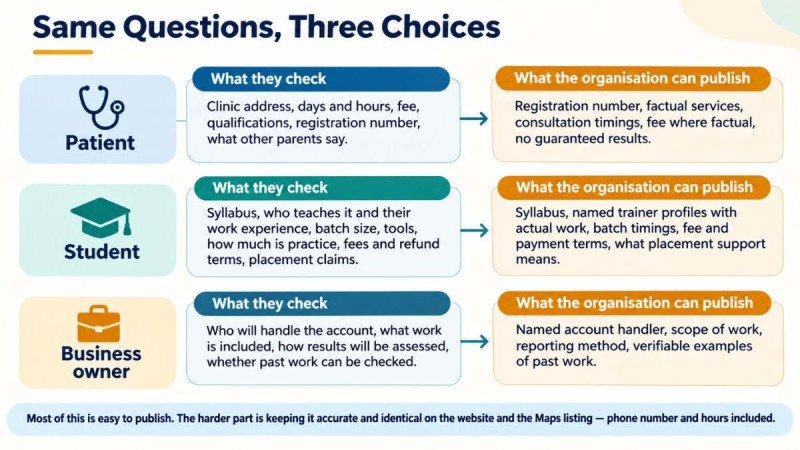
A family that has moved to a new city and needs a paediatrician will look at the practical things first: where the clinic is, which days and hours the doctor sees patients, the fee, and what other parents say. Qualifications come next, and some people also check the registration number on the National Medical Commission’s Indian Medical Register. The register carries a note that its data is being updated, so if a search finds nothing, that is not proof the doctor is unregistered. The relevant State Medical Council can confirm the details. Registration itself establishes only that the doctor is registered. A claimed specialisation, years of experience or hospital affiliation has to be checked separately.
The NMC’s guidelines distinguish between factual information and communication intended to promote medical services. They place restrictions on the latter. These limits are set out in the NMC’s Guidelines on Ethical Advertising and Public Communication by Hospitals/Medical Institutions and Registered Medical Practitioners. The guidelines prohibit guaranteed cures and exaggerated or unverifiable success claims. Comparative claims such as “best” or “No. 1” come with a condition. They are allowed only when they can be objectively verified through a transparent, independently ascertainable methodology, and only if they are otherwise permissible under applicable law. Fake, paid or misleading reviews are prohibited. Patient testimonials and endorsements are restricted for promotion. A doctor publishing online is expected to give their name, qualifications, registration status and SMR/NMR registration number.
That shapes what a trustworthy online presence for doctors in India looks like: qualifications and registration number, the clinic’s address, consultation days and hours, and the services offered, described factually and without promises of results.
The Questions Students Ask Before Joining an Institute
A trainer’s teaching ability cannot be checked against a register, so the evidence has to come from the institute: what the syllabus covers, who teaches it and what work experience they have, how many students share a batch, which tools are used, and how much of the course is practice rather than lecture. Fees matter because they are usually paid before the first class, and students should understand the refund terms before enrolling. Placement claims need the most careful reading. A student can reasonably ask what is being promised, to how many students, and how it could be checked.
All of this is information an institute can put on its own website: the syllabus, a short profile of each trainer, batch timings and the fee. Whether it does so is a basic decision in digital marketing for coaching and training institutes, and a student reading three websites in a row will notice the difference.
How Location Changes the Search
Where a student lives changes what the comparison looks like. In Barasat, the choice is between the digital marketing institutes in town and the journey to Kolkata, so travel time and cost weigh as much as the syllabus. In Durgapur, a student going through the courses on offer will mostly be reading curricula closely: which tools are taught, and how much of the course is hands-on work and how much is lecture. In Siliguri, the first thing to check about a course advertised for the city is whether it has a classroom there at all, or is taught online or from somewhere else.
What a student sees when searching from any of these places also depends on how Google ranks local results. Google’s own help pages say they are decided mainly by three things: relevance, distance and prominence. Relevance is how closely a business profile matches what was searched for. Distance is measured from the place named in the search, or from where the searcher seems to be. Prominence is how well known the business is, and Google gives links from other websites and the number of reviews as examples. Because of distance, two people searching for the same thing from opposite ends of a city can be shown different businesses. These factors help Google decide which businesses appear in local results, but they do not tell someone how good the service will be. Judging the service still means visiting, sitting in on a demo class or talking to someone who has used it.
A Search Result Does Not Settle the Decision
Take an institute that appears near the top for a course search. The student opens its website and finds no named trainers, a fee page that says “contact us”, a batch calendar from an earlier session and a phone number that differs from the one on its Maps listing. The institute might be excellent. The student has no way of knowing, and the next result is one tap away.
Rank is no guide to the teaching or the fee’s worth, so the student is left to judge from the pages themselves. With two phone numbers in circulation, they cannot even tell which one reaches the institute. A mismatch like this costs more at a clinic. A patient who travels across town on the strength of the hours shown on Maps and finds the door shut has lost an afternoon.
Reviews help, but each is one person’s account of one experience, and a high rating on its own tells a reader little. A rating gives a quick impression, but it does not explain what people actually experienced. It is more useful to see what the reviewer actually describes, whether the comments are specific and recent, whether the same complaint keeps coming up, and how the organisation replies. India has a standard, IS 19000:2022, setting out principles and requirements for collecting, moderating and publishing online consumer reviews. The Bureau of Indian Standards’ certification scheme for it assesses an organisation’s review process. It does not certify the reviews themselves. Readers still need to look at what the comments actually say.
What Organisations Need to Say Clearly
For a doctor, credentials come first. A clinic website that names its doctors but leaves out registration numbers makes patients do extra work, and the NMC guidelines expect doctors who publish online to state them. For an institute, the equivalent is a profile of each trainer with their actual work. “Industry expert trainers” without a name gives a student nothing to weigh.
Fees are the next thing people look for. Doctors may publish fees where the disclosure is factual and not misleading, and institutes can publish course fees and payment terms. A visitor who cannot find even a range may simply look elsewhere. Services need explaining too. A course name or a treatment name means little without a line on what it involves and who it suits.
A reply to a critical review shows how an organisation handles complaints. It is still only the owner’s side of the story. Doctors need to take care not to disclose anything that could identify a patient.
The same checking applies to a business owner. Someone choosing a digital marketing agency in Barasat, or anywhere else, needs answers to a similar set of questions: who will handle the account, what work is included, how results will be assessed and whether examples of past work can be checked. Clinics have an extra consideration when they hire an agency. The NMC guidelines place strict limits on third-party promotion of medical services, and doctors remain responsible for promotional content they authorise or allow to be published.
The Decision Still Depends on What People Find
For a patient, a student and a business owner alike, the checking starts after the recommendation or the search result, not before it. What settles the decision is what each of them can confirm for themselves: a registration number, a trainer’s background, a fee, who is responsible for the work. Most of this is easy for an organisation to publish. The harder part is keeping it accurate and the same on the website and the Maps listing, including the phone number and hours, because that is where people compare one source with another.