
How to Rank #1 on Google
A client once handed me her analytics dashboard and said, "I've read seventeen articles about SEO, and I still don't know what to do on a Monday morning." Seventeen. Every single one of them promised a formula, a checklist, a "proven system." None of them told her the one thing that would have actually helped: there isn't a formula. There's a trust account, and you either pay into it consistently or you don't.
That's the mental model I want you to leave this article with, because it explains almost everything else in it. Think of your website as a bank account with Google. Every genuinely useful page, every fast load time, every honest review, every link someone gives you because they wanted to, not because you asked twice, is a deposit. Every thin page, every broken redirect, every keyword crammed in sideways is a withdrawal, even if it doesn't feel like one at the time. Position one doesn't go to whoever plays the cleverest trick. It goes to whoever has the highest balance when the query comes in. Everything below is about how to make consistent deposits, and how to stop making withdrawals without realising it.
I've audited a few hundred websites at this point, mostly for small and medium businesses that don't have the budget to throw six figures at an agency and hope. This is the order I actually work through when someone hands me their site and says,
"Make this rank." Not a list of forty tips lifted from the same five sources everyone else quotes. A sequence, with the reasoning behind each step, because the reasoning is what lets you adapt it to your own site instead of copying mine.
If you'd rather learn this properly, with live projects instead of theory, that's the exact process we teach inside the Digital Marketing Course, and the dedicated SEO Course goes even deeper into everything below. But read the article first. Most of what you need is here.
What Google Is Actually Trying to Do
People talk about "the algorithm" like it's a single locked box. It's more useful to think of Google as a matchmaker whose entire business depends on making good introductions. If Google keeps sending searchers to pages that don't satisfy them, those searchers eventually stop trusting the introduction and go elsewhere. So Google's incentive, underneath all the technical machinery, is simple: find the page that will make this particular searcher stop searching and start reading.
Google's own guidance on creating helpful, reliable, people-first content says almost exactly this: the systems are built to reward pages made to help people, not pages built to game rankings. That's not a soft PR line. It's the actual design brief, and once you internalise it, half the "SEO tactics" you read elsewhere reveal themselves as either shortcuts to the same goal or ways of gaming a system that's specifically built to detect gaming.
In practice, three things decide who gets the introduction:
Relevance is whether your page matches not just the words in the query, but the format the searcher expects for that kind of question. Authority is whether Google has learned, through links, mentions, and a track record, that your domain can be trusted on this subject. Experience is whether the page actually works once someone lands on it — loads fast, doesn't jump around, doesn't fight them on mobile.
Here's the part most guides skip: these three things don't average out. A page can be nine out of ten on content and still lose to a seven out of ten competitor if your site takes nine seconds to load on a phone. I watched this happen to a genuinely excellent 3,000-word guide that sat on page four for eight months, purely because of an unoptimised image carousel nobody had thought to test on a phone. The moment we fixed load speed, the page moved to position six within three weeks, without a single word of the content changing. Fail badly enough at one leg of the stool, and the other two don't matter.
Why Good Content Still Loses: Search Intent
I want to challenge something that gets repeated constantly: "just write comprehensive content and it'll rank." I've audited well-written, genuinely comprehensive pages that go nowhere, for one reason only — they answered the right topic in the wrong shape.
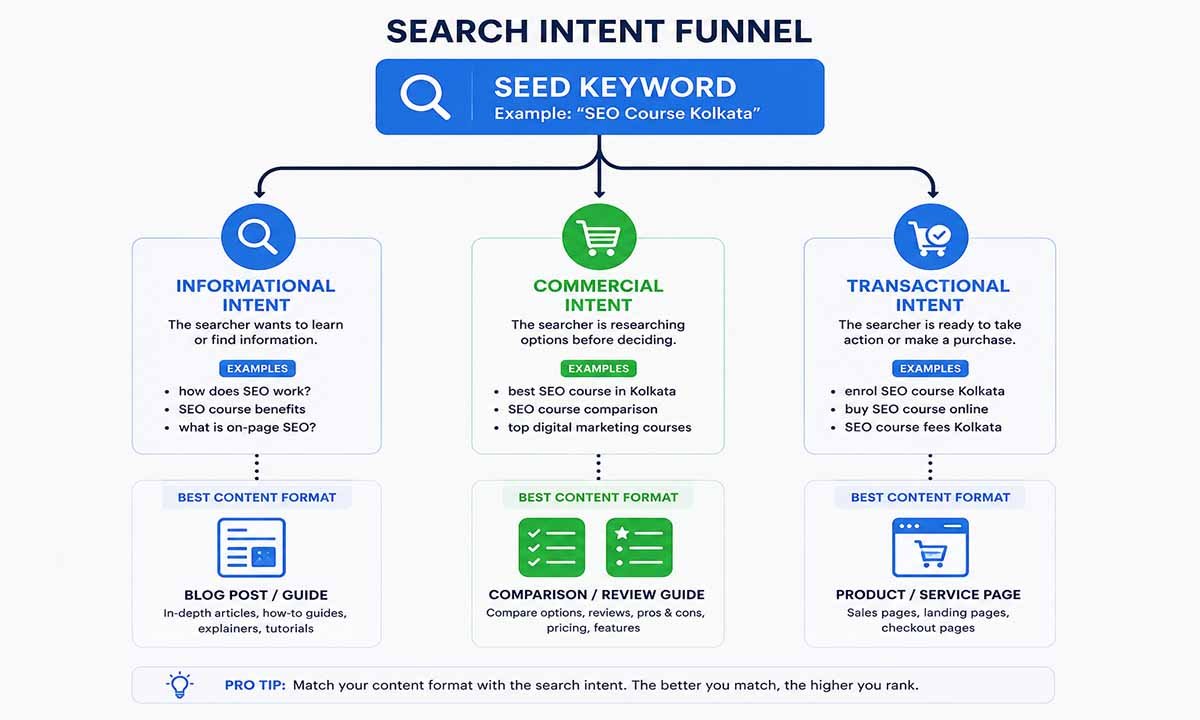
Google sorts queries into a handful of underlying intents, and if your content format doesn't match the intent, no amount of writing quality rescues it. Someone typing "how does Google decide rankings" wants an explanation. Someone typing "best SEO course in Kolkata" wants to compare options. Someone typing "enrol SEO course Kolkata" has already decided and wants a page to act on. Someone typing a brand name by itself is just trying to find that brand's website again. This article, deliberately, has to satisfy the first three of those at once, which is exactly why you'll see it link to the Digital Marketing Course at the point where a reader is genuinely weighing DIY against training, not stapled on as an afterthought at the bottom.
Here's a diagnostic I actually use on client calls, because it takes five minutes and it's more honest than any keyword tool: type your target phrase into Google yourself and look at what's already sitting there. If the top five results are comparison-style guides and you've published a single sales page, you don't have a content quality problem. You have a format problem, and it's the kind of problem backlinks can't fix.
Keyword Research: Listening Before You Guess
Most keyword research I watch clients do runs backwards. Open a paid tool, sort by search volume, pick the biggest number on the list, write around it. Then wonder, six months later, why a brand-new page never beats a competitor that's been sitting at position two for four years.
I do the opposite. Before I open any tool, I type the seed phrase into Google and read what's actually there — is there a map pack, an AI-generated summary, a "People Also Ask" box full of questions nobody thought to answer directly? That five minutes of reading tells me more about real intent than an entire afternoon inside a keyword tool ever has.
From there I build outward in layers rather than chasing one phrase: the secondary terms that naturally orbit the topic, the commercial phrases people use while comparing (best SEO course, hire an SEO consultant), the local variants if geography matters to the business, the long-tail questions with genuinely less competition, and the semantic vocabulary a real expert would use without thinking about it — search intent, domain authority, crawl budget, structured data. None of this needs to appear a set number of times. It needs to appear because it's the language someone who actually understands the topic would naturally reach for.
For the tool-by-tool mechanics rather than the philosophy, we've written that up separately in 10 best keyword research tools for SEO content writers. Once a draft exists, I'll run it through our keyword density checker — not to hit a percentage, which is a myth I'll come back to, but as a sanity check that the writing hasn't drifted into repetitive phrasing without me noticing while I was in the middle of it.
A myth worth retiring properly: keyword density as a target number never worked the way it was taught. I still see briefs asking writers to use a phrase "2% of the time." Modern systems understand context well enough that this kind of counting exercise does nothing except make the writing worse. Write the phrase where it belongs, use its natural variants everywhere else, and stop counting.
Topical Authority: Why One Great Article Never Wins for Long
Ranking a single page for a single keyword is a party trick. I've done it for clients as a quick win, and it rarely survives a competitor waking up. Ranking twenty interlinked pages that genuinely cover every corner of a subject is what keeps you on page one for years, because at that point you're not competing on one page's merit — you're competing on the accumulated trust of an entire cluster.
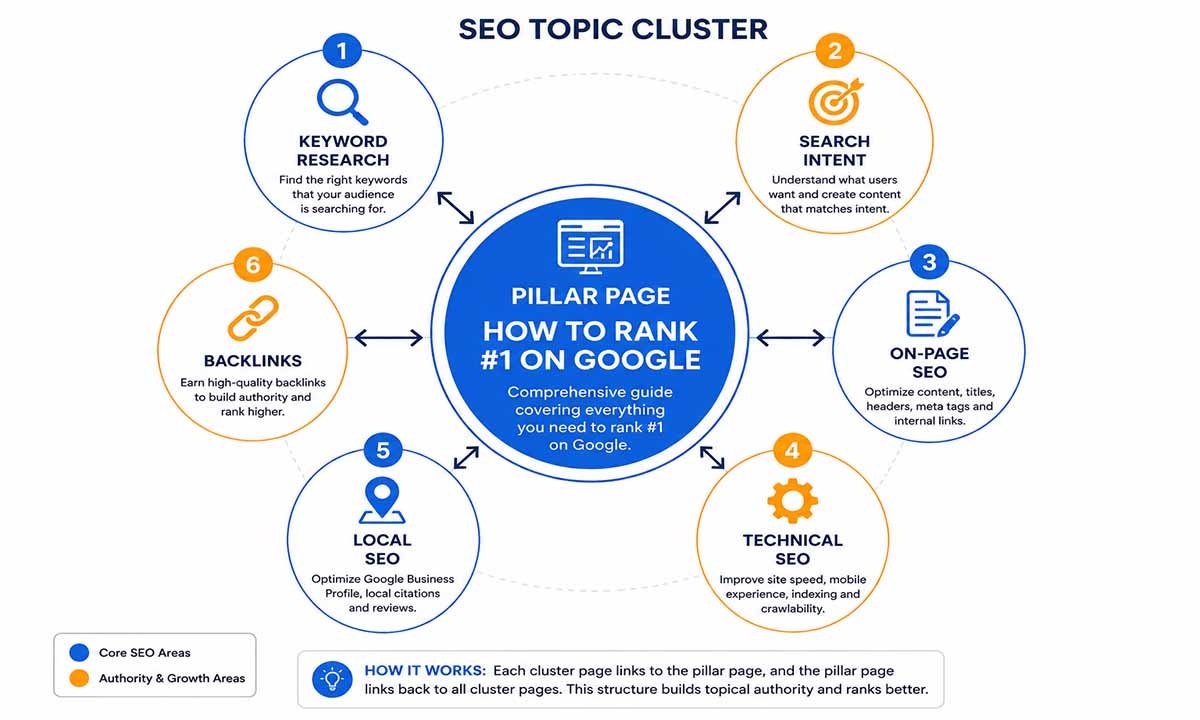
We go deeper into the mechanics of this in mastering topical authority for SEO success, but the shape of it is straightforward. Pick a core topic you genuinely know, specific enough to actually own — not "marketing" broadly, but something like local SEO for service businesses in a particular city. Build one pillar page, comprehensive like this one, that exists to link out rather than to say everything itself. Publish cluster content around the long-tail variations of that pillar topic, each piece linking back to it. Interlink relentlessly, so every new piece connects to at least two or three existing ones. And keep expanding, because once a domain has proven genuine depth in a niche, brand-new pages on that same niche tend to start ranking faster — the site has already earned the benefit of the doubt from a search engine that's seen it deliver before.
I've tested this enough times to say it plainly: a site with ten thorough, tightly interlinked articles on local SEO will beat a site with one exhaustive, isolated 8,000-word piece and nothing supporting it, almost every time. Depth beats a monument.
If you want a quick audit of your own site, run our internal links checker and look for orphaned pages — content nobody, including you, is currently linking to. That's usually where topical authority is quietly leaking away without anyone noticing.
Structured Data: Helping Machines Understand What You've Already Built
Schema markup doesn't push you up the rankings by itself. What it does is help a search engine parse exactly what a page is, which matters more now that AI-driven search features lean heavily on clearly structured content rather than pulling meaning out of vague prose.
The ones worth implementing properly are Article schema for blog content, including author and publish date; FAQPage schema for genuine question-and-answer sections rather than ones invented purely to earn the markup; LocalBusiness schema for location pages, including service area and hours; and Review schema, strictly for genuine, collected reviews, never fabricated ones. Google has confirmed via its search documentation updates that FAQ markup is still read and used even in cases where the visual dropdown snippet no longer appears in results — the signal outlived the specific visual treatment.
Validate everything with our schema validator before publishing. Structured data that contradicts what's actually visible on the page reads as a spam signal, not a shortcut, and I'd genuinely rather see a client skip schema entirely than ship it inconsistent with the content sitting underneath it.
Internal Linking: The Cheapest Lever Almost Nobody Pulls Properly
If I had to pick the single most underused lever on this entire list, it's this one, because most businesses already own every page they'd need to link — they just never connect them.
Every new article should link back to its pillar and at least two related pieces, using anchor text that describes the destination rather than "click here." Commercial pages deserve links wherever the context genuinely calls for it — a paragraph on keyword research pointing toward the SEO Course for readers who'd rather be taught the whole process directly, or a paragraph on writing itself linking to our beginner's guide to SEO content writing. Older, already-ranking pages should periodically pick up links pointing to newer, relevant content, so some of their accumulated trust gets passed forward instead of sitting stranded on one page. And a periodic check with the internal links checker will catch pages nobody on the site is currently linking to at all.
If content strategy is where you're actually starting from, rather than SEO mechanics, our piece on content writing strategies that work is a useful companion — internal linking only does anything if there's genuinely relevant content sitting on the other end of the link.
Backlinks: Where "More Is Better" Finally Died
Backlinks remain one of the strongest ranking signals available. What's changed, and what a surprising number of businesses still haven't absorbed, is that the industry finally stopped pretending volume could substitute for relevance. Backlinko's ongoing ranking factors research has pointed to the same conclusion for years: a single link from a genuinely respected, topically relevant source outperforms dozens of low-quality ones combined.
What actually works is original research or a genuinely useful free tool worth referencing elsewhere; guest contributions on publications the target audience actually reads; relationship-based outreach that produces a real mention from someone who's used the product or read the work; and simply asking, politely, for a link from sites that have already mentioned the business without one. What quietly gets a site penalised instead is bulk directory submissions, paid link networks, and reciprocal exchanges done purely for SEO value with no genuine relevance behind them.
If the domain's overall link profile feels stuck rather than actively harmed, our guide on how to increase domain authority covers the diagnostic side of this in more depth.
Myth vs reality: "backlinks are dead" gets repeated in nearly every SEO comment section. They're not dead. What died was the idea that quantity alone could substitute for relevance, which is a different claim entirely, and one worth being precise about.
E-E-A-T: Proving You're Not a Content Mill
Experience, Expertise, Authoritativeness, Trustworthiness. Google's own guidance on AI-generated content and search quality makes a point worth sitting with properly: these signals matter regardless of how the content was produced, human or AI-assisted. The actual question a search engine is trying to answer is whether the content is genuinely original and useful, not which tool typed the first draft.
In order of what I'd fix first on a client site: named authors with real, checkable credentials, not "Admin"; first-hand examples — screenshots, specific numbers, genuine case studies, not hypotheticals dressed up as examples; citations to credible sources, which builds reader trust just as much as algorithmic trust; and a real About page with transparent contact details, which a surprising number of otherwise polished sites still haven't bothered to build properly.
A myth I hear constantly: "E-E-A-T only matters for medical and finance sites." In reality, once a niche has enough content in it for a search engine to tell genuine expertise apart from generic writing, this is exactly what separates the two, and most niches crossed that threshold a while ago.
Local SEO and Google Business Profile, Done Properly
For any business serving a specific city, local SEO is often the highest-return channel available, faster and cheaper than trying to compete nationally from a standing start. We've covered this from a few different angles already: why "near me" searches matter, how to rank a business in local search results, and specifically how to use local SEO to grow a Kolkata-based business.
Three pillars matter here, always in the same order: a fully optimised Google Business Profile, consistent name-address-phone citations across the site and every directory the business appears in, and a genuine, ongoing review generation habit rather than a one-time push before launch. Google's own guidance on improving local ranking is direct about this: incomplete or inaccurate business information is one of the single most common reasons a profile fails to surface for relevant local searches. Our deep dive on optimising a Google Business Profile walks through category selection, posting cadence, and review responses step by step.
The Client Story I Tell Most Often
A local services client came to us ranking nowhere for their core term, despite a functional site that had existed for two years. The diagnosis was depressingly familiar: technically sound, but thin — an unclaimed Google Business Profile, and zero supporting content around the topic they most wanted to own.
Over roughly four months, we claimed and fully built out the profile with accurate categories and weekly posting, published eight cluster articles around their core service alongside one comprehensive pillar page, fixed the Core Web Vitals issues their own Search Console had flagged for over a year without anyone looking, and started a modest, genuinely earned review process by asking satisfied customers directly after each job.
By month three they'd entered the local map pack for their primary term. By month four, two of the cluster articles were ranking on page one for long-tail variations neither of us had specifically targeted — a direct result of the topical depth the cluster had built, not any single trick. Nothing here was a shortcut. It was fundamentals, applied consistently, in the right order, for long enough that the trust account actually had time to build a balance.
Ranking on Google Maps
Maps ranking runs on three signals working together: relevance, distance, and prominence. Relevance comes mostly from the primary category chosen and how closely the profile's language matches what people actually search. Distance is largely outside anyone's control beyond correctly configuring a service area. Prominence is driven almost entirely by reviews — volume, recency, and how quickly the business responds to them.
Review recency tends to matter almost as much as raw review count, which surprises most business owners the first time they hear it. A profile with five reviews from the last month regularly outperforms one with fifty reviews from two years back. We go into the specific mechanics, including posting and photo cadence, in how to rank higher on Google Maps.
AI Search and the New Rules of Being Found
Ranking first on the classic blue links no longer guarantees a citation inside an AI-generated overview or an answer engine. Google's own updates on generative AI features in Search address this directly, and the recurring theme worth repeating is that the same fundamentals — helpfulness, structure, E-E-A-T — remain the foundation for AI visibility too. It isn't a separate playbook, whatever the "GEO" framing occasionally suggests.
What I'm actually doing differently for clients on this front is structuring content around direct questions with the answer sitting near the top of each section rather than buried under throat-clearing; keeping FAQPage schema in place even after the visual dropdown disappeared from some results, because both Google and other AI crawlers still read it; and doubling down on E-E-A-T signals specifically, since AI systems appear to lean on clear authorship and citations when deciding what to surface as an answer rather than merely what to rank.
For a blunter take on where this is genuinely heading, without the corporate hedging, we wrote what nobody is being honest about with SEO right now.
Google Search Console: The Free Tool Most People Open Once
Most business owners open Search Console once, glance at the clicks graph, and never come back. Used properly, it's the best free diagnostic tool available, and Google's own About Search Console documentation is worth reading end to end at least once.
Four things are worth checking regularly. The Performance report, filtered by query, tells its own story: high impressions with low clicks usually means a weak title or meta description, while high position with low impressions usually means a demand mismatch nobody's noticed yet. The Page Indexing report catches pages excluded by crawl errors or an accidental noindex tag nobody remembers adding. The Core Web Vitals report flags failing pages at scale rather than one at a time. And the Links report shows which pages are already earning links on their own, and where the internal linking has genuine gaps.
We track this in more depth, alongside third-party tools, in our guide to SEO keyword rank tracking.
If I Had to Rank a Brand-New Website Today
People ask me this often enough that it's worth writing down properly, because most guides skip straight to tactics without ever showing the actual sequence in real time. Here's exactly what I'd do, and why, if someone handed me a domain registered yesterday.
Day one is entirely technical, and I'd resist the urge to write anything yet. Verify the domain in Search Console, submit a sitemap even though it's nearly empty, confirm the site isn't accidentally set to noindex (an embarrassingly common launch-day mistake), and check that HTTPS is configured properly across every page, not just the homepage. None of this earns rankings on its own. All of it removes the reasons a search engine would refuse to consider the site at all.
Week one is spent picking the single topic the business can genuinely claim to know better than most competitors, and mapping it into a pillar-and-cluster structure before writing a single sentence of content. I'd rather spend five days planning than one day writing the wrong thing well.
Week two is the first pillar page, built properly, with on-page fundamentals handled from the start rather than retrofitted later — proper headers, a URL that reads cleanly, alt text on every image, and internal links prepared for cluster pages that don't exist yet but will within the month.
Month one finishes with three or four cluster articles published around that pillar, each one genuinely useful on its own rather than written purely to exist, plus a claimed and fully completed Google Business Profile if the business serves a specific location. At this stage nothing is ranking yet, and that's expected. New domains take time to earn the trust that lets Google show them confidently, and I'd rather set that expectation on day one than let a client discover it disappointed in week six.
Month two is where outreach starts, cautiously and specifically — a handful of genuine, relevant mentions or guest pieces rather than a mass email blast, alongside the first Search Console check to see which queries are already generating impressions even without clicks. That data usually reveals which cluster topic is closest to working, and I'd double down on expanding that one rather than spreading effort evenly across all of them.
Month three is a genuine review of what Search Console has shown so far: which pages are getting impressions at position fifteen to twenty five, close enough to page one that a targeted push — better internal links, a content refresh, an extra outbound reference — can move them meaningfully. I'd also start the first content refresh cycle here, on whichever early piece has the most traffic potential, rather than waiting for a fixed six-month schedule.
By the end of month three, a genuinely new domain, run this way, is usually starting to show early local or long-tail wins, not competitive head terms. Anyone promising a brand-new site position one on a competitive term inside ninety days is either exaggerating or picking a keyword so obscure it was never worth targeting in the first place.
Mistakes I See on Almost Every Audit
Keyword stuffing a business name or heading is a direct guideline violation that can trigger both content-quality penalties and Google Business Profile suspensions. Publishing one strong article with nothing supporting it is genuinely the single most common pattern I audit, and one of the easiest to fix once it's actually pointed out. Ignoring mobile performance because "our customers mostly use desktop" is irrelevant, since the mobile version gets indexed regardless. Treating a Google Business Profile as a one-time setup rather than an active channel is the fastest way to lose ground to a competitor who simply posts more often. And buying links or joining exchanges purely for SEO value, with no genuine relevance behind them, remains one of the fastest ways to turn deposits into withdrawals in that trust account I mentioned at the start.
Your Step-by-Step Checklist
Audit technical health first — indexing, mobile usability, speed, duplicate content — then fix whatever Search Console's Core Web Vitals report flags before anything else. Map the core topic and build a keyword cluster around it, confirming search intent for every target keyword before writing a word. Write one comprehensive pillar page, then build supporting cluster content around it, applying on-page fundamentals as you go — titles, meta descriptions, headers, alt text. Add relevant schema and validate it before publishing, then interlink new and existing content with descriptive anchor text. Build genuine backlinks through outreach and real relationships rather than volume tactics, and if the business serves a local market, claim and fully optimise the Google Business Profile, followed by a consistent, genuine review generation process. Check Search Console monthly and adjust based on real data rather than assumptions, and refresh existing content on a schedule instead of only ever publishing new pages.
Don't try to do all of this in one week. Spend the first month on technical issues and the Google Business Profile if local. Spend the next two building the pillar page and first wave of cluster content. From month four onward, shift into maintenance: monthly Search Console reviews, ongoing review generation, and steady, genuine outreach. Businesses that treat this as a system rather than a one-off project are the ones still ranking twelve months later.
If you'd rather have this entire process built for you, or want to properly learn to run it yourself, both the Digital Marketing Course and the dedicated SEO Course walk through it with live projects, not slides.
Frequently Asked Questions
How long does it actually take to rank #1 on Google?
Competitive keywords usually take several months to a year of consistent work. Local and long-tail keywords can move noticeably faster, sometimes within sixty to ninety days.
Can a page rank #1 without any backlinks at all? For competitive terms, it's genuinely difficult. For low-competition, long-tail, or hyper-local keywords, strong content and solid on-page SEO alone can be enough on their own.
Is keyword density still worth tracking?
Not as a percentage target. Modern systems understand context well enough that natural, varied language consistently beats repeated exact-match phrasing, and chasing a density number tends to make writing worse rather than better.
How often should existing content actually get updated?
Every three to six months for the top-performing pages tend to sustain rankings better than only ever publishing new content and leaving older pages untouched.
Do Core Web Vitals genuinely move rankings, or is that overstated?
They genuinely move rankings, particularly when competing pages are otherwise similar in quality, where speed becomes the deciding factor.
What exactly is topical authority, in practical terms?
It's the depth of expertise a search engine assigns to a site within a niche, built through consistent, interlinked content rather than a single article, and it affects how quickly brand-new pages on that topic start ranking.
Is local SEO really a different discipline from regular SEO?
Yes. It adds Google Business Profile optimisation, citation consistency, and active review management on top of the standard on-page and technical work.
How much do Google reviews actually matter for local ranking?
A great deal. Review volume, recency, and response rate are among the strongest prominence signals for both Maps and the local pack.
What's the simplest, most honest way to demonstrate E-E-A-T? Named author credentials, genuine first-hand examples, and citations to credible sources. These are real markers of expertise, not a score that can be directly gamed.
Does ranking well in AI Overviews require a completely separate strategy?
Largely no. Strong organic and local rankings already draw on overlapping signals; clear, structured, question-led content helps beyond that, but it isn't a different discipline.
Can a small, local business genuinely compete with much bigger competitors?
Yes, particularly locally, where topical focus and consistent Google Business Profile management often matter more than sheer domain size or budget.
What's the single biggest SEO mistake you see across almost every audit?
Treating SEO as a one-time project instead of an ongoing one, especially abandoning a Google Business Profile or content strategy right after the initial setup is done.
Should someone learn SEO themselves, or just hire it out?
It depends on available time and how complex the site already is. Most owners benefit from structured training first, to understand the fundamentals, before deciding whether to bring in ongoing outside help.
How do you actually know if a strategy is working, month to month?
Track keyword positions and organic clicks in Search Console, and for local businesses, watch calls, direction requests, and map pack position every month rather than checking sporadically.